Reviews
Part of Review the edition, not the logo: how to compare social scheduling software fairly
Buffer Team, Hootsuite Advanced and Sprout Social Advanced on a perishable shortlist
A transparent, non-ranked shortlist of three social scheduling editions, using dated first-party records, disclosed desk research and buyer-side gates.
There is no defensible universal best provider in the evidence reviewed. The three exact editions below form a small, non-ranked evidence shortlist for an England organisation that needs scheduled publishing and a documented approval route. They are candidates for testing, not winners.
What to take away
- No universal best provider exists in the evidence reviewed, so the three editions are candidates for testing only.
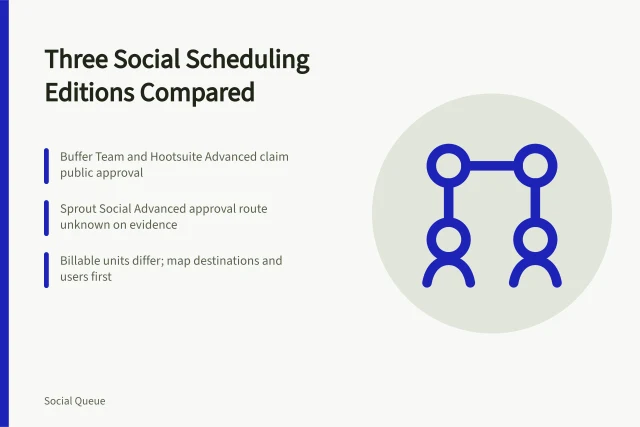
- Buffer Team, Hootsuite Advanced and Sprout Social Advanced each claim approvals or collaborative workflow relevant to the defined case.
- All evidence is desk research from supplier pages, so prices, performance and usability remain unassessed.
- Record an evidence-expiry date beside each edition and reopen entries when suppliers change plans or terms.
- Any unresolved critical gate should keep the purchase on hold even when scheduling appears functional.
Published list method
- Research date
- 6 September 2026.
- Reviewer
- editorial procurement researcher; a named person must be recorded before publication.
- Geography and scope
- products whose current public pages could be read from England; this does not prove contracting, support or every feature is available to a particular England buyer.
- Inclusions
- an identifiable current edition, first-party scheduling information and an approval or collaborative-workflow claim relevant to the defined case.
- Exclusions
- products without enough public edition-level evidence, agencies, platform-native schedulers and manual spreadsheets.
- Ranking
- non-ranked.
Bestreflects the search question, not an evidence-backed award. - Funding and conflicts
- none declared. No provider paid, supplied access or approved the text.
- Evidence boundary
- desk research only. Prices, performance, customer sentiment and hands-on usability were not assessed.
Buffer Team
Buffer's current pricing and feature record identifies Team as the edition intended for collaboration and lists approvals for that plan. Its accessibility statement says the service is partially conformant with WCAG 2.1 AA and describes self-evaluation and automated assessment. Both are supplier statements, not independent findings.
Put Buffer Team on a test list where the buyer wants a visibly documented approval path and can validate the exact social networks it uses. Public evidence reviewed here does not settle the contract entity for a specific England order, all transfer arrangements, support response, complete export or deletion behaviour. Those fields remain unknown until documented.
Hootsuite Advanced
The first-party Hootsuite plans page describes Advanced as adding content review and approval plus team coordination. Hootsuite's accessibility page refers to platform and application VPATs, but a buyer still needs the current report for the exact interfaces and tasks in scope.
This edition merits controlled evaluation when approval hand-offs are central to the brief. The public pages do not demonstrate that the buyer's account structure, destination platforms, retention needs or incident route will work as required. No service level or support outcome was verified.
Sprout Social Advanced
Sprout Social's current plan record identifies Advanced as an edition for cross-functional teams and workflows. Its accessibility record says a VPAT for the web application can be requested and attributes WCAG 2.2 AA testing to an external specialist. That scope must be matched to the proposed workflow rather than treated as a blanket verdict.
Sprout Social Advanced belongs in discovery where cross-functional work is a stated need. The reviewed plan page did not answer every common criterion, including the buyer's precise approval sequence, data return, contract exit and England support arrangement.
Keep the shortlist perishable
Record one evidence-expiry date beside each edition. Reopen an entry when the supplier changes its plan name, feature matrix, terms, trust material or accessibility record. If an edition disappears, do not silently substitute its successor. Reassess the replacement against the original case and retain the old capture so reviewers can explain why the candidate changed.
How to choose without a league table
Give each candidate the same synthetic posts, roles and failure cases. Require evidence for privacy and PECR, security, accessibility, advertising review, intellectual-property controls, contract terms, support and exit. The NCSC advises cloud buyers to define needs and assess provider evidence in its cloud selection guidance. Any unresolved critical gate should keep the purchase on hold, even when scheduling appears functional.
Before you act
- Record a named reviewer before publication.
- Set one evidence-expiry date beside each edition.
- Test each candidate with the same synthetic posts and roles.
- Require evidence for privacy, security, accessibility and contract terms.
- Keep the purchase on hold if a critical gate is unresolved.
Common questions
What is the shortlist actually for?
It is a small, non-ranked evidence shortlist for an England organisation that needs scheduled publishing and a documented approval route. The three editions are candidates for testing, not winners, and the ranking reflects the search question rather than an evidence-backed award.
What did the desk research not assess?
The evidence boundary is desk research only. Prices, performance, customer sentiment and hands-on usability were not assessed. Public pages also did not settle contract entity, transfer arrangements, support response, complete export or deletion behaviour, so those fields remain unknown until documented.
When should a shortlist entry be reopened?
Reopen an entry when the supplier changes its plan name, feature matrix, terms, trust material or accessibility record. If an edition disappears, do not silently substitute its successor. Reassess the replacement against the original case and retain the old capture so reviewers can explain why the candidate changed.