Reviews
Part of Review the edition, not the logo: how to compare social scheduling software fairly
How we review social scheduling software, using tests that can actually fail
A defensible method for reviewing social scheduling software, with evidence grades, buyer tests, conflicts, unknowns and independent decision gates.
A useful social media scheduling review does not begin with stars or a feature count. It begins with a specific publishing job, names the evidence needed to judge it and refuses to score an unanswered question. This method is for organisations operating in England, although most privacy and electronic-marketing rules discussed are UK-wide.
What to take away
- Define the publishing job with named accounts, approvers and exit requirements before reviewing any product.
- Use an evidence ladder that prioritises contract documents and controlled tests over marketing claims.
- Run acceptance tests with synthetic posts and test accounts that can fail, not supplier demonstrations.
- Score no overall number; a missing non-compensating gate produces unknown or hold.
- Separate verdicts for functional fit, privacy, security, accessibility, advertising, contract, support and exit.
Review record
Review Record Boundaries
- Named reviewer before publication
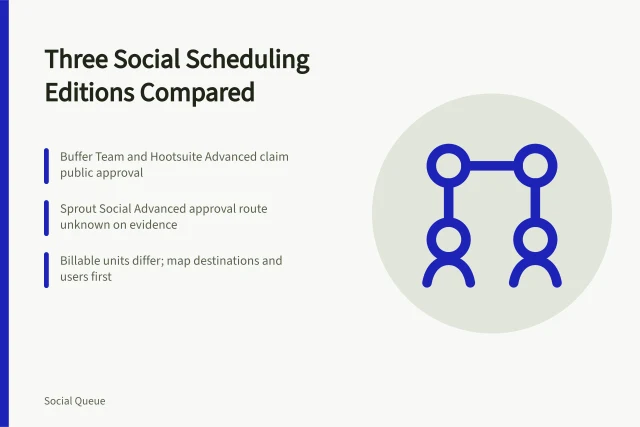
- Exact product edition and workflow
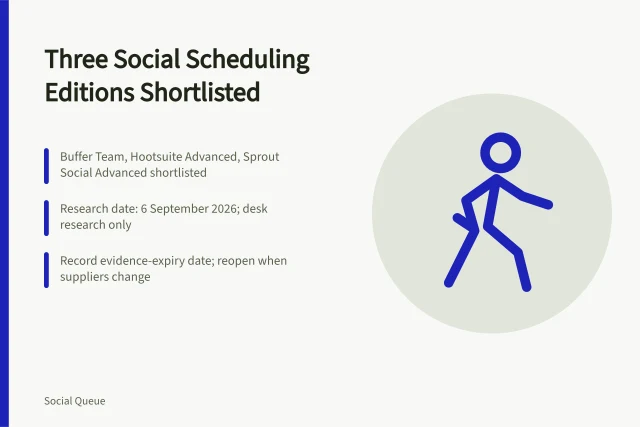
- Research cut-off 6 September 2026
- No hands-on testing this draft
- No overall score; gates yield unknown
- Reviewer
- a named commercial technology and procurement editor must be appointed before publication.
- Subject
- the exact product edition and buyer workflow stated in the review, not the supplier brand generally.
- Research cut-off
- 6 September 2026.
- Method
- desk review of current first-party product, terms, privacy, security, accessibility, support and export records, followed by buyer-controlled acceptance tests where access is available.
- Hands-on boundary
- no account was opened and no feature, integration, support response or export was tested for this draft.
- Conflicts and funding
- none declared; no supplier supplied access, payment or editorial approval.
- Exclusions
- customer-review averages, affiliate lists, unsourced feature matrices and supplier case studies as proof of typical performance.
- Scoring rule
- no overall score. A missing non-compensating gate produces
unknownorhold, not zero and not an estimated value.
Define the job before the product
Write one scenario with named accounts, content classes, approvers, publishing timezone, incident route and exit requirement. A plausible example is an England-based organisation scheduling approved editorial posts to accounts it already controls. Paid advertising, creator endorsements and promotional direct messages sit outside that scenario unless the brief includes them.
Define the Job First
- Named accounts and content classes
- Approvers and publishing timezone
- Incident route and exit requirement
- Paid ads and DMs excluded unless briefed
That boundary matters because scheduling capability is not legal permission, while the ICO's direct marketing guidance separates direct-marketing questions from ordinary operational processing.
The ASA says paid and brand-owned social advertising must be judged by the communication's likely impression under its recognising ads guidance. A qualified reviewer must apply current rules to the actual message and audience.
Use an evidence ladder
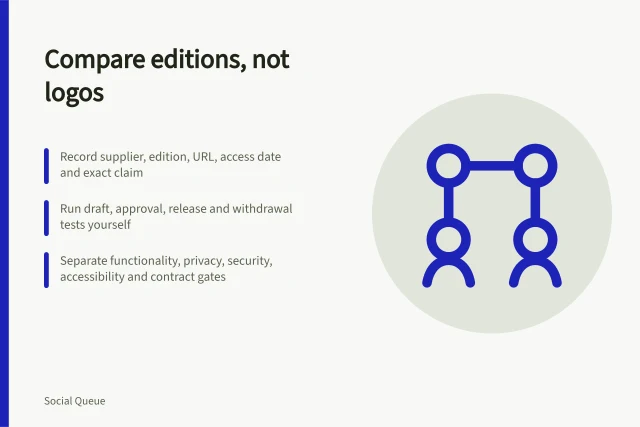
Record each claim in a grid with product, edition, geography, page title, URL, capture date, quoted field, reviewer interpretation and expiry trigger. Give most weight to contract documents, product documentation and controlled tests. Treat marketing pages as supplier claims. Screenshots without a page identity or date are weak evidence.
Security needs its own file. The NCSC's cloud-provider selection guidance asks buyers to understand their requirements and seek evidence against cloud security principles. A trust badge may define the scope of an assessment, but it does not prove the buyer's configuration, staff process or recovery route.
Accessibility is equally non-compensating. Review the supplier's dated statement, then test the exact tasks with keyboard and relevant assistive technology. A statement about a website, mobile application or another edition cannot silently be extended to the workflow being bought.
Run tests that can fail
Use synthetic posts and test accounts. Attempt drafting, approval separation, final preview, timezone handling, pause, correction, account revocation, audit export and data return. Predetermine the expected result and retain a screen capture or log. A supplier demonstration can clarify operation, but the buyer should reproduce critical steps independently.
End with separate verdicts for functional fit, privacy and PECR, security, accessibility, advertising evidence, intellectual-property controls, contract, support and exit. State who accepts each residual risk and the date for rechecking changed plans or terms. This creates an auditable buying decision without pretending the review predicts reliability, suitability or outcomes.
Before you act
- Write one scenario with named accounts, approvers and publishing timezone.
- Record each claim in a grid with product, edition, URL and capture date.
- Review the supplier's dated accessibility statement and test exact tasks.
- Run tests with synthetic posts and test accounts that can fail.
- State who accepts each residual risk and the recheck date.
Common questions
What should a reviewer do before looking at any product features?
The article says to define the job first. Write one scenario with named accounts, content classes, approvers, publishing timezone, incident route and exit requirement. This boundary matters because scheduling capability is not legal permission. The scenario should cover an organisation scheduling approved editorial posts to accounts it already controls.
How should a reviewer treat marketing pages and screenshots as evidence?
Treat marketing pages as supplier claims and give most weight to contract documents, product documentation and controlled tests. Screenshots without a page identity or date are weak evidence. Record each claim in a grid with product, edition, geography, page title, URL, capture date, quoted field, reviewer interpretation and expiry trigger.
Why is accessibility a non-compensating gate in this method?
Accessibility is non-compensating because a statement about a website, mobile application or another edition cannot silently be extended to the workflow being bought. Review the supplier's dated statement, then test the exact tasks with keyboard and relevant assistive technology. A missing gate produces unknown or hold, not an estimated value.