Strategy
Part of A social scheduling strategy that begins with a communication decision, not a calendar
A social scheduling plan template with fields for rights, timezone and stop rules
Fill a practical social scheduling plan covering audience, evidence, rights, accessibility, approval, timezone, monitoring, correction and stop rules.
This social media scheduling planning template is a blank control record for one item or tightly related series. Copy it into a versioned workspace. Do not release content while a critical field is blank, failed or awaiting specialist review.
What to take away
- Do not release content while a critical field is blank, failed or awaiting specialist review.
- A label field alone does not settle the claim or advertising relationship.
- A scheduling timestamp shows a request was made, not that the audience saw it.
- Test the fallback before relying on it, because an untested list is not continuity.
- Material edits invalidate the preview and return the item to review.
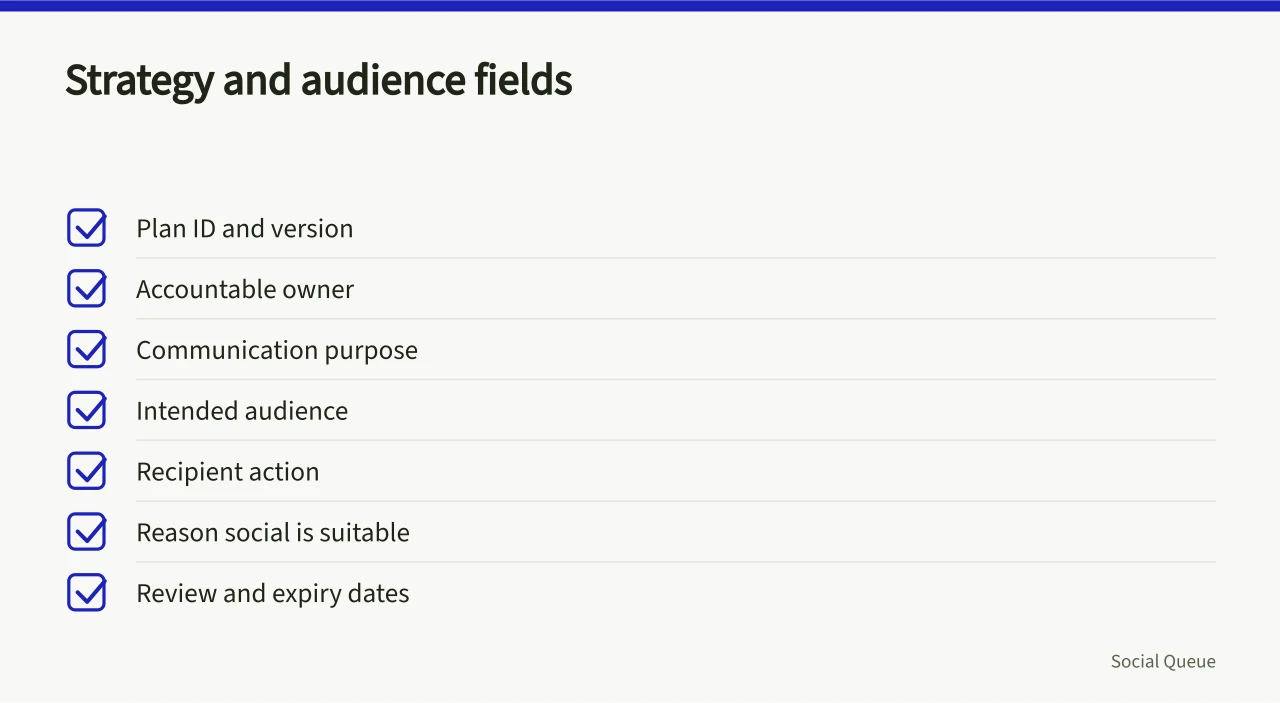
Strategy and audience
Field / Entry
- Plan ID and version
- [blank]
- Accountable owner
- [name and role]
- Communication purpose
- [editorial, service, advertising, direct marketing or combination]
- Intended audience
- [eligibility and England geography rule]
- Recipient action
- [observable action, if any]
- Reason social is suitable
- [evidence, not reach assumption]
- Manual or no-post baseline
- [current route and owner]
- Review and expiry dates
- [dates]
If the content targets selected people or uses audience matching, record the data source and obtain qualified UK GDPR and PECR review. The ICO's direct-marketing planning guidance is a starting record, not clearance for a campaign.
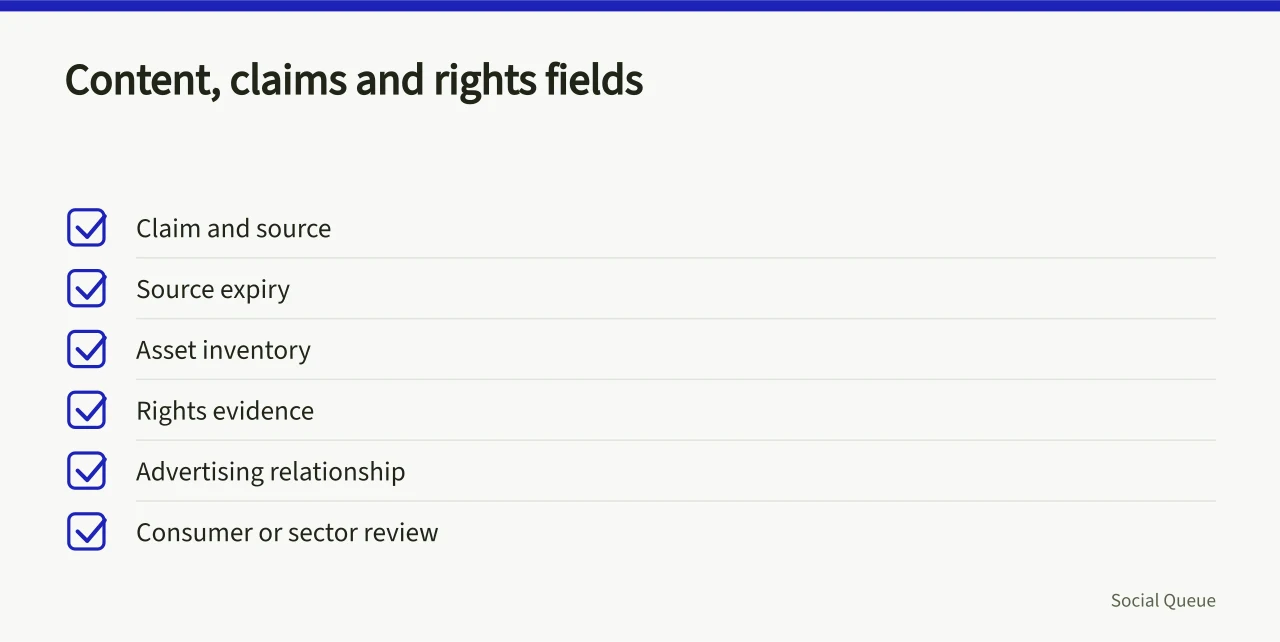
Content, claims and rights
Field / Entry
- Claim and source
- [exact proposition, URL or record, owner, date]
- Source expiry
- [date or event]
- Asset inventory
- [text, image, video, audio, link]
- Rights evidence
- [owner, licence, territory, media, edits, expiry]
- Advertising relationship
- [party, benefit, substantiation and label]
- Consumer or sector review
- [reviewer and outcome]
The ASA's social advertising recognition guidance makes label prominence contextual. Save the approved preview. A label field alone does not settle the claim or relationship.
Accessibility and release configuration
Field / Entry
- Alternatives and captions
- [test evidence]
- Contrast and text rendering
- [test evidence]
- Keyboard and reading order
- [test evidence]
- Platform and account type
- [exact service]
- Content format
- [exact type]
- Release time and timezone
- [local time, timezone, embargo]
- First-party platform record
- [URL, date, limitation]
- Fallback route
- [manual or service channel]
Use the W3C WCAG 2 overview as a technical reference, then test the actual authoring and final output with suitable users and assistive technology.
Accessibility and release configuration
- Alternatives and captions
- Contrast and text rendering
- Keyboard and reading order
- Platform and account type
- Content format
- Release time and timezone
- First-party platform record
- Fallback route
Approval, monitoring and exception fields
Field / Entry
- Author and content reviewer
- [names, dates]
- Specialist gate outcomes
- [privacy, PECR, claims, rights, security, accessibility, contract, finance]
- Final approver and preview hash
- [name, timestamp, identifier]
- Platform acceptance evidence
- [request ID or record]
- Publication confirmation
- [event, source and monitoring owner]
- Correction or withdrawal
- [authority, steps and response channel]
- Incident escalation
- [owner, contact and evidence preservation]
- Stop condition
- [observable trigger]
- Retention and deletion
- [record, period, owner]
The NCSC's organisational social-media guidance supports access oversight. Record individual roles and recovery rather than sharing credentials.
Measurement and cost fields
Field / Entry
- Eligible-item definition
- [population and inclusion rule]
- Publication event
- [exact platform or observer event]
- Numerator and denominator
- [units]
- Period and timezone
- [dates and timezone]
- Exclusions and failures
- [reported separately]
- Source and query version
- [system, field and version]
- Operating effort
- [role, evidenced minutes and period]
- Supplier and assurance cost
- [currency, VAT, term and source]
- Threshold and reason
- [baseline or service consequence]
Leave numbers blank until the owner provides traceable evidence. A scheduling timestamp can show that a request was made, but not that the audience saw the item or that timing caused a commercial outcome. Record platform-reported reach separately from internal service measures.
Change and continuity fields
Field / Entry
- Dependency
- [platform permission, supplier, person or source]
- Change trigger
- [observable event]
- Queue pause authority
- [name and contact]
- Manual fallback
- [steps, owner and test date]
- Export and deletion
- [format, evidence and owner]
- Restart approval
- [required reviewers and conditions]
Test the fallback before relying on it. An untested contact list, undocumented administrator or expired asset is not a continuity plan.
Gate decision
Choose hold, release, revise or cancel, with decision-maker, time and reasons. Material edits invalidate the preview and return the item to review. Reopen the plan if a source, platform permission, account role, audience, legal position or publication time changes.
Before you act
- Record the data source and obtain UK GDPR and PECR review.
- Save the approved preview with the advertising label.
- Test the final output with users and assistive technology.
- Record individual roles and recovery instead of sharing credentials.
- Leave numbers blank until the owner provides traceable evidence.
- Choose hold, release, revise or cancel with reasons.
Common questions
When should content be held back from release?
Do not release content while a critical field is blank, failed or awaiting specialist review. The gate decision offers hold, release, revise or cancel, with decision-maker, time and reasons recorded. Material edits invalidate the preview and return the item to review.
What does a scheduling timestamp actually prove?
A scheduling timestamp can show that a request was made, but not that the audience saw the item or that timing caused a commercial outcome. Record platform-reported reach separately from internal service measures, and leave numbers blank until the owner provides traceable evidence.
What must be recorded for claims and rights?
Record the exact proposition with URL or record, owner and date, plus source expiry. List assets, rights evidence covering owner, licence, territory, media, edits and expiry, any advertising relationship with substantiation and label, and the consumer or sector review outcome.