Strategy
Part of A social scheduling strategy that begins with a communication decision, not a calendar
A ninety-day social scheduling plan that ends with a decision and an exit route
Use a staged ninety-day social scheduling plan in England to define the task, clear independent gates, test safely and make an evidenced decision.
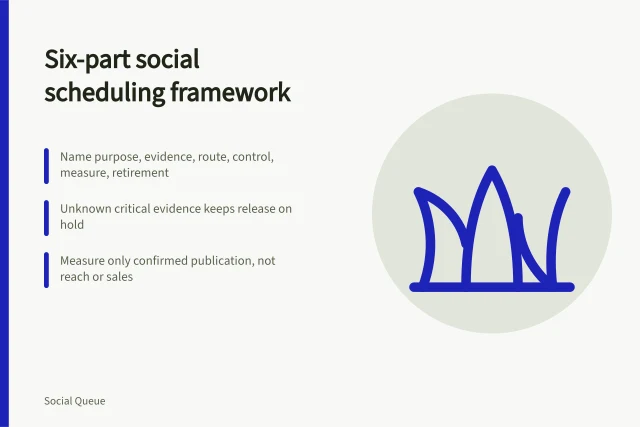
This social media scheduling ninety day plan is an editorial sequence for one England audience task. The phases expose dependencies; they are not a promise that procurement, legal review or platform approval will finish within ninety days. Pause the clock when a critical gate lacks evidence.
What to take away
- Pause the ninety day clock whenever a critical gate lacks supporting evidence.
- Classify editorial, service, advertising and direct-marketing elements separately before any scheduling work begins.
- Independent decisions on privacy, security, accessibility and claims cannot be replaced by a weighted score.
- Compare the new route with the baseline using identical definitions, periods, timezones and exclusions.
- Rehearse export, credential return, deletion and manual fallback before expanding the approach.
Days 1 to 15: define the job
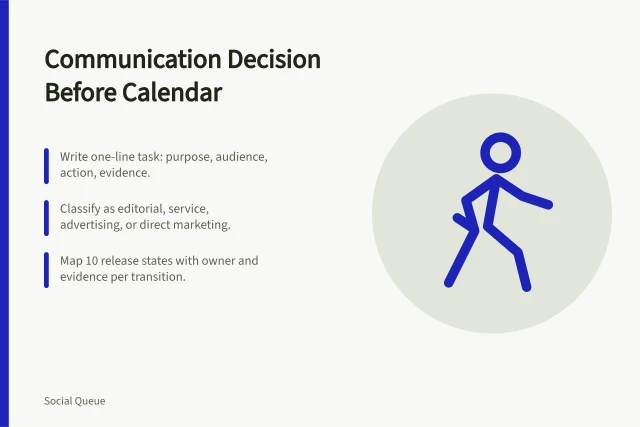
Name the accountable owner, intended audience, England geography rule and recent communication event. Classify editorial, service, advertising and direct-marketing elements separately. Write the manual or no-post baseline.
Define the job workflow
- Name accountable owner
- Define intended audience
- Set England geography rule
- Classify content elements
- Write manual baseline
- Map approval states
Map the brief, sources, rights, drafting, review, approval, timezone, release, monitoring, correction and incident states. Record who can move each state. The ICO's direct-marketing planning guidance supports purpose and channel analysis but does not clear a campaign.
Gate 1: stop if the audience, purpose, owner or current workflow cannot be evidenced.
Days 16 to 30: establish the baseline
Observe a defined set of eligible items through the current route. Record timestamps in one timezone, approval changes, platform confirmation, failures, corrections and staff minutes. Do not insert example results or compare them with an industry benchmark.
Baseline observation checklist
- Record timestamps in one timezone
- Log approval changes
- Note platform confirmations
- Track failures and corrections
- Record staff minutes
- Inventory account roles and recovery
Inventory account roles and recovery. The NCSC's guidance for organisational social-media publishing supports oversight and account protection. Remove unnecessary access through the approved process; do not disrupt production to satisfy the study.
Gate 2: continue only if the baseline is complete enough for a like-for-like test and account ownership is clear.
Days 31 to 45: build the release specification
Complete the planning template for a synthetic item. Attach claim sources, rights records and the exact platform help page. Define accessibility tests for text alternatives, captions, contrast, reading order, keyboard use and errors. W3C's WCAG 2 material is a technical reference, not proof of the final social output.
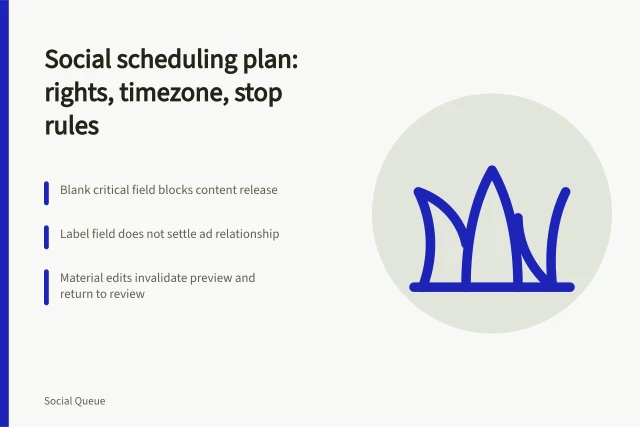
Obtain independent decisions for privacy and PECR, advertising and consumer claims, security, accessibility, intellectual property, employment, contract and finance. No weighted score can compensate for failure in one of these areas.
Gate 3: hold when any critical outcome is fail or unknown.
Days 46 to 60: run controlled acceptance work
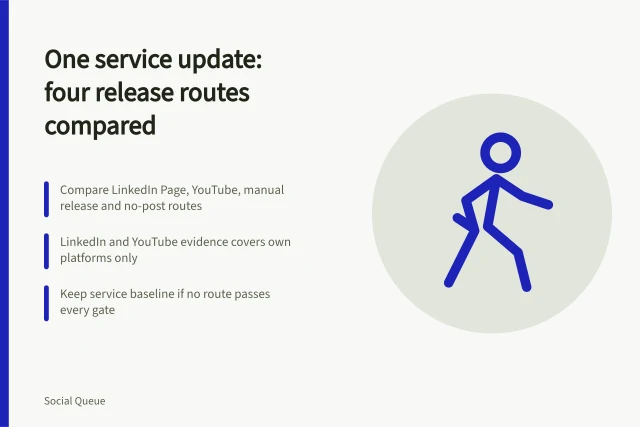
Use non-production access and synthetic content where platform rules allow it. Test role changes, exact formats, release time and timezone, late edits, rejection, alerts, correction, export and recovery. Keep supplier claims separate from observed test records.
Revoke one test role and show that access disappears. Simulate an unavailable approver and prove the queue stops. Do not connect customer data merely to make the scenario realistic.
Gate 4: reject the route if rollback, evidence capture or administrator recovery fails.
Days 61 to 75: compare with the baseline
Use the same eligible-item definition, period unit, timezone, inclusions and exclusions. Compare staff effort, release evidence, exceptions and full economic cost. Treat reach, response and revenue as separate outcomes requiring their own design; scheduling timestamps do not establish causality.
Ask the service owner whether the operational difference matters. Ask specialist reviewers whether any control changed. Preserve disagreement and unknowns.
Days 76 to 90: decide and prepare exit
Choose continue, revise or retire. The decision pack should contain the task, audience rule, baseline, test configuration, source versions, gate outcomes, incidents, costs and limitations. If continuing, set an owner and review trigger for every dependency.
Rehearse export, credential return, deletion, manual fallback and supplier failure before expansion. Retire the approach if the existing route meets the need, the audience task has ended, critical evidence cannot be retained or the business case depends on assumed engagement or sales.
Before you act
- Name the accountable owner and audience rule.
- Write the manual or no-post baseline.
- Record timestamps in one timezone throughout.
- Attach claim sources and rights records.
- Revoke one test role and confirm access disappears.
- Rehearse export and credential return before expansion.
Common questions
What should happen when a critical gate lacks evidence?
The article says to pause the clock when a critical gate lacks evidence. Gate 1 stops if audience, purpose, owner or workflow cannot be evidenced. Gate 3 holds when any critical outcome is fail or unknown. Gate 4 rejects the route if rollback, evidence capture or administrator recovery fails.
How should the new route be compared with the baseline?
Use the same eligible-item definition, period unit, timezone, inclusions and exclusions. Compare staff effort, release evidence, exceptions and full economic cost. Treat reach, response and revenue as separate outcomes needing their own design, because scheduling timestamps do not establish causality. Ask the service owner whether the operational difference matters.
What belongs in the decision pack at the end of the ninety days?
The decision pack should contain the task, audience rule, baseline, test configuration, source versions, gate outcomes, incidents, costs and limitations. Choose continue, revise or retire. If continuing, set an owner and review trigger for every dependency. Retire the approach if the existing route meets the need or critical evidence cannot be retained.