Strategy
Part of A social scheduling strategy that begins with a communication decision, not a calendar
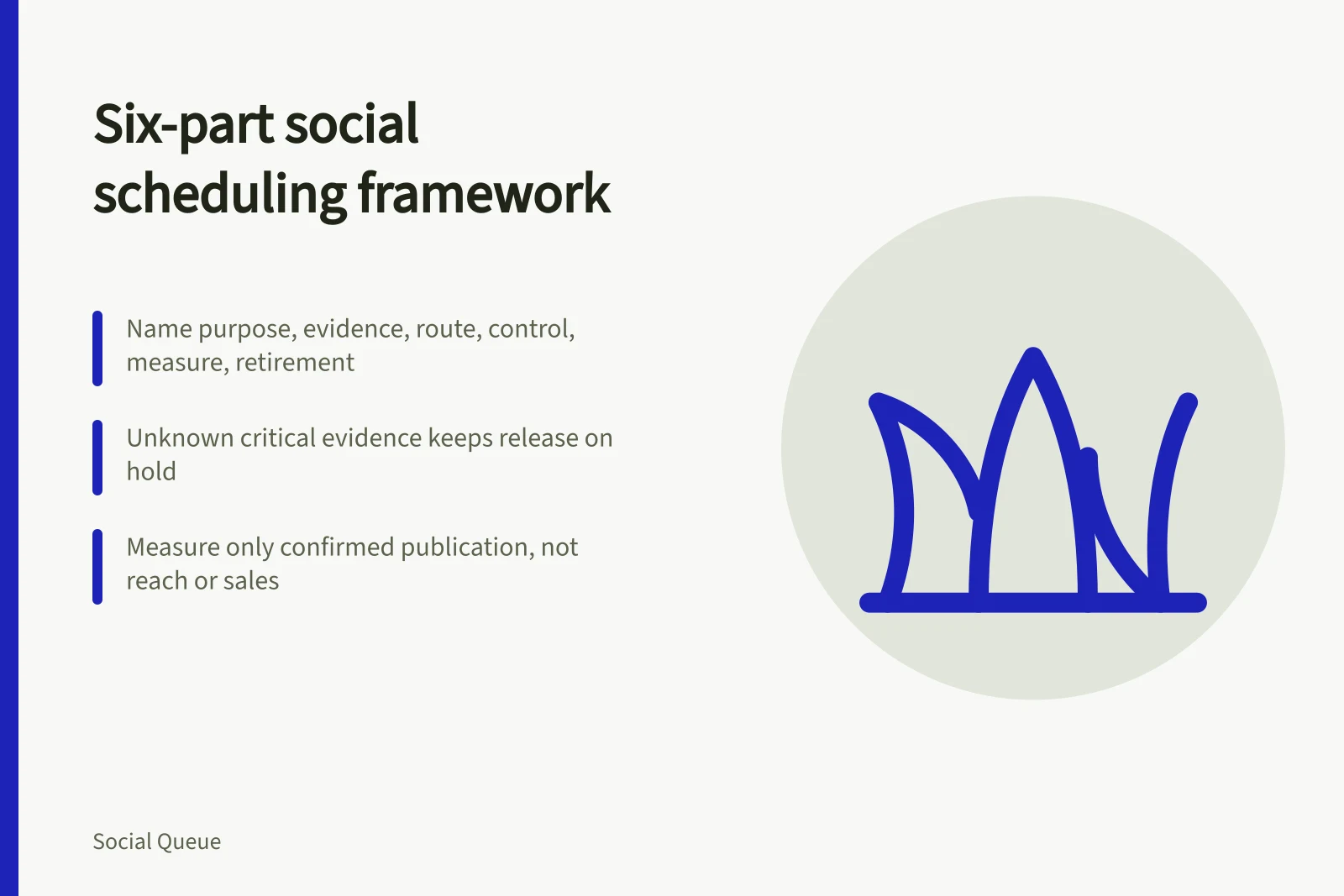
A six-part social scheduling framework, from purpose through to retirement
Use a six-part social scheduling framework to connect an England audience task with evidence, owners, release gates, measurement and stop rules.
A social media scheduling strategy framework should connect one audience task to an accountable release decision. Use six linked records: purpose, evidence, route, control, measure and review. Posting frequency is an operating choice made later.
What to take away
- A scheduling framework links one audience task to an accountable release decision across six records.
- Posting frequency is an operating choice made after the framework, not part of it.
- Unknown critical evidence keeps release on hold until a dated gate resolves it.
- Measure scheduling only through confirmed publication, not reach, engagement or sales.
- The final pack must let a replacement owner reconstruct the decision without private context.
1. Purpose: name the communication job
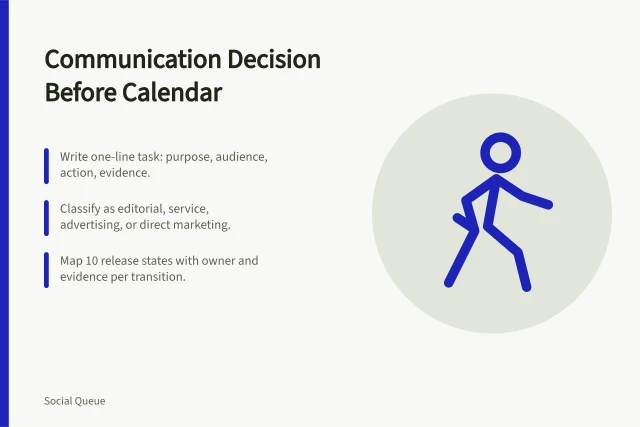
Write who needs what information, why the organisation should provide it and what action is expected. Define England by operating site, contracting entity or intended population. Keep account followers separate from the intended audience.
Classify the item as editorial, service, advertising or direct marketing, allowing more than one label when necessary. The ICO's direct-marketing planning guidance supports purpose, data-source, fairness and channel analysis. It does not make a scheduling status legally decisive.
2. Evidence: prove the content and rights
Attach the current source for every material claim, its owner, date and expiry. Record the origin and permitted use of images, audio and video. GOV.UK's copyright-use page describes permission, ownership and exceptions as possible routes. A qualified reviewer must assess the actual asset and use.
For advertising, retain the commercial relationship, substantiation, label and final preview. The ASA's guidance on recognising social-media advertising explains why identification and placement depend on context.
3. Route: select a platform account and fallback
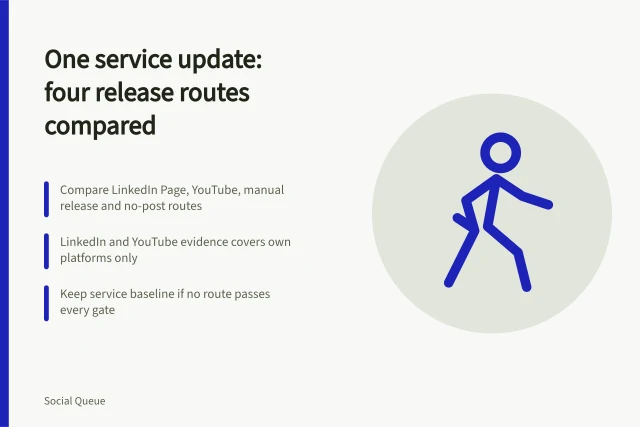
Name the platform, account type, content format, authorised role, release window and timezone. Use a current first-party record. LinkedIn's Page scheduling instructions, for example, set service-specific role and content limits. They are not evidence about another network.
Compare this route with native manual release and with no social post. A controlled service channel may be more appropriate for important operational information.
4. Control: design the state changes
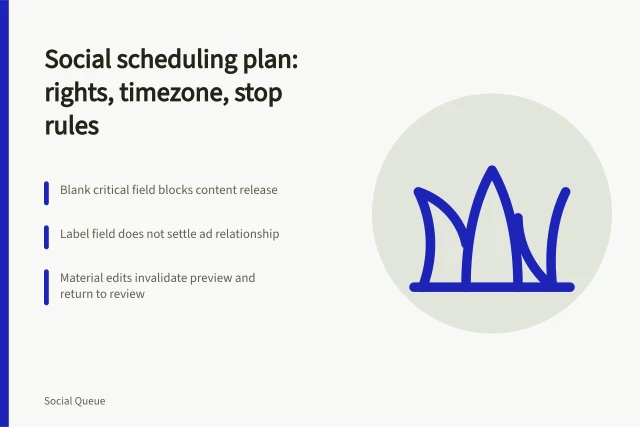
Define draft, specialist review, approval, scheduled, confirmed, failed, corrected and archived states. Each transition gets an owner and required evidence. Material edits after approval return to review.
The NCSC's social-media publishing guidance supports organisational oversight and account protection. Rehearse incorrect publication, credential loss and administrator absence. Platform access and legal permission remain separate gates.
5. Measure: observe what scheduling controls
Use a metric card with eligible population, event, numerator, denominator, period, timezone, exclusions, source, owner and uncertainty. A defensible operational measure is the share of eligible approved items with platform confirmation inside their stated window. Report cancelled items and outages separately.
Do not claim that timing caused reach, engagement or sales without a credible counterfactual. Set thresholds from the consequence of failure and the documented baseline, not an industry number.
Record the reporting query and version beside the result. A platform dashboard, internal queue and manual observation may define publication differently. Reconcile the item identifiers before calculating a rate. Where the platform provides no durable confirmation, say that the evidence is incomplete rather than treating an empty error log as success.
6. Review: decide and retire
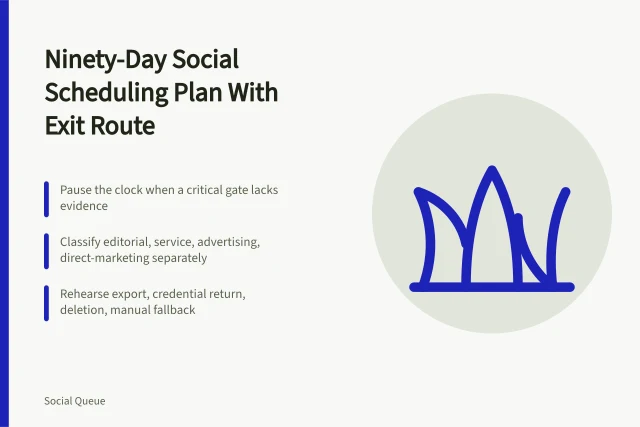
At a dated gate, mark privacy and PECR, advertising, security, accessibility, rights, contract and finance as pass, fail or unknown. Unknown critical evidence keeps release on hold. Continue only if the route beats the current process on the agreed task without transferring unacceptable risk.
Pause when evidence expires, permissions change or monitoring fails. Retire the framework for that task if the audience no longer needs the communication or the baseline remains adequate.
The final framework pack should allow a replacement owner to reconstruct the decision without private context. Include the audience rule, task, state map, source versions, gate decisions, metric card, open risks and next review. Strategy remains on hold when the handover depends on one person's memory.
Before you act
- Name the audience, task and expected action.
- Attach source, owner, date and expiry for each claim.
- Name the platform, account, format, role and timezone.
- Define each state change with an owner and evidence.
- Record the metric card and reporting query version.
- Mark each gate pass, fail or unknown.
Common questions
What six records make up the scheduling framework?
Purpose, evidence, route, control, measure and review. Purpose names the communication job, evidence proves content and rights, route selects a platform account and fallback, control designs state changes, measure observes what scheduling controls, and review decides and retires.
How should a team measure whether scheduling worked?
Use a metric card with eligible population, event, numerator, denominator, period, timezone, exclusions, source, owner and uncertainty. A defensible operational measure is the share of eligible approved items with platform confirmation inside their stated window. Report cancelled items and outages separately.
When should the framework be paused or retired?
Pause when evidence expires, permissions change or monitoring fails. Retire the framework for that task if the audience no longer needs the communication or the baseline remains adequate. Continue only if the route beats the current process without transferring unacceptable risk.