Rules and ethics
Mapping the UK rules for social scheduling, with GDPR, DPA and PECR kept distinct
Map current UK rules for social scheduling in England across privacy, PECR, advertising, consumer claims, rights, security, access and contracts.
Scheduling changes when a communication is released; it does not decide whether the underlying activity is lawful. An England organisation should classify the message, map the people and data involved, verify the claim and rights, then apply separate privacy, electronic-marketing, advertising, consumer, security, accessibility, platform, employment and contract gates.
This is general legal information, not legal advice. It does not certify a tool, checklist, post or business as compliant. The law and guidance were checked on 6 September 2026 and require publication-day verification by the named qualified UK reviewers in the metadata.
What to take away
- Scheduling changes release timing only, not whether the underlying communication is lawful.
- Keep UK GDPR, the Data Protection Act 2018 and PECR as separate legal gates.
- A lawful basis for processing does not satisfy PECR, and a PECR exception does not remove UK GDPR duties.
- Objections and opt-outs must reach every route and survive later imports.
- Check the current legal record, because the Data (Use and Access) Act 2025 changed parts of the framework.
Check the current legal record first
The Data (Use and Access) Act 2025 amended parts of the UK data-protection and electronic-communications framework. The ICO's main direct-marketing guidance records an update on 28 April 2026 to reflect commencement. Do not rely on an old compliance note or treat a planned commencement date as the current position.
The relevant rule may extend across the UK even though the organisation operates in England. Territorial reach, establishment, targeting, controller roles and the people affected need review for the actual facts. Platform availability is not legal permission.
Classify the communication and delivery route
A queue may contain very different items:
| Communication | Practical example | Questions before release |
|---|---|---|
| Public editorial post | an evidence-led explanation published to an open Page | accuracy, rights, accessibility, platform terms and correction |
| Service notice | a requested or necessary update for existing users | purpose, affected population, channel suitability and operational continuity |
| Advertising | a promoted product claim or commercially influenced creator post | substantiation, commercial intent, disclosure and consumer impression |
| Targeted advert | promotion delivered through selected or matched audiences | advertising controls plus personal-data source, targeting and objection |
| Direct message | promotional material directed to a particular recipient | direct-marketing definition, subscriber type, consent or exception and sender identity |
The ICO's identify direct marketing guidance explains that promoting aims and ideals may be direct marketing and that not every communication is. Genuine research, a requested response and a service message should not be relabelled simply to obtain a preferred rule. Record purpose, content, audience selection and route, then obtain legal review.
Keep UK GDPR, DPA and PECR questions distinct
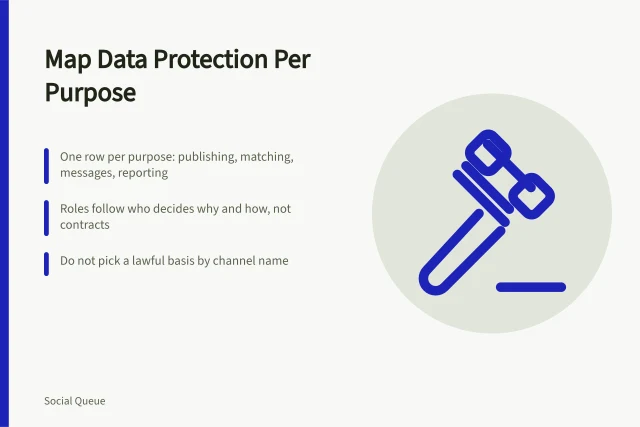
The UK GDPR text and Data Protection Act 2018 form part of the data-protection framework. The Privacy and Electronic Communications Regulations 2003 contain channel-specific rules. A lawful basis for personal-data processing does not by itself satisfy PECR, and a PECR exception does not remove UK GDPR duties.
Map the real data flow:
- intended people and any audience-matching source;
- account identifiers, contact details, pixels, redirects and device information;
- purpose and necessity for each field;
- controller, joint-controller and processor decisions;
- platform, scheduler, agency and sub-processor access;
- retention, suppression, objections and rights handling;
- overseas access, security, deletion and incident support.
Do not choose a lawful basis generically for "social media". The purpose, relationship, reasonable expectations, data source and effect on people matter. The ICO's planning guidance is a starting point for qualified assessment.
Direct messages may be electronic mail under PECR depending on the service and facts. The ICO's April 2026 electronic-mail marketing guidance explains consent and exception analysis, including the 2025 Act's charity soft opt-in changes. Do not extend one exception to a different sender, purpose, subscriber type or collection route.
Design objections and suppression before automation
An objection or opt-out must reach every relevant route without being overwritten by a later import. Store enough suppression information to prevent renewed contact, but do not reuse it for promotion. Define the sender, brands, channels and audience systems covered. Test propagation with synthetic records.
Public posts still require a privacy review where targeting, matched audiences, tracking or identifiable engagement is used. A public account alone does not make personal data unrestricted. Separate responding to an individual from profiling them for later promotion.
Review the final advertisement, not just the draft
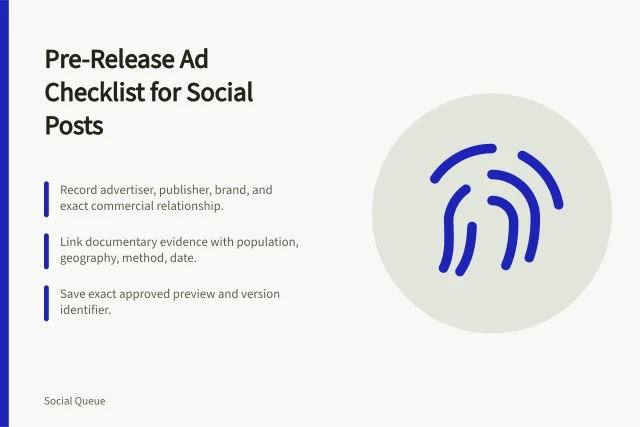
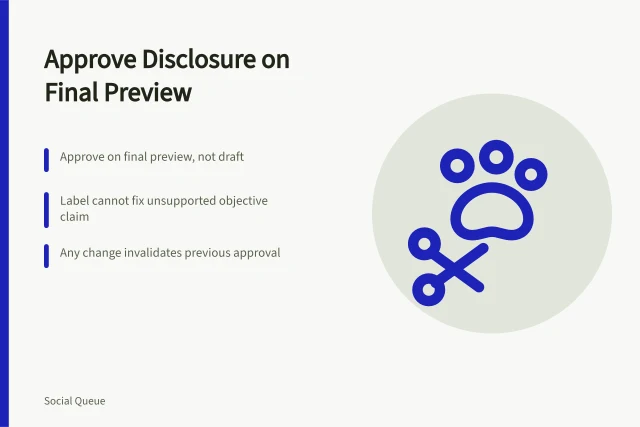
The CAP Code's recognition rules say marketing communications must be obviously identifiable and commercial intent must be clear where it is not apparent. The ASA's current social-media recognition advice explains that labels and placement are contextual. Save the final preview, including crops, overlays and the first visible frame.
Objective claims need evidence before distribution. CAP's March 2026 substantiation advice points to Code rule 3.7 and documentary support for objective claims. A scheduler cannot repair an unsupported claim. The claim owner should record the precise proposition, evidence, population, date, limitations and expiry.
Consumer protection is a separate legal boundary. The CMA's unfair commercial practices guidance explains the Digital Markets, Competition and Consumers Act 2024 provisions applying from 6 April 2025, including misleading actions and omissions. Qualified consumer-law review should examine the likely impression, not just literal wording.
Preserve intellectual-property evidence
Store the owner, source, licence, territory, media, permitted edits and expiry for every image, clip, soundtrack and commissioned item. GOV.UK's copyright-use guidance describes permission, ownership and exceptions as possible routes. It does not decide whether a particular meme, extract or platform audio library covers the proposed commercial use.
Platform terms and technical permissions need a dated record for the exact account and function. A native scheduling button or API permission is evidence of capability only. It cannot grant rights in third-party material or settle advertising and privacy questions.
Protect account access and publishing authority
The NCSC's guidance on protecting organisational social-media publishing covers oversight and account controls. Use named accounts, least privilege, protected administrators, leaver removal and recovery. Separate who can prepare, approve and release content. Rehearse a mistaken post, compromised credential and unavailable administrator.
Employment status and worker monitoring need their own review. Acas's self-employment guidance notes that the practical relationship matters, not merely the contract label. Do not infer that an agency or freelancer arrangement removes employment, tax or supervision issues.
Test accessibility as an independent gate
The Equality Act 2010 is primary legislation applying in Great Britain, with fact-specific duties requiring legal advice. Accessibility testing should cover the authoring process and final platform output: text alternatives, captions, contrast, focus, keyboard use, reading order and error recovery. An automated score or supplier statement is not a legal conclusion.
Contract for the actual service and exit
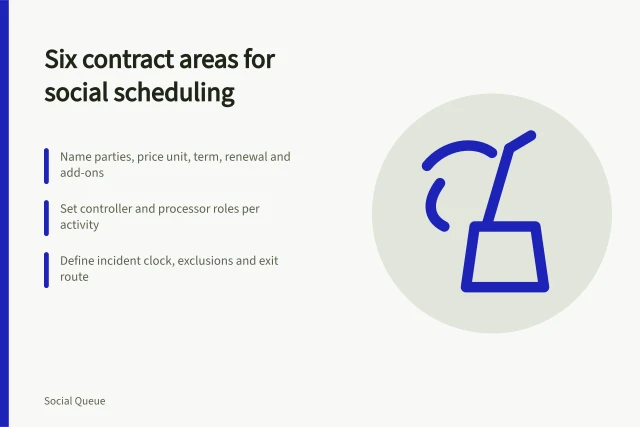
Identify the contracting parties, exact product or service, users, accounts, platforms, formats, volume, hours and acceptance evidence. The Small Business Commissioner's contract guide supplies prompts on parties, scope, quantity, limitations, duration and payment.
Where a supplier processes personal information, actual decision-making determines controller and processor roles. The ICO's controller and processor contract guidance covers instructions, confidentiality, security, sub-processors, assistance, deletion and audits. The page carries a legislative-review warning, so the precise current wording must be checked before publication and signature.
Also specify platform permission changes, service levels and measurement clocks, incident notice, claim and asset liability, subcontracting, insurance, renewal, price changes, data export, credential return, deletion and transition. No label such as "processor" or "SaaS" replaces review of the facts and terms.
Use a release record that can stop the queue
For every scheduled item, retain:
- communication class and intended population;
- data source, purpose, role and PECR analysis where relevant;
- claim evidence and consumer-impression review;
- commercial relationship, disclosure and final preview;
- rights and accessibility evidence;
- platform terms, account role and security state;
- specialist reviewers, approver and version identifier;
- release time, timezone, monitoring and correction owner;
- objection, complaint, incident and withdrawal routes;
- retention, deletion and publication-day recheck date.
Material edits after approval return to review. Pause when evidence expires, targeting changes, a platform alters the output, access is uncertain or a qualified reviewer withdraws approval. This record improves accountability; it is not a safe harbour or compliance certificate.
Before you act
- Check the current legal record before relying on any old compliance note.
- Classify the message and map the people and data involved.
- Record purpose, content, audience selection and delivery route.
- Design objections and suppression before automating any scheduling.
- Review the final advertisement, not just the draft.
- Test accessibility as an independent gate.
Common questions
Does a lawful basis for processing cover electronic marketing?
No. The article says a lawful basis for personal-data processing does not by itself satisfy PECR, and a PECR exception does not remove UK GDPR duties. The two frameworks must be assessed separately for the actual facts, purpose, relationship and data source.
When should a public post get a privacy review?
Where targeting, matched audiences, tracking or identifiable engagement is used. The article states that a public account alone does not make personal data unrestricted, and that responding to an individual should be separated from profiling them for later promotion.
Can a scheduler fix an unsupported advertising claim?
No. The article says objective claims need evidence before distribution, and a scheduler cannot repair an unsupported claim. The claim owner should record the precise proposition, evidence, population, date, limitations and expiry, with qualified review of the likely consumer impression.
In this guide
- The separate UK legal questions behind a scheduled social post, from PECR to contractsUnderstand the separate UK legal questions behind scheduled social content in England, from data and PECR to ads, rights, access and contracts.
- A pre-release advertising checklist for scheduled social posts, down to the final impressionUse a pre-release social advertising checklist for claim evidence, commercial relationships, labels, final impressions, targeting and correction.
- Data protection for social scheduling, one row per purpose and no basis chosen by channelMap data protection for social scheduling in England across purpose, roles, targeting, suppliers, retention, objections, security and transfers.
- Six social scheduling contract areas, from price unit to suspension and exitReview six social scheduling contract areas through a dated, non-ranked UK method covering scope, data, security, rights, service controls and exit.
- A social scheduling disclosure procedure approved on the preview, not the draftCreate a blank social scheduling disclosure procedure covering relationships, evidence, labels, previews, approvals, monitoring and withdrawal.