Rules and ethics
Part of Mapping the UK rules for social scheduling, with GDPR, DPA and PECR kept distinct
A social scheduling disclosure procedure approved on the preview, not the draft
Create a blank social scheduling disclosure procedure covering relationships, evidence, labels, previews, approvals, monitoring and withdrawal.
A social media scheduling disclosure policy should make commercial relationships visible in the final item and preserve why the decision was made. This blank procedure is not legal advice, approved wording or a safe harbour. A qualified UK advertising and consumer-law reviewer must approve the actual relationship, content and presentation.
What to take away
- Approve the disclosure on the final preview, not the draft, because placement and prominence are judged on the complete item.
- A disclosure label does not fix an unsupported objective claim, so hold documentary evidence before distribution.
- Any change to claim, benefit, control, label, placement, format or targeting invalidates the previous approval.
- When live output differs from the approved preview, preserve both records, pause queued items and get a fresh decision.
- Test escalation with a synthetic item to prove a reviewer can stop release and correct output without shared credentials.
Policy ownership and scope
Field / Entry
- Policy owner and deputy
- [names and roles]
- Applies to
- [brands, accounts, creators, agencies and formats]
- England and wider geography
- [operating and audience rule]
- Effective and review dates
- [dates]
- Source versions
- [CAP, ASA, CMA, sector and platform records]
- Escalation route
- [named qualified reviewer]
Include paid, gifted, affiliate, controlled and other commercially influenced content according to legal review. Do not assume that one disclosure label fits every relationship or platform format.
Policy ownership and scope
- Name policy owner and deputy
- List brands, accounts, creators, agencies
- Set England and wider geography rule
- Set effective and review dates
- List CAP, ASA, CMA, platform sources
- Name qualified escalation reviewer
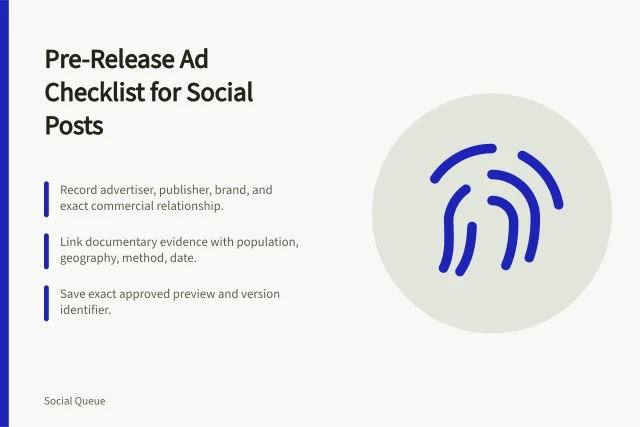
Record the relationship and claim
For each item complete:
Field / Entry
- Advertiser and publisher
- [legal entities and brands]
- Creator or affiliate
- [party and role]
- Benefit or control
- [money, gift, commission, approval or other interest]
- Exact objective claim
- [proposition]
- Evidence
- [owner, source, population, date, limitations and expiry]
- Sector review
- [reviewer and outcome]
CAP's recognition rules address obvious identification and commercial intent. CAP's substantiation advice explains the need for documentary evidence before distribution of objective claims. Disclosure does not cure an unsupported statement.
Approve label and placement on the preview
Field / Entry
- Proposed label
- [exact wording]
- Placement
- [first visible frame, text position and timing]
- Format checks
- [crop, overlay, contrast, sound-off and mobile]
- Platform tool
- [name, state and limitation]
- Final preview ID
- [version or checksum]
- Approver and timestamp
- [name and date]
The ASA's August 2026 social-media advertising advice treats clarity and prominence as contextual and warns that a platform label may not always be enough. Review the likely impression of the complete item, not a label in isolation.
Separate targeting and consumer review
If personal information selects or matches an audience, attach the data source, purpose, transparency, role, objection and PECR review. The ICO's direct-marketing guidance applies to the actual activity, not the policy title.
Record price, availability, material conditions and exclusions as viewers will encounter them. The CMA's unfair commercial practices guidance supports review of misleading actions, omissions and consumer decisions.
Monitor, correct and withdraw
Name the person who checks the live output, comments, complaints, claim expiry and relationship changes. Define triggers for queue pause, correction, replacement disclosure or withdrawal. Save what appeared, when, to which configured audience and what action followed.
Use a monitoring record with these blank fields:
Field / Entry
- Live URL and observation time
- [URL, date, time and timezone]
- Label as rendered
- [text, position and visibility evidence]
- Claim or offer change
- [change and owner]
- Complaint or regulator contact
- [reference and response owner]
- Correction or withdrawal
- [action, authority and timestamp]
- Evidence retention
- [location, access and deletion date]
Do not silently overwrite the approved preview when the live platform output differs. Preserve both records, pause related queued items and obtain a fresh decision. If a creator or affiliate relationship ends, identify future scheduled content and reassess it rather than assuming old disclosures remain accurate.
The procedure owner should test escalation with a synthetic item. The test should show that an authorised reviewer can stop release, locate the evidence and remove or correct the item without shared credentials. Record failures and repeat only after the control changes.
Any edit to the claim, benefit, control, label, placement, format or targeting invalidates the previous approval. Recheck the policy and sources on publication day, after regulator guidance changes and whenever a platform changes its rendering or branded-content controls.
Before you act
- Name the policy owner, deputy and escalation route.
- Record the relationship, benefit or control and exact claim.
- Attach evidence owner, source, date, limitations and expiry.
- Approve the exact label and placement on the final preview.
- Separate targeting and consumer review from the disclosure decision.
- Recheck sources on publication day and after guidance changes.
Common questions
What should happen if the live platform output differs from the approved preview?
Do not silently overwrite the approved preview. Preserve both records, pause related queued items and obtain a fresh decision. The monitoring record should capture the live URL, observation time, label as rendered, and any correction or withdrawal action with its authority and timestamp.
When does an approval stop being valid?
Any edit to the claim, benefit, control, label, placement, format or targeting invalidates the previous approval. Recheck the policy and sources on publication day, after regulator guidance changes and whenever a platform changes its rendering or branded-content controls.
Does a platform disclosure label settle the compliance question?
No. The ASA treats clarity and prominence as contextual and warns a platform label may not always be enough. Review the likely impression of the complete item, not a label in isolation, and remember disclosure does not cure an unsupported statement.