Audience research
Audience research for social scheduling in England, from sampling to the buying decision
Plan ethical audience research for social scheduling in England, from sampling and interviews to privacy, analysis limits and buying decisions.
Audience research for a social scheduling offer is not a search for people who like social media. It studies a defined publishing job, the people who do or authorise it, and the organisations that may pay to change it.
England is the operating context. UK research and global product records are labelled, not silently treated as England evidence.
This desk guide reports no completed interview or survey fieldwork. It provides a protocol that a named researcher can use, subject to ethical, privacy, accessibility, security and commercial review. It does not supply invented personas, response rates or market demand.
What to take away
- Separate operating organisations, buyers, campaign operators and audience members before recruitment rather than merging them into a generic user segment.
- Write the research protocol, including the England geography rule and decision threshold, before seeing any participants.
- Interest in a feature is weaker evidence than a recent publishing event supported by an artefact.
- Research participation and later marketing are separate activities requiring their own lawful basis and review.
- A survey can test how often a defined event appears only if the question, denominator and response route are clear.
Separate four populations before recruitment
A scheduling decision can involve several groups whose interests differ:
Four populations, different decisions
Population
- Operating organisation
- England workflow
- Buyer or approver
- Controls budget
- Campaign operator
- Prepares and schedules
- Recipient or audience
- Encounters post
Inclusion rule
- Operating organisation
- Problem exists?
- Buyer or approver
- Change fundable?
- Campaign operator
- Where work fails
- Recipient or audience
- Communication usable?
Decision informed
- Operating organisation
- Buyer or approver
- Campaign operator
- Recipient or audience
Separate four populations
| Population | Inclusion rule | Decision the research can inform |
|---|---|---|
| Operating organisation | carries out the chosen publishing workflow under the stated England geography rule | whether a recurring organisational problem exists |
| Buyer or approver | controls budget, risk acceptance or supplier approval for that workflow | whether change is authorised and fundable |
| Campaign operator | prepares, checks, schedules or monitors the content | where work fails and what evidence is needed |
| Recipient or audience member | may encounter the resulting post or message | whether the communication is appropriate and usable |
Do not merge these into a generic "user" segment. A campaign operator can want fewer hand-offs while a data-protection lead objects to the proposed targeting. An audience member's platform use does not prove a buyer will purchase software.
The research unit also needs a geography rule. A practical England study might include organisations whose relevant operating site is in England, even if a parent company contracts elsewhere. Another study might use the contracting entity's address. Choose one rule, record exceptions and avoid changing it after responses arrive.
For a frame of registered enterprises or local units, the Office for National Statistics publishes UK business activity, size and location data. Its quality and methodology information explains the enterprise and local-unit distinction and the VAT or PAYE basis of the register. These are sampling choices, not a directory of scheduler buyers.
Start with a decision, not a demographic profile
Write the decision that research must support. For example: "Should we test an approval and recovery service for two-person publishing teams in England?" The question names a workflow and a possible next step without assuming the answer.
Then list the evidence that could change the decision:
Start with a decision
- a recent publication reconstructed from brief to monitoring;
- the participant's actual role, authority and platform access;
- an approval delay, failed release, rights gap or recovery problem supported by an artefact;
- the present workaround and its owner;
- a reason the current native or manual route does not meet the stated acceptance test;
- a dated budget or procurement step, if the study concerns buying rather than usability.
Interest in a feature is weaker evidence than a recent event. A single event can reveal a failure mode but not its prevalence across England. Keep counts tied to the eligible sample and field dates.
Write the protocol before seeing participants
A protocol reduces the temptation to redefine success around convenient answers. Record:
Write the protocol
- the research question and accountable owner;
- the eligible organisation, buyer and operator populations;
- the England rule and fieldwork dates;
- the sampling frame, recruitment route and screening questions;
- expected burdens, incentives and conflicts;
- interview or survey instrument version and question order;
- personal information collected, lawful basis, transparency route and retention decision;
- recording, transcription, access and deletion controls;
- exclusions, analysis method and known sources of bias;
- the decision threshold, stop condition and next review date.
Government Social Research's ethical assurance guidance is written for government research, not private product discovery. Its principles of sound conduct, informed participation, enabling participation and minimising harm are still useful prompts. A commercial team needs its own qualified ethical and legal decisions.
Recruit without disguising promotion as research
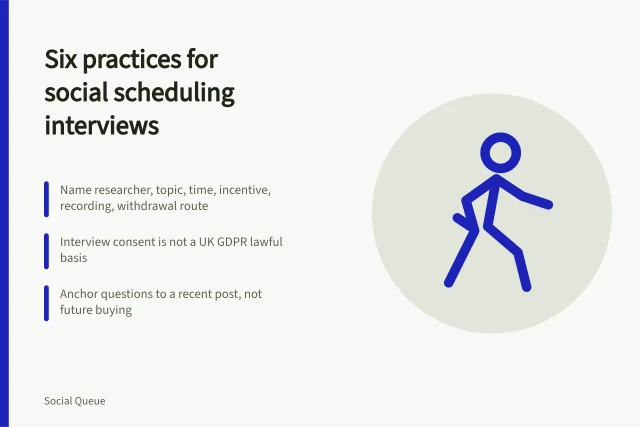
The invitation should identify the researcher, commissioning organisation, topic, reason for selection, expected time, incentive, recording position, data use and withdrawal route. It should not imply that participation is required or that a sales benefit depends on taking part.
Research participation and later marketing are separate activities. The ICO's direct-marketing planning guidance requires organisations to define purposes and assess UK GDPR and PECR issues. A participant's agreement to an interview is not permission to add their details to a promotional audience or upload them to a social platform.
Recruitment by an employer can pressure staff, especially where managers nominate staff. Give workers a way to decline that is not reported as poor performance.
If the study examines individual productivity or account activity, get specialist employment, privacy and equality review before collection. Do not use research data for employment decisions unless that purpose and its legal and ethical basis were settled separately in advance.
Paying an incentive may compensate time, but it can also affect who responds. State the amount, eligibility, payment timing and whether it is still paid after a participant withdraws early. Finance and tax review should cover the real arrangement. Never describe a convenience sample as representative because incentives were used.
Screen on observable work
A short screener should establish eligibility without collecting an unnecessary biography. Ask about:
- the organisation and operating-site rule;
- the participant's role in a recent social publishing task;
- platforms and account types actually used;
- whether they prepare, approve, release, monitor or buy;
- the date of the most recent relevant workflow;
- conflicts such as supplier employment or a current sales relationship.
Avoid requesting special category information unless the research question genuinely requires it and qualified review approves the route. The ICO's current research-processing principles distinguish ethical consent to participate from consent as a UK GDPR lawful basis. They also explain that there is no universal research lawful basis. The organisation must document its own purpose, necessity and basis.
Conduct interviews around a recent event
Ask the participant to choose one recent publication and reconstruct it in order. Begin with the brief and source material, then follow the edits, rights checks, approvals, scheduling, platform response and monitoring. Neutral prompts include:
- "What happened next?"
- "Which record did you use at that point?"
- "Who could approve or stop the release?"
- "How did you know it had published correctly?"
- "What did you do when the expected event did not occur?"
Do not introduce the proposed tool before understanding the current process. Avoid "Would an automated approval queue help?" because it supplies a solution and invites agreement. If a participant makes a general claim, ask for the most recent instance and its evidence.
Keep five layers distinct in notes: the question asked, observable artefact, participant statement, researcher's interpretation and unresolved point. No quotation should appear in publication without authorised wording, context and attribution. This cluster contains none.
Make surveys small enough to interpret
A survey can test how often a defined event appears in an eligible frame, but only if the question, denominator and response route are clear. Pilot the exact instrument with people who resemble the target respondents. Test keyboard navigation, screen-reader output, validation messages, mobile layout and a non-digital alternative where needed.
Every reported item needs the question text, answer options, eligible base, number responding, missing-data treatment, field dates and geography. Do not combine buyers and operators in one percentage unless that mixed population is the intended denominator. Randomly offered question order, branching and mandatory fields must be documented because they affect what respondents saw.
The software does not decide whether collection is fair or accessible. The ICO's guidance on appropriate research safeguards highlights data minimisation and, where possible, anonymous or pseudonymous approaches. Pseudonymous information remains personal data. Security, role access, exports, backups and deletion need evidence for the exact service configuration.
Choose a tool through a controlled comparison
Start with a manual or no-new-tool baseline, then compare named services using the same instrument and acceptance tests. Useful fields are exact product and tenant edition, responder authentication, question logic, accessible authoring and response evidence, export format, administrator roles, data terms, sub-processors, retention, deletion, incident support, contract, price unit and exit.
First-party documentation shows supplier-stated capability, not independent proof. Google explains how Google Forms can create and analyse forms and responses can be downloaded as CSV.
Its August 2026 Workspace privacy-compliance record identifies the Cloud Data Processing Addendum route. Microsoft publishes a security and privacy page for Microsoft Forms, accessibility conformance portal and current products and services DPA catalogue.
The buyer must confirm the tenant, ordered service, applicable contract, regional settings and practical output, and nothing here was hands-on tested.
Analyse absence and disagreement, not just themes
Maintain a recruitment disposition log: invited, ineligible, declined, no response, booked, completed, withdrawn and excluded from analysis. Non-response may be related to workload, confidence, language, accessibility or dissatisfaction. Without evidence, it remains unknown.
Use a case matrix rather than a pile of memorable quotations. Rows can be eligible organisations; columns can capture workflow, role, failure evidence, existing alternative, decision authority and unresolved gates. Let a second analyst review a sample against the instrument and coding rules. Record disagreements instead of forcing consensus silently.
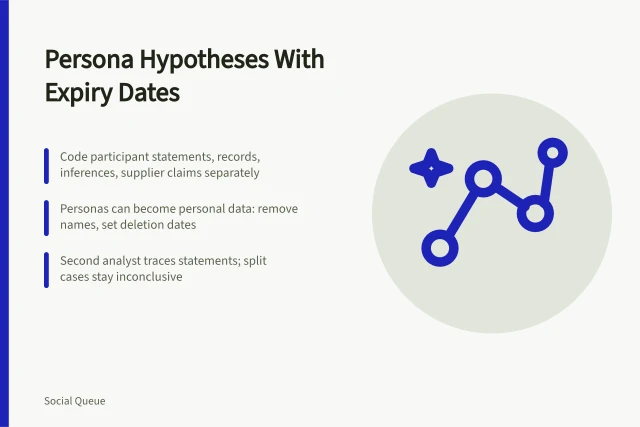
A persona is a compact hypothesis assembled from repeated evidence fields. It is not a named fictional customer. Give each persona version a supporting case count, frame, dates, contradictory cases, unknowns and expiry trigger. Retire it when the workflow or evidence no longer holds.
Research competitors without copying them
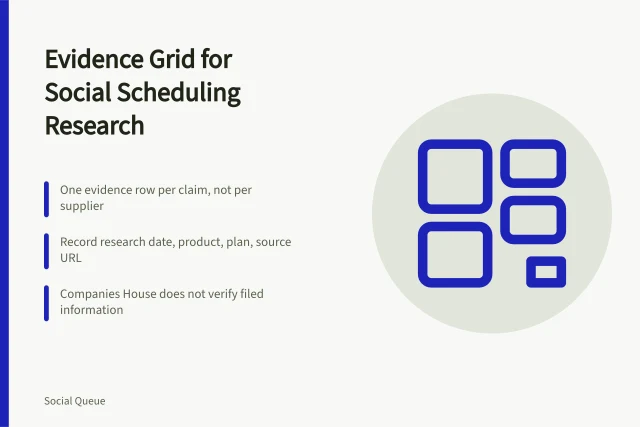
A competitor evidence grid should identify the legal entity where claimed, page URL, access date, exact product or service, source type and quotation-free factual note. Companies House's company information service can verify register information, but the service itself warns that filed information is not validated for accuracy. Registration does not prove product quality, trading status or market share.
Public pages are not a licence to reproduce databases, images or substantial text. GOV.UK explains copyright and database protection in broad terms. Site terms, automated-access restrictions, personal-data purpose and research necessity require separate review. Describe facts in original words and retain a dated source record.
Competitor advertising can show a claim worth testing, not that the claim is true. The Competition and Markets Authority's online reviews case material illustrates why published reviews and endorsements need careful provenance. Do not turn star ratings, search position or review volume into market share.
Convert findings into a bounded decision
At the end of fieldwork, report the frame, recruitment, eligible cases, completions, withdrawals, excluded records and analysis date. State whose views are missing. Separate observed workflow evidence, participant statements, editorial inference and supplier claims.
A proceed decision might authorise a synthetic pilot for one workflow, not a market launch. A revise decision could narrow the population or rewrite the instrument. Stop when the eligible frame cannot be reached, participation is not voluntary, critical data cannot be protected, findings depend on leading questions, or the existing process meets the acceptance test.
Archive the protocol, instrument versions, decision log and retention actions. Research becomes useful when another reviewer can see exactly who was eligible, what was asked, what was observed and why the next step followed.
Before you act
- Choose one England geography rule and record exceptions.
- Write the decision the research must support.
- Record the protocol before seeing participants.
- Screen on observable recent publishing work.
- Keep five layers distinct in interview notes.
- Pilot the exact survey instrument before fieldwork.
Common questions
Why should the four populations be kept separate?
A campaign operator can want fewer hand-offs while a data-protection lead objects to proposed targeting. An audience member's platform use does not prove a buyer will purchase software. Merging these groups into a generic user segment hides conflicting interests and weakens the evidence each decision needs.
What should an interview reconstruct?
Ask the participant to choose one recent publication and reconstruct it in order. Begin with the brief and source material, then follow edits, rights checks, approvals, scheduling, platform response and monitoring. Do not introduce the proposed tool before understanding the current process.
What must every reported survey item include?
Every reported item needs the question text, answer options, eligible base, number responding, missing-data treatment, field dates and geography. Do not combine buyers and other populations. Pilot the exact instrument with people who resemble the target respondents before fieldwork.
In this guide
- Defining a social scheduling target audience from observable work, not job titlesDefine a social scheduling target audience in England through observable work, clear eligibility, careful recruitment and decision-ready evidence.
- Social scheduling persona hypotheses with contradictions and expiry dates attachedBuild evidence-led social scheduling persona hypotheses for England with role, workflow, authority, contradictions, uncertainty and expiry fields.
- Six practices for social scheduling interviews, from candid invitation to missing voicesRun social scheduling interviews around recent work using a dated, non-ranked method covering consent, neutral prompts, evidence and withdrawal.
- Social media scheduling survey tools: Microsoft Forms, Google Forms or a manual baselineCompare Microsoft Forms, Google Forms and a manual baseline for England research using common evidence, privacy, access, export and exit fields.
- Social scheduling competitor research that compares evidence, not marketing pagesResearch social scheduling competitors with a dated evidence grid covering identity, claims, rights, personal data, comparability and careful conclusions.