Foundations
Part of England's social scheduling market, with the unit fixed before anyone talks about size
Sizing England's social scheduling opportunity without inventing a revenue figure
Measure England's social scheduling opportunity without inventing revenue by defining the category, population, evidence gaps and research units.
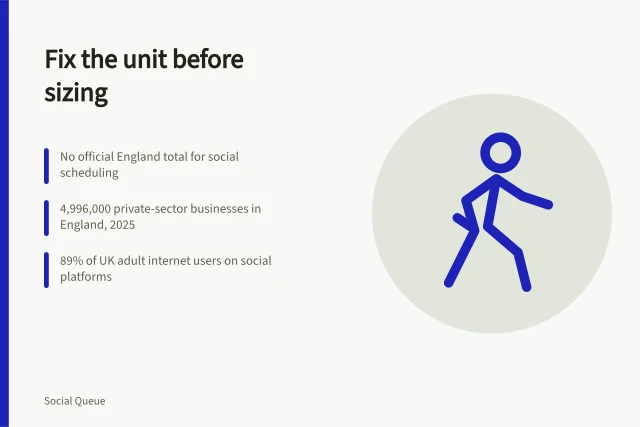
There is no reliable official figure for the social media scheduling market size in England. Public statistics count businesses and registered sites, while communications research measures audiences. They do not identify scheduler subscriptions, service contracts, supplier revenue or purchase intent. A single monetary answer would therefore be an editorial estimate, not an observed market total.
What to take away
- No official figure exists for England's social media scheduling market size, so any single number is an editorial estimate.
- Decide what counts as scheduling before collecting data, since advertising, production and analytics sit outside the category.
- Accounts, users, businesses, premises and contracts cannot be substituted for one another in a market study.
- Official business counts give context only and say nothing about scheduling activity or willingness to pay.
- Publish counts, interviews and verified contracts with exclusions until the sample supports a range.
Define what would be counted
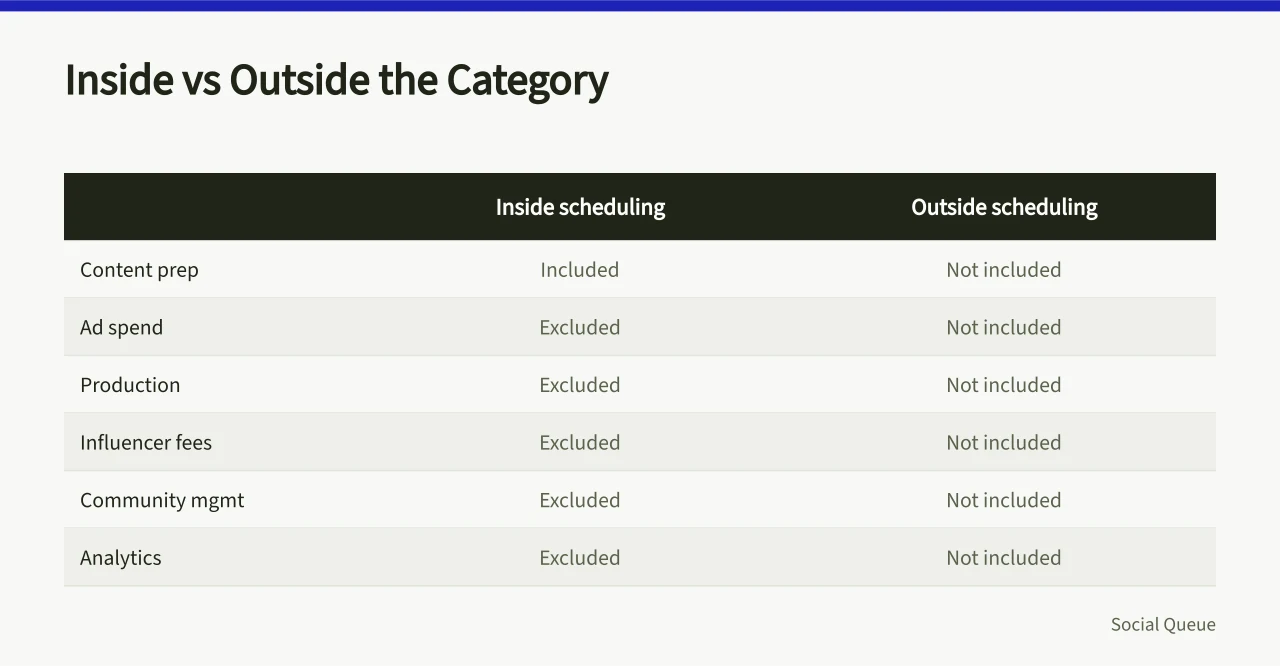
Social media scheduling means preparing content for later publication through a platform's own controls, separate software, a managed service or a custom connection. It does not automatically include advertising spend, content production, influencer fees, community management or general analytics. An analyst must decide whether each of those is inside the category before collecting money or account data.
The unit matters too. One England business may operate several brand accounts, buy one subscription for a UK team and use an agency for only one channel. Conversely, an English branch may use a contract bought by a head office elsewhere. Accounts, users, businesses, premises and contracts cannot be substituted for one another.
What official business data establishes
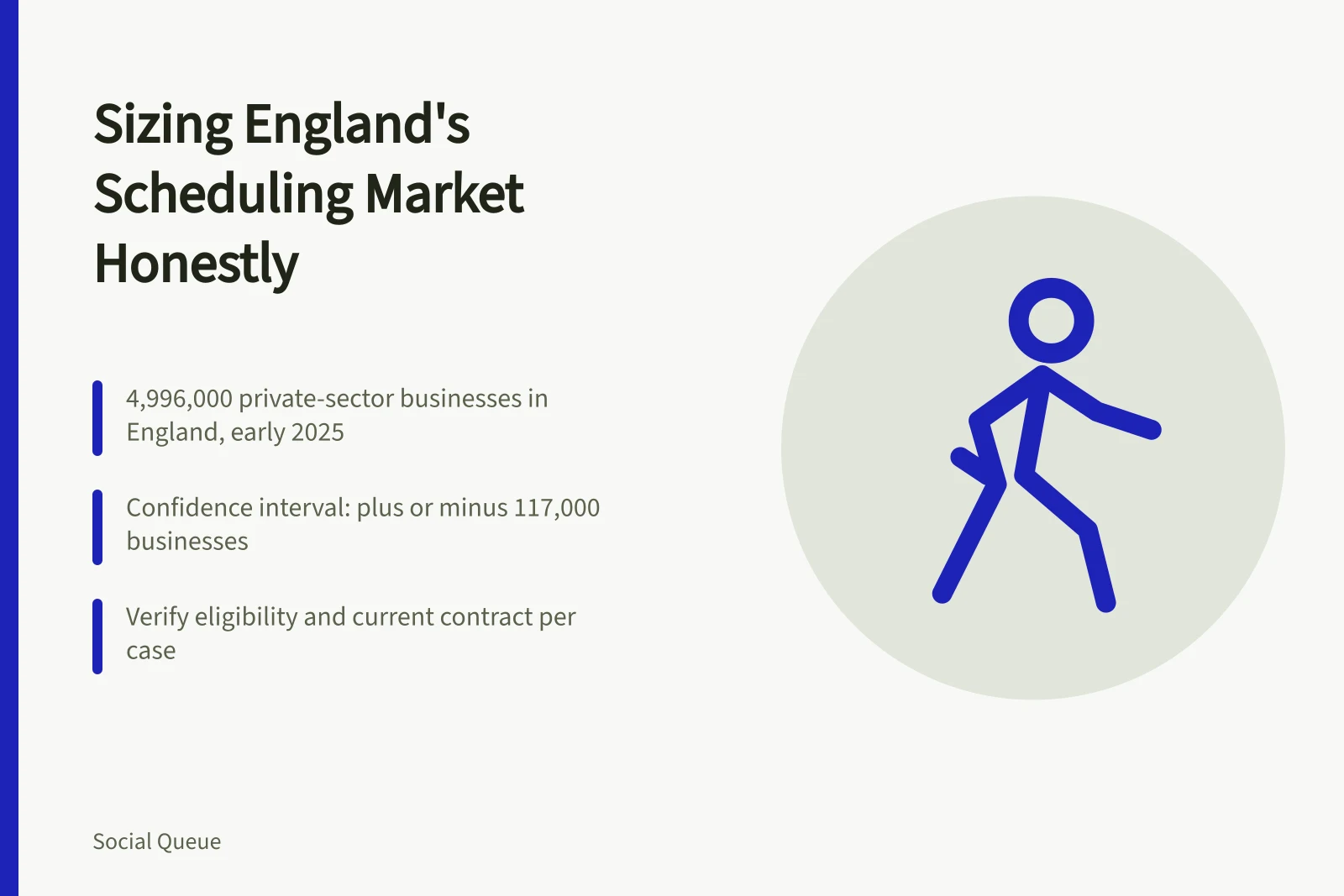
The Department for Business and Trade estimated 4,996,000 private-sector businesses in England at the start of 2025. The published 95% confidence interval is plus or minus 117,000.
Official Business Data
- 4,996,000private-sector businesses in England
- ±117,00095% confidence interval
- 2025start of year estimate
Its regional statistical release assigns businesses by head-office location and includes an estimate for unregistered firms. That is economic context only. It says nothing about social accounts, scheduling activity or willingness to pay.
The Office for National Statistics offers a narrower frame. Its 2025 business dataset covers VAT and/or PAYE-registered enterprises and local units from the Inter-Departmental Business Register. The accompanying quality information explains the distinction between an enterprise and an operating site, as well as coverage limits. It can support a reproducible denominator for research, but not a scheduling-software market value.
Industrial classifications do not solve the supplier side. The official UK SIC record groups organisations by broad economic activity. A software code can contain firms that never sell scheduling products, while agencies may sit in other categories. Using a SIC count as the niche supplier population would misstate the category.
Build a market study without a false total
Start with a named buyer segment and a fixed period. Recruit through a documented frame.
Then verify four facts for each eligible organisation: it operates in England under the chosen rule; manages specified social accounts; has a recurring publish-and-approval task; and an authorised person can describe the current contract or manual process.
Record contracts separately from interest. For each evidenced purchase, capture currency, VAT basis, billing period, seats or connected accounts, included channels, service work, add-ons and renewal term. Keep unpaid native tools and internal labour visible rather than calling them free.
Report a range only when the sample and method support one. Until then, publish counts of eligible cases, completed interviews and verified contracts alongside exclusions and uncertainty. The appropriate conclusion today is an evidence gap. The next decision is whether a properly sampled buyer study is worth funding, not which unsupported number looks plausible.
A later estimate also needs an update rule. Reopen the study when the category definition changes, a major platform removes a publishing route, the sampling frame is revised or contract evidence becomes too old for the intended decision. Preserve the earlier version so readers can see whether a changed result comes from the market, the method or both.
Before you act
- Define the buyer segment and fixed period first.
- Decide whether advertising, production and analytics are inside the category.
- Choose the unitaccounts, users, businesses, premises or contracts.
- Verify eligibility and current contract or manual process for each case.
- Record contracts separately from stated interest.
- Report a range only when sample and method support one.
Common questions
Why can't official business statistics give a scheduling market value?
Public statistics count businesses and registered sites, while communications research measures audiences. They do not identify scheduler subscriptions, service contracts, supplier revenue or purchase intent. The Department for Business and Trade figure of 4,996,000 private-sector businesses in England is economic context only and says nothing about social accounts, scheduling activity or willingness to pay.
What should a market study verify for each eligible organisation?
Recruit through a documented frame, then verify four facts: it operates in England under the chosen rule; it manages specified social accounts; it has a recurring publish-and-approval task; and an authorised person can describe the current contract or manual process. Record contracts separately from interest, capturing currency, VAT basis, billing period, seats, channels, service work, add-ons and renewal term.
When should a later estimate be reopened or updated?
Reopen the study when the category definition changes, a major platform removes a publishing route, the sampling frame is revised, or contract evidence becomes too old for the intended decision. Preserve the earlier version so readers can see whether a changed result comes from the market, the method or both.