Foundations
Part of England's social scheduling market, with the unit fixed before anyone talks about size
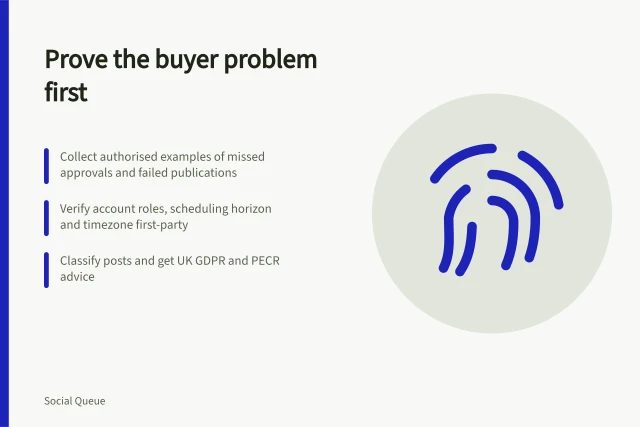
Social scheduling opportunities framed as buyer problems that can be tested and retired
Frame social scheduling opportunities in England as testable buyer problems with evidence triggers, accountable owners, limits and retirement rules.
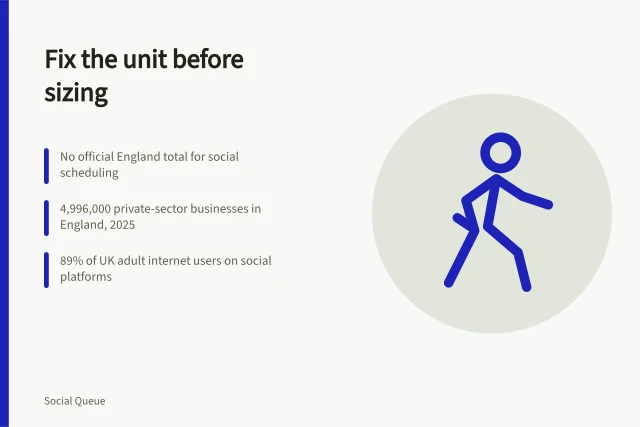
Social media scheduling commercial opportunities in England are hypotheses about costly or risky publishing work. They are not a forecast derived from the number of businesses or social-media users. A credible proposition identifies a buyer, a recent failure, the evidence needed to continue and the condition that retires the idea.
What to take away
- Social scheduling opportunities are hypotheses about costly or risky publishing work, not forecasts.
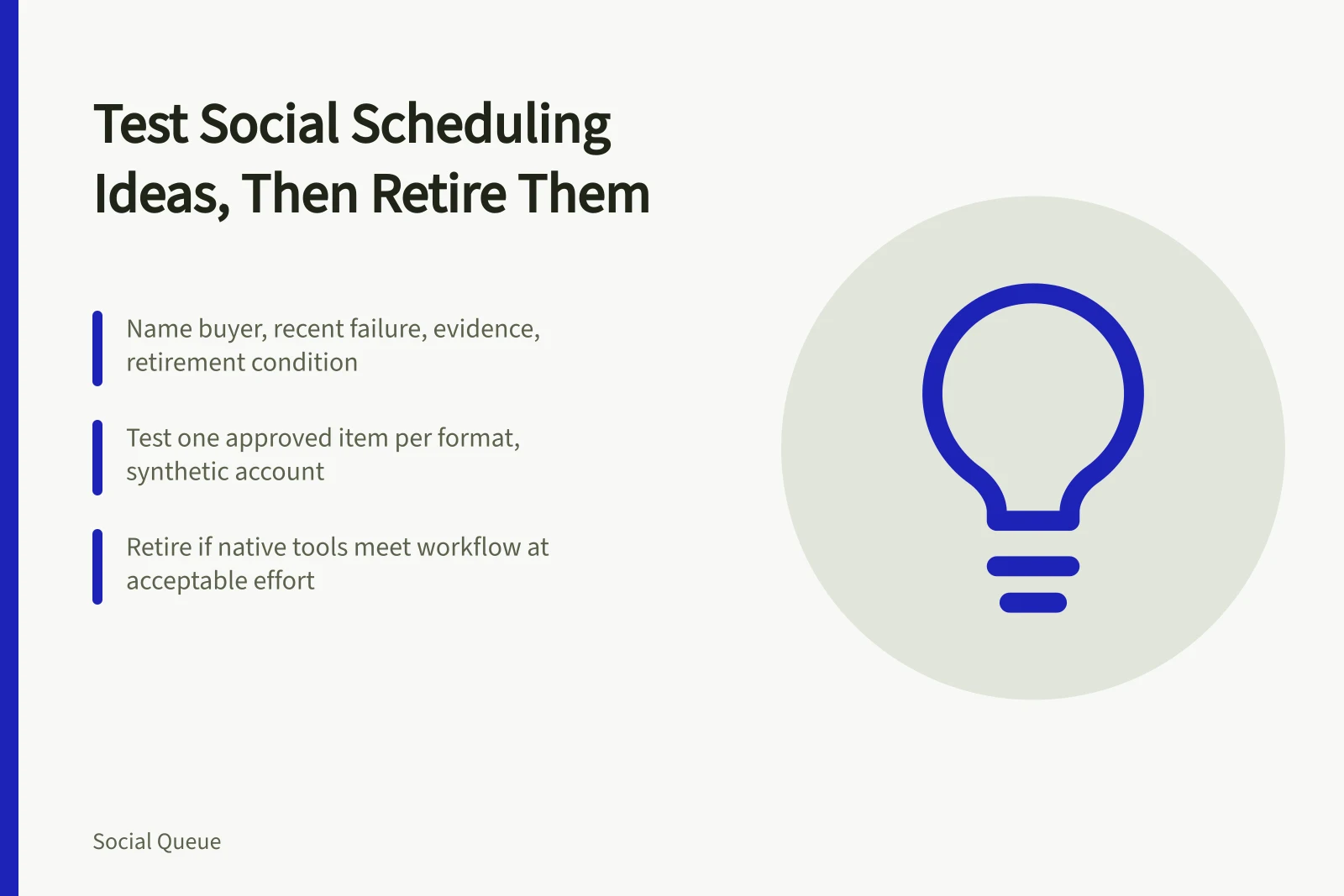
- A credible proposition names a buyer, a recent failure, needed evidence and a retirement condition.
- Test one approved item per required format with a synthetic account or safe fixture.
- Retire the opportunity if native tools meet the workflow at acceptable effort.
- Commercial evidence should be a dated statement of work and completed acceptance record.
Approval evidence for commercial posts
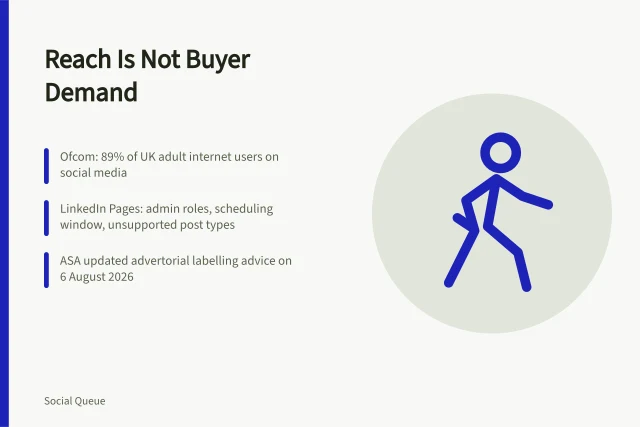
An offer could help a team preserve the classification, claim evidence, reviewer and final preview for a scheduled advert. The trigger is a real approval trail that cannot show why a post was released. The ASA's August 2026 guidance on recognising social media advertising explains that advertising must be identifiable and that labels need to work in context.
Evidence to seek includes the content brief, commercial relationship, approved claim, label, platform preview and release record. A compliance or marketing owner should decide whether the problem is material. Retire the proposition if the buyer's existing process produces complete, timely evidence. Software cannot make an unsubstantiated claim acceptable.
Safer publisher access and offboarding
Another proposition might reduce reliance on shared credentials and unmanaged former users. The NCSC names social accounts among important online services and advises organisations to protect sign-in and remove unnecessary access in its small-organisation account guidance.
The buyer should supply a current role list, access-change history and recovery route. The security owner sets the test and retains the logs. Stop if the proposed service needs broader privileges than the task or cannot return control promptly. Two-step verification and individual accounts are controls to test, not evidence that the whole service is secure.
Publishing failure control across channels
A service may be useful when teams cannot detect or recover from rejected, mistimed or duplicated posts. Platform rules differ. LinkedIn's scheduled Page-post guidance lists current role, horizon and content-type constraints for that service. It says nothing about another network or a third-party connection.
Test one approved item per required format with a synthetic account or safe fixture. Capture the intended timezone, publication identifier, failure message, alert recipient and recovery action. Retire the opportunity if native tools meet the workflow at acceptable effort, or if the supplier cannot evidence supported permissions and rollback.
Rights and accessible-content checks
There may be a service opportunity in checking asset rights, captions, alternatives and final rendering before a queue opens. GOV.UK's copyright material guidance sets out permission, ownership and exception routes. W3C's WCAG material provides technical criteria for web content, while platform behaviour still requires practical testing.
The content owner should provide licences, source files and intended uses. An accessibility specialist should examine representative tasks with relevant assistive technology. Stop if rights are unclear, the final platform output cannot be inspected or the offer presents a checklist as legal approval.
Bounded onboarding and exit work
Some buyers may need a finite migration rather than another subscription: inventory accounts, map approvals, configure roles, move approved content and rehearse exit. The Small Business Commissioner's contract guide supports clear written scope, parties, duration, limitations and payment terms.
Commercial evidence should be a dated statement of work and completed acceptance record, not projected savings. Quote implementation, ongoing service and exit separately, with currency, VAT treatment and buyer labour visible. A useful first experiment is one buyer segment, one workflow and one paid or unpaid discovery period with written stop conditions. Broader expansion waits for repeatable, independently reviewed evidence.
Before you act
- Identify the buyer and a recent publishing failure.
- Gather the content brief, approved claim and release record.
- Test one approved item per required format.
- Confirm the supplier can evidence supported permissions and rollback.
- Quote implementation, ongoing service and exit separately.
- Set written stop conditions for the first experiment.
Common questions
What evidence should a buyer seek for an approval trail problem?
Evidence includes the content brief, commercial relationship, approved claim, label, platform preview and release record. A compliance or marketing owner should decide whether the problem is material. Retire the proposition if the buyer's existing process produces complete, timely evidence.
How should a team test publishing failure control across channels?
Test one approved item per required format with a synthetic account or safe fixture. Capture the intended timezone, publication identifier, failure message, alert recipient and recovery action. Retire the opportunity if native tools meet the workflow at acceptable effort, or if the supplier cannot evidence supported permissions and rollback.
What should a bounded onboarding and exit contract include?
The Small Business Commissioner's contract guide supports clear written scope, parties, duration, limitations and payment terms. Commercial evidence should be a dated statement of work and completed acceptance record, not projected savings. Quote implementation, ongoing service and exit separately, with currency, VAT treatment and buyer labour visible.