Foundations
Part of England's social scheduling market, with the unit fixed before anyone talks about size
Before offering social scheduling as a service, prove the buyer problem exists
Use a staged social scheduling market-entry checklist for England covering demand proof, platform access, claims, privacy, security and exit.
A social media scheduling market entry checklist should stop a weak proposition before real accounts or customer data are exposed. Use evidence for one England buyer segment and one publishing job. Passing a software test cannot compensate for a failed legal, security, accessibility or commercial gate.
What to take away
Scheduling market entry checklist
- A scheduling market entry checklist should stop a weak proposition before real accounts or customer data are exposed.
- Passing a software test cannot compensate for a failed legal, security, accessibility or commercial gate.
- Any unknown that could expose people, accounts, rights or material cost keeps the launch on hold.
- Enter a controlled pilot only when the current process and proposed route can be compared on the same tasks and evidence.
- Expire the approval if the product edition, platform permission, legal position, contract or data flow changes before launch.
Define the offer and evidence boundary
- Name the exact jobdraft, review, approve, schedule, publish, detect failure, respond and retain evidence.
- State whether the offer is software, implementation, ongoing service or custom development.
- Define the England geography rule, buyer role, organisation size, platform-account type and research period.
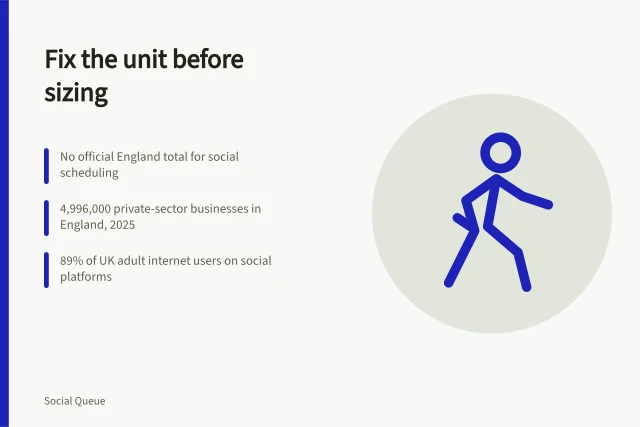
- Keep business counts and audience statistics outside the sales forecast. The ONS 2025 business dataset counts registered enterprises and local units, not scheduler buyers.
Prove a current buyer problem
- Collect recent, authorised examples of missed approvals, failed publications, duplicated work or unmanaged access.
- Record the eligible cases, exclusions, evidence owner and alternative explanation.
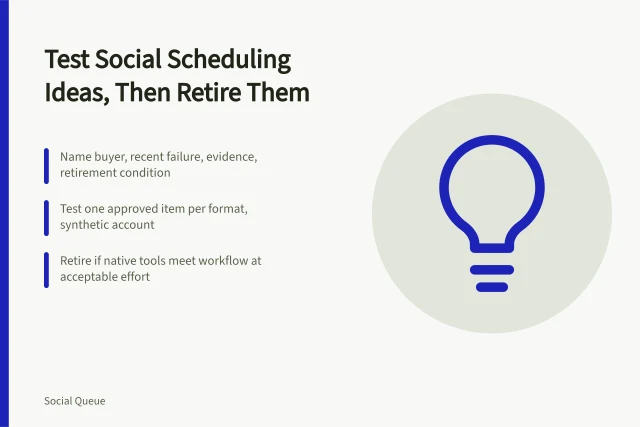
- Set a stop rule if the problem cannot be reproduced or the present native process remains adequate.
Check platform permissions and recovery
- Verify every required account role, content type, scheduling horizon, timezone and connection method against the platform's current first-party record.
- Test with synthetic content and non-production accounts where the platform permits it.
- Prepare for revoked permissions, expired credentials, rejected media and an unavailable supplier.
- Follow the NCSC's social-media publishing guidance when designing oversight, access and recovery. This is security guidance, not product approval.
Separate content and legal decisions
- Classify each post as editorial, service communication, direct marketing or advertising before scheduling.
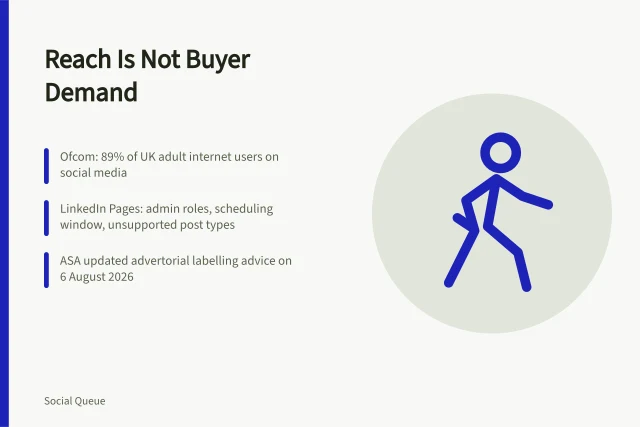
- Obtain qualified advice on UK GDPR lawful basis, PECR, transparency, targeting, objections and suppression. The ICO's planning guidance shows that social-media audience tools can involve personal information.
- Require substantiation, approval and a visible label where content is advertising. The ASA's social-media recognition guidance explains why placement and context matter.
- Log the owner, licence, permitted uses and expiry for every image, clip, track and commissioned asset. The official copyright-use guide sets out three possible bases to investigate: permission under a licence, acquired ownership or an exception that covers the intended use.
Test accessibility and security independently
- Review text alternatives, captions, contrast, reading order and keyboard use for the content and approval interface. W3C's WCAG overview is a technical reference, not proof that a platform or post conforms.
- Use individual accounts, least privilege, two-step verification, access reviews and a leaver process.
- Rehearse a mistaken post, compromised account and lost administrator route, then retain recovery evidence.
Contract for delivery and exit
- Identify the legal parties, controller and processor roles, sub-processors, overseas access, support boundaries, incident duties and audit evidence.
- Quote price in a stated currency and period, with users, accounts, volume, term, renewal, VAT and add-ons explicit.
- Set content export, audit-log retention, credential return, deletion and transition duties before signing.
Make the go or no-go decision
The accountable owner should sign a dated gate record showing pass, fail or unknown for each section. Any unknown that could expose people, accounts, rights or material cost keeps the launch on hold. Enter a controlled pilot only when the current process and proposed route can be compared on the same tasks and evidence.
Expire the approval if the product edition, platform permission, legal position, contract or data flow changes before launch.
Before you act
- Name the exact publishing job and evidence boundary.
- Collect authorised examples of missed approvals or failed publications.
- Verify account roles and scheduling limits against the platform record.
- Classify each post before scheduling and obtain qualified legal advice.
- Test accessibility and security independently with synthetic content.
- Set export, retention, deletion and transition duties before signing.
Common questions
What evidence must be gathered before offering social scheduling as a service?
Collect recent, authorised examples of missed approvals, failed publications, duplicated work or unmanaged access. Record the eligible cases, exclusions, evidence owner and alternative explanation. Set a stop rule if the problem cannot be reproduced or the present native process remains adequate.
How should platform permissions and recovery be checked?
Verify every required account role, content type, scheduling horizon, timezone and connection method against the platform's current first-party record. Test with synthetic content and non-production accounts where permitted. Prepare for revoked permissions, expired credentials, rejected media and an unavailable supplier, following NCSC guidance.
When can a controlled pilot begin?
Enter a controlled pilot only when the current process and proposed route can be compared on the same tasks and evidence. The accountable owner should sign a dated gate record showing pass, fail or unknown for each section. Any unknown that could expose people, accounts, rights or material cost keeps the launch on hold.