Costs and pricing
Part of A social scheduling budget for England that keeps five values separate
Six social scheduling costs that England budgets tend to miss
A dated, non-ranked list of six social scheduling cost categories often missed in England budgets, with official evidence, exclusions and blank estimates.
Social media scheduling hidden costs are usually omitted work or risk, not secret fees. This non-ranked list gives England budget owners six cost categories to expose before purchase, with figures or labelled ranges for each.
Method: mapped the scheduling lifecycle from selection to exit against current official and first-party records. Research date: 6 September 2026.
Scope: organisations operating in England, with UK or Great Britain rules labelled. Inclusions: cash, internal resource, assurance, operational and exit costs. Exclusions: invented prices, labour rates, incident frequencies, savings and tax conclusions. Ranking: non-ranked. Conflicts: no supplier funded this work and no product was tested.
What to take away
- Hidden costs are omitted work or risk, not secret fees, so expose six categories before purchase.
- Count each supplier unit separately and retain plan, currency, VAT note, period, term, limit and quote date.
- Set-up, content, privacy, security and exit tasks consume internal or contracted time after software purchase.
- Assign a cost owner and an evidence owner, and record whether amounts are quoted or unresolved scenarios.
- Use separate sensitivities for quantity growth, delayed launch, failed testing and additional specialist review.
- Typical England rates for the work range from £250 to £900 per day, with specialist compliance or security input at £150 to £450 per hour.
1. Units that expand with the workflow
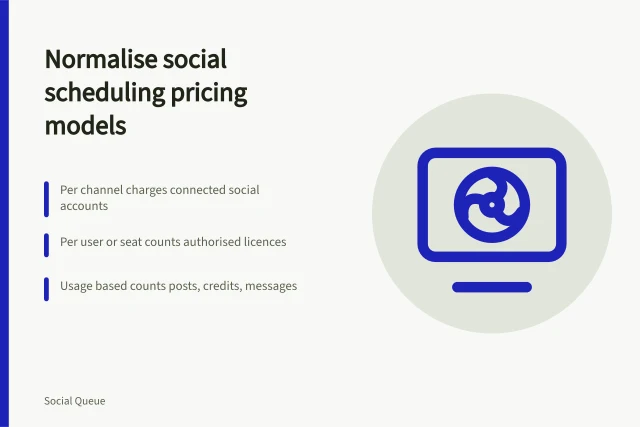
Users, seats, profiles, channels, usage and add-ons can grow differently. Public list prices for social schedulers often start at no cost for one user and three channels.
Monthly cost per unit
- Small-team plans£5–£25
- Mid-market suites£50–£200
- Enterprise quotes£400+
Paid small-team plans commonly run from about £5 to £25 per channel or user each month. Mid-market suites often sit between £50 and £200 per user each month. Enterprise quotes can exceed £400 per user each month.
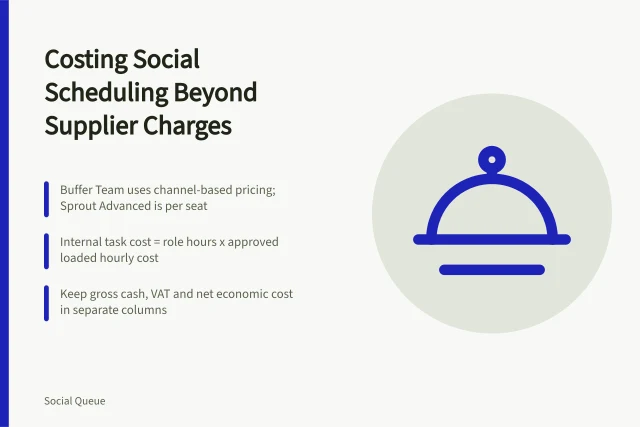
Buffer's current plan record defines Team around channel charging and users. Hootsuite, Sprout Social, Later and SocialPilot publish tiered plans that mix seats, profiles and post volume.
Count each required supplier unit. Retain the plan, currency, VAT note, period and term. Add the limit and quote date. Do not apply Buffer's unit to another vendor.
2. Set-up and migration work
Procurement, contract review, account mapping, integration and role configuration consume time. Content transfer, testing and training add more. The Small Business Commissioner's contract guide supports specifying scope, quantities, limitations, duration and payment.
Set-up and migration costs
- £250–£600Internal marketing day rate
- £400–£900Specialist integration day rate
- 10–30 hoursBasic migration
- 60–150 hoursMulti-brand migration
Internal marketing operations day rates in England typically range from £250 to £600. Specialist integration contractors often charge £400 to £900 per day. A basic migration may take 10 to 30 hours. A multi-brand migration with SSO, approval chains and historical data can take 60 to 150 hours.
At £350 per day, 20 hours is about £875. At 100 hours it is about £3,500. Cost each task from local hours and approved rates, with no generic allowance.
3. Content, rights and accessible output
Writing, design, claim evidence, licences and alternative text continue after software purchase. Captions, approvals and corrections add more. GOV.UK's copyright guidance sets out permission, ownership and exception routes for protected material. The Equality Act 2010 provides the Great Britain legislative boundary.
Freelance copywriting in England typically costs £150 to £500 per article or £250 to £600 per day. Design asset creation often runs £75 to £250 per asset. Accessibility remediation for a social post template may take 2 to 8 hours per template at £40 to £90 per hour.
Stock image or music licences commonly range from £10 to £80 per asset per project. Paid-media or broadcast extensions cost more. Qualified specialists must assess the actual duties and tests; neither source supplies a price.
4. Privacy, PECR and advertising review
Targeting, direct messages, tracking and inbox data need route-specific assessment. The ICO's direct marketing guidance explains why purpose, data protection and PECR questions remain distinct. CAP's substantiation advice requires documentary support for objective claims.
A data protection review for a scheduling workflow commonly costs £500 to £2,500 for a small organisation. A DPIA, direct marketing review and PECR assessment can push that to £2,500 to £10,000.
Advertising claim substantiation may need 5 to 20 hours of specialist time at £150 to £450 per hour. Budget evidence gathering, specialist review and correction without calling them one compliance charge.
5. Security, support and disruption
Access design, assurance review, offboarding, recovery tests and supplier support need owners and time. Incident response adds more. The NCSC's cloud provider guidance recommends evidence proportionate to the buyer's requirements.
A cloud security assurance review often costs £1,500 to £7,500 for a small deployment. Penetration testing of a scheduling integration typically ranges from £3,000 to £15,000. Incident response retainers commonly start at £1,000 to £5,000 per month. Ad hoc response often runs £150 to £400 per hour.
Recovery tests may take 4 to 20 hours. Model named incident scenarios with blank quantities instead of assuming a universal loss or frequency. Name scenarios such as account takeover, token leak, ransomware and data deletion.
6. Renewal, tax and exit
Notice administration, repricing, assurance refresh, retraining and export can occur after the initial budget closes. Transition, token revocation and deletion evidence add more. HMRC's VAT reclaim record makes recovery conditional rather than automatic.
VAT on UK digital services is usually 20% where applicable. Recovery depends on the buyer's VAT status. A repricing at renewal commonly adds 5% to 15%. Some suppliers quote 20% or more when moving from monthly to annual or from legacy to current tiers.
Exit work, including export, transition and deletion evidence, often takes 10 to 40 hours. At £350 per day, 20 hours is about £875. Record gross cash, VAT and economic cost separately, then obtain advice for the real supplier and invoice.
Turn each category into evidence
Assign a cost owner to estimate quantity and approved rate. Assign an evidence owner to show why the task or risk exists. Note whether the amount is quoted, based on recorded internal time, or still an unresolved scenario.
Put renewal and exit work in the same comparison period as the supplier proposal, rather than leaving it for a later team.
Use separate sensitivities for quantity growth, delayed launch, failed testing and additional specialist review. Do not hide all four inside one contingency percentage. The budget should state which event releases contingency, who approves it and what happens if the allowance is exhausted.
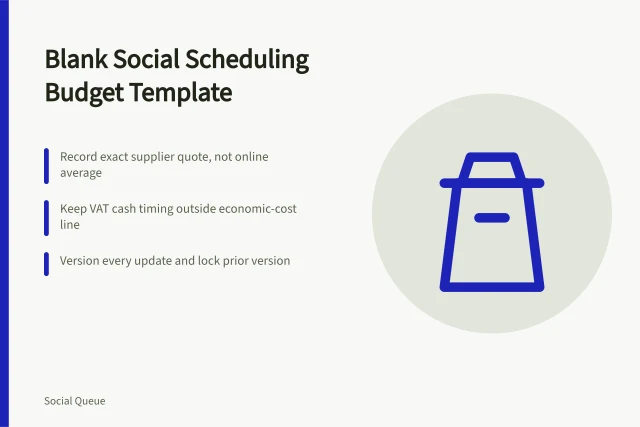
For every category, enter source, unit, quantity, currency and VAT status. Then add period, inclusion, exclusion, confidence and owner. Add a reforecast trigger and stop condition. A cheap subscription does not compensate for an unfunded security, accessibility, privacy or exit requirement. This is general cost information, not financial, accounting, tax, legal or procurement advice.
Before you act
- Count each required supplier unit and retain plan details.
- Cost each set-up task from local hours and approved rates.
- Budget evidence gathering and specialist review for privacy and advertising.
- Model named incident scenarios with blank quantities.
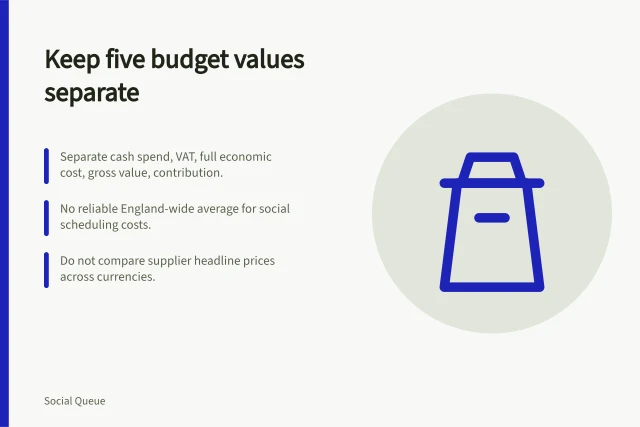
- Record gross cash, VAT and economic cost separately.
- Enter source, unit, quantity, currency and VAT status; then period, inclusion, exclusion, confidence and owner.
Common questions
What hidden costs should budget owners expose before buying social scheduling software?
The article lists six categories: units that expand with the workflow, set-up and migration work, content rights and accessible output, privacy and advertising review, security and disruption, and renewal tax and exit. These are omitted work or risk, not secret fees, and should be exposed before purchase.
How should a budget owner treat renewal and exit work in the comparison period?
Put renewal and exit work in the same comparison period as the supplier proposal, rather than leaving it for a later team. Notice administration, repricing, assurance refresh, retraining, export, transition, token revocation and deletion evidence can occur after the initial budget closes.
What should be recorded for every cost category in the budget?
For every category, enter source, unit, quantity, currency and VAT status. Then add period, inclusion, exclusion, confidence and owner. Add a reforecast trigger and stop condition. Also state which event releases contingency, who approves it and what happens if the allowance is exhausted.