Costs and pricing
Part of A social scheduling budget for England that keeps five values separate
A blank social scheduling budget with exact units, VAT and reforecast triggers
Use a blank social scheduling budget template for England that records exact units, VAT, labour, assurance, risk, renewal, exit, owners and reforecast triggers.
This social media scheduling budget template is blank by design. Fill it with an exact supplier quote and the organisation's own workload evidence. Do not insert an online average where a quantity, rate or tax treatment is unknown.
What to take away
- Fill the blank template with an exact supplier quote and your own workload evidence, not an online average.
- Record the tax reviewer's conclusion and supporting evidence rather than choosing VAT treatment from the template.
- Keep VAT cash timing outside the economic-cost line until a tax specialist confirms recovery.
- Version every update and lock the prior version so a favourable new estimate cannot erase the history.
- Close the budget with stop, recovery and reapproval conditions, and stop launch if a required control has no funded owner.
Project header
Copy these fields into the working sheet:
Project header fields
- Legal buyer and England unit
- Service purpose and exclusions
- Supplier entity, product, plan
- Quote reference, currency, expiry
- Contract start, end, notice, renewal
- VAT statement and tax reviewer
- Budget owner and approval ceiling
- legal buyer and England operating unit:
- service purpose and excluded activities:
- supplier legal entity, product and plan:
- quote reference, currency and expiry:
- contract start, end, notice and renewal dates:
- VAT statement and qualified tax reviewer:
- budget owner, operational owner and approval ceiling:
- baseline option and comparison period:
HMRC's place-of-supply notice shows why business status, customer location and service type matter. Do not choose treatment from this template. Record the reviewer's conclusion and supporting evidence.
Cost lines
Create one row for each item, with columns for unit, quantity, unit cost, currency, VAT, billing period, term, inclusion, exclusion, evidence URL or record, date, confidence and owner.
Cost line categories
Category
- Subscription
- Seats, profiles, overage
- Set-up
- Migration, integrations, tests
- Content
- Copy, design, licences
- Assurance
- Privacy, security, tax review
- Operations
- Admin, training, support
- Resilience and exit
- Recovery, export, deletion
Typical items
- Subscription
- Quote and plan terms
- Set-up
- Contract and test records
- Content
- Approval and claim evidence
- Assurance
- Reviewer conclusions
- Operations
- Tickets and reports
- Resilience and exit
- Test and deletion evidence
Evidence to record
- Subscription
- Set-up
- Content
- Assurance
- Operations
- Resilience and exit
- Subscriptionbase plan, users or seats, profiles or channels, usage, add-ons, overage and payment fees.
- Set-upprocurement, contract work, account mapping, integrations, migration, configuration and synthetic tests.
- Contentplanning, copy, design, licences, accessible alternatives, claim evidence, approval and correction.
- Assuranceprivacy and PECR, advertising, security, accessibility, IP, employment, procurement, finance and tax review.
- Operationsadministration, access changes, training, support, complaints, platform changes and reporting.
- Resilience and exitincident response, manual continuity, recovery tests, export, transition and deletion evidence.
The NCSC's supplier assurance guidance supports budgeting evidence review to the level required by the intended service. It does not provide a fixed assurance allowance.
Blank equations
supplier cash before tax = sum of fixed charges + quoted unit price x contracted quantity x billed periods + add-ons + overage
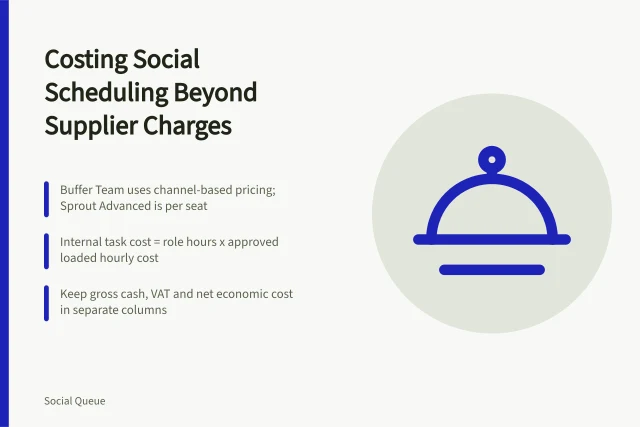
internal economic cost = sum of role hours x approved loaded hourly cost + allocated existing-resource cost
whole-service economic cost = supplier cost excluding recoverable VAT + internal economic cost + contractor cost + risk allowance + exit cost
For each equation, write the currency, period, data owner, source and exclusions. Avoid double counting contractor work inside both an implementation fee and internal hours. Keep VAT cash timing outside the economic-cost line until a tax specialist confirms recovery.
HMRC says a VAT-registered business may reclaim VAT on qualifying business expenses when conditions and records are met in its reclaim guidance. That statement is not a conclusion for this purchase.
Control sheet
Add columns for approved budget, committed cash, paid cash, accrued amount, forecast completion, variance reason and corrective action. Set the organisation's own tolerance and escalation owner. Useful triggers include a plan change, more users, another platform, foreign-exchange exposure, delayed integration, a failed accessibility test, new legal work or an unproven export.
Version every update. The change record should name the editor, date, altered assumption, supporting evidence, approval and effect on cash and economic cost. Lock the prior version so a favourable new estimate cannot erase the history. Reconcile committed amounts to purchase orders or contracts and paid amounts to invoices, while keeping unpriced risks visible.
The 2026 Green Book recommends examining risk and uncertainty rather than relying on a single optimistic case. Use a base case plus lower-benefit, higher-cost and later-delivery sensitivities. Do not borrow government percentage adjustments without checking whether they fit the project.
Close the budget with stop, recovery and reapproval conditions. A required control with no funded owner stops launch. Archive the quote, tax advice, assumptions, approvals and reforecast history. This template is general information, not accounting, tax, investment, legal or procurement advice.
Before you act
- Copy the project header fields into the working sheet.
- Create one cost row per item with unit, quantity, unit cost and VAT.
- Write the currency, period, data owner and source for each equation.
- Avoid double counting contractor work in fees and internal hours.
- Set your own tolerance and escalation owner on the control sheet.
- Archive the quote, tax advice, assumptions, approvals and reforecast history.
Common questions
Why should I not use an online average for a quantity, rate or tax treatment?
The template is blank by design. You fill it with an exact supplier quote and the organisation's own workload evidence. Where a quantity, rate or tax treatment is unknown, the article says do not insert an online average. Record the qualified tax reviewer's conclusion and supporting evidence instead.
What should the change record contain when I update the budget?
Version every update. The change record should name the editor, date, altered assumption, supporting evidence, approval and effect on cash and economic cost. Lock the prior version so a favourable new estimate cannot erase the history. Reconcile committed amounts to purchase orders or contracts and paid amounts to invoices.
How should I handle risk and uncertainty in the budget?
The 2026 Green Book recommends examining risk and uncertainty rather than relying on a single optimistic case. Use a base case plus lower-benefit, higher-cost and later-delivery sensitivities. Do not borrow government percentage adjustments without checking whether they fit the project. Keep unpriced risks visible in the control sheet.