Operations
Part of Social scheduling operations built on classification, evidence and the final render
The social scheduling quality checks to pass before a post is released
Use this evidence-led social scheduling checklist before release, covering claims, rights, accessibility, approval, timing, security and recovery.
Use this social media scheduling quality checklist on the exact content package loaded for release. A clean writing review cannot compensate for missing claim evidence, rights, permissions, accessibility or account control.
Method: the checks follow a post from classification to recoverable release. Review date: 6 September 2026. Scope: organisations operating accounts from England, with UK-wide regulatory sources labelled. Inclusions: public editorial posts, adverts, paid creator content, service messages and promotional direct messages. Exclusions: sector-specific clearance, legal advice, supplier assurance and invented platform tests. Ranking: this is a workflow, not a ranking. Conflicts: no supplier funded the checklist.
What to take away
- A clean writing review cannot fix missing claim evidence, rights, permissions, accessibility or account control.
- Classify each item as one communication type and escalate mixed or uncertain content rather than choosing the least restrictive label.
- Objective advertising claims need documentary evidence before publication, and protected assets need permission, acquisition or exception evidence.
- Disclosure must be obvious in the final crop, first frame, caption and supported device views.
- A failed item returns to its owner, and approval cannot carry forward to revised copy, media, audience settings or timing.
Intake and classification
- Record the business purpose, intended audience, account and Europe/London release window.
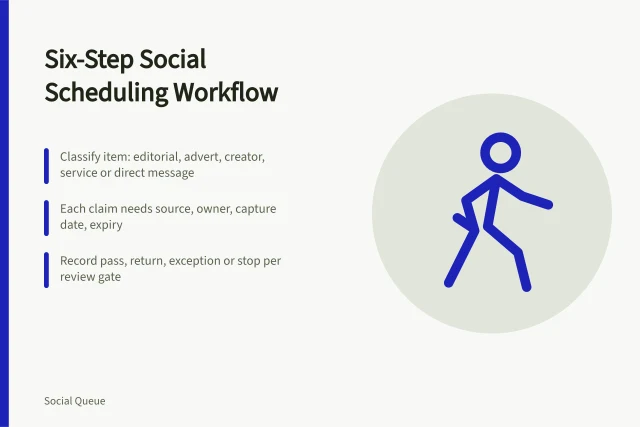
- Choose one communication class and give the reasonpublic editorial, advert, paid creator content, genuine service message or promotional direct message.
- Escalate mixed or uncertain content instead of selecting the least restrictive label.
- Identify the accountable owner, scheduler, monitor and withdrawal authority.
The ICO's direct marketing identification guidance covers targeted social advertising and messages directed to particular people. It also distinguishes direct marketing from other communications by purpose and content. The qualified privacy and PECR reviewer must apply that guidance to the real route.
Evidence, claims and rights
- Link each objective claim to the source version actually reviewed.
- Check geography, population, date, product edition and qualification beside the claim.
- Test every outbound destination and confirm it supports the nearby statement.
- Hold permission, acquisition or exception evidence for each protected asset.
- Record creator obligations, territory, media, duration and attribution.
CAP's substantiation guidance says documentary evidence should exist before publication for objective advertising claims. GOV.UK's copyright guidance sets out the permission, ownership and exception routes. Neither page clears a particular post without its facts.
Disclosure and accessible presentation
- For an advert or paid creator item, inspect whether its commercial nature is obvious before engagement.
- Check disclosure in the final crop, first frame, caption and supported device views.
- Put essential meaning in text as well as imagery.
- Provide purposeful alternative text and verify captions against the audio.
- Use descriptive link text where the format permits it.
The ASA's influencer advertising guidance stresses early, prominent and understandable identification in the final context. ONS Digital offers practical accessible-content checks, but a specialist must determine the appropriate tests and legal duties for the service.
Approval, timing and security
- Freeze a revision identifier before approvals begin.
- Preserve a separate outcome for privacy, PECR, advertising, rights, accessibility, security, contract, employment and finance gates where relevant.
- Match the approved revision to the scheduled object.
- Resolve the local release time against Europe/London and inspect the tool's timestamp.
- Confirm authorised account, audience, link, crop, thread order and disclosure in preview.
- Check access revocation, recovery contacts and pause authority.
The NCSC's guidance for social publishing recommends controlled access, review and authorisation, protection for management tools and an emergency recovery plan. Apply those controls to the actual accounts and supplier arrangement.
Release and exception record
- Verify the live item against the approved package and capture its identifier.
- Start the documented monitoring window and response route.
- Send privacy, safety, security or regulated-product issues to their named specialists.
- Record corrections, removals or paid-distribution pauses with reason, time and owner.
- Link the job to a justified retention, review, withdrawal or deletion event.
A failed item returns to its owner. The defect log should show what failed, which release was affected and what evidence is required to restart. Re-run all affected checks after a change. Do not carry approval forward to revised copy, media, audience settings or timing without an explicit decision.
Before you act
- Record business purpose, audience, account and release window.
- Link each objective claim to the reviewed source version.
- Freeze a revision identifier before approvals begin.
- Match the approved revision to the scheduled object.
- Verify the live item and capture its identifier.
- Log corrections, removals or pauses with reason, time and owner.
Common questions
What must be checked for each objective claim?
Link each objective claim to the source version actually reviewed. Check geography, population, date, product edition and qualification beside the claim. Test every outbound destination and confirm it supports the nearby statement. CAP's substantiation guidance says documentary evidence should exist before publication for objective advertising claims.
How should disclosure be handled for adverts and paid creator content?
Inspect whether the commercial nature is obvious before engagement. Check disclosure in the final crop, first frame, caption and supported device views. The ASA's influencer advertising guidance stresses early, prominent and understandable identification in the final context.
What happens when a post fails a check?
A failed item returns to its owner. The defect log should show what failed, which release was affected and what evidence is required to restart. Re-run all affected checks after a change, and do not carry approval forward to revised copy, media, audience settings or timing without an explicit decision.