Operations
Part of Social scheduling operations built on classification, evidence and the final render
Six social scheduling roles, from accountable publisher to live monitor
A dated, non-ranked map of social scheduling roles for England teams, with evidence for ownership, review, security, accessibility and recovery.
Social media scheduling team roles describe accountabilities, not job titles or a universal organisation chart. One person may hold several roles; a larger organisation may divide them. Each decision still needs a named owner and deputy.
Method: mapped the publishing lifecycle against current regulator, government and workplace records. Research date: 6 September 2026. Scope: organisations operating from England, with UK or Great Britain sources identified by their publisher. Inclusions: operational ownership from intake to recovery. Exclusions: headcount, salary, seniority, sector-specific posts and claims that a role guarantees compliance. Ranking: non-ranked. Conflicts: no platform, agency or supplier funded this list.
What to take away
- Social scheduling roles describe accountabilities, not job titles, and each decision needs a named owner and deputy.
- The accountable publisher authorises the exact final revision or stops it, with senior involvement when workflows are bypassed.
- Reviewers for advertising, privacy, accessibility and rights must assess the likely final impression and document their checks.
- Schedulers load only approved revisions, and live monitors compare the live item with the package and route complaints.
- Record decision, owner, deputy, evidence, limit and escalation, and keep independent gates even if roles are combined.
1. Accountable publisher
This owner accepts the purpose, account, audience, release window and business risk. They authorise the exact final revision or stop it. The NCSC's social media publishing guidance recommends authorised publishing, review routes and senior involvement when normal workflows may be bypassed. It does not prescribe a job grade.
2. Content package owner
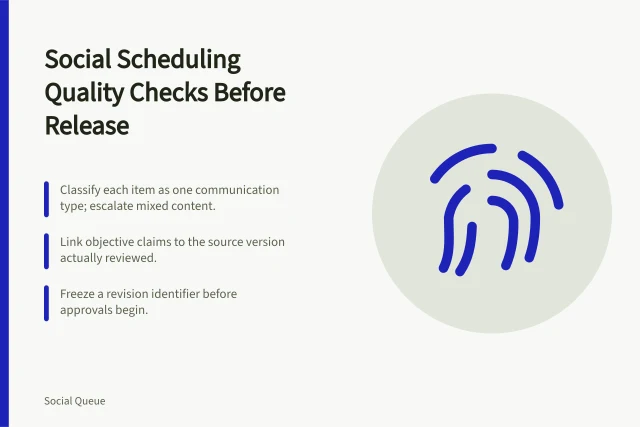
The package owner keeps copy, media, captions, alternative text, links, sources, rights and revisions together. They return unresolved factual or rights questions instead of filling the calendar. GOV.UK's copyright guidance supports the need to evidence permission, ownership or an applicable exception for protected material.
3. Advertising and consumer-claims reviewer
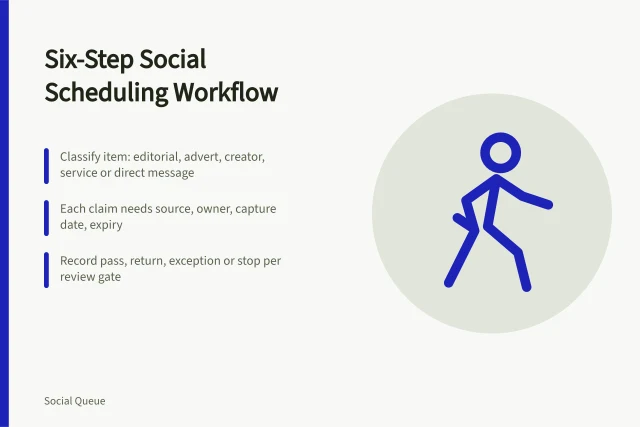
This specialist assesses whether content is an advert, whether its commercial nature is recognisable and whether objective claims have evidence. They review the likely final impression rather than isolated wording. CAP's brand-owned and paid social guidance explains the recognisability requirement across paid and brand-controlled contexts. Regulated products may require a different or additional reviewer.
4. Privacy and PECR reviewer
The reviewer examines audience data, targeting, profiling, tracking, direct messages, transparency, objections and suppression. A service message is not accepted merely because the sender used that label. The ICO's direct marketing guidance is UK-wide and was updated in April 2026 to reflect the Data (Use and Access) Act timetable. Publication-day review remains necessary.
5. Accessibility and rights reviewer
This owner chooses tests for text, contrast, images, audio, video, links and the final platform rendering. Rights review can sit with the same person only if competence and independence are documented. The Equality Act 2010 applies across Great Britain, but a statutory citation cannot decide reasonable adjustments for a specific service. Keep the legal review separate from practical checks.
6. Scheduler and live monitor
The scheduler loads only the approved revision, resolves the Europe/London timestamp and inspects the preview. The monitor then compares the live item with that package, watches the agreed period and routes complaints or defects. Neither role changes wording or audience settings silently. A correction creates a recorded decision and, if material, another approval.
7. Security and recovery owner
This owner manages authorised access, connected tools, authentication, logs, revocation, recovery contacts and the queue pause. During an incident they coordinate, but specialists decide privacy notification and legal questions. The NCSC's cyber incident response process separates analysis, containment, remediation and recovery and calls for tracked tasks and findings.
8. Records and supplier owner
The records owner links evidence, approvals, releases, corrections and incidents to justified retention and deletion events. The supplier owner maintains contracts, platform dependencies, support and exit routes. The ICO's storage limitation guidance says organisations should justify retention rather than keep personal data indefinitely.
If creators or schedulers are freelancers, confirm how work is really controlled. Acas notes that employment status reflects the contract and actual relationship. Obtain separate employment, tax and commercial advice instead of assuming that a role label decides status.
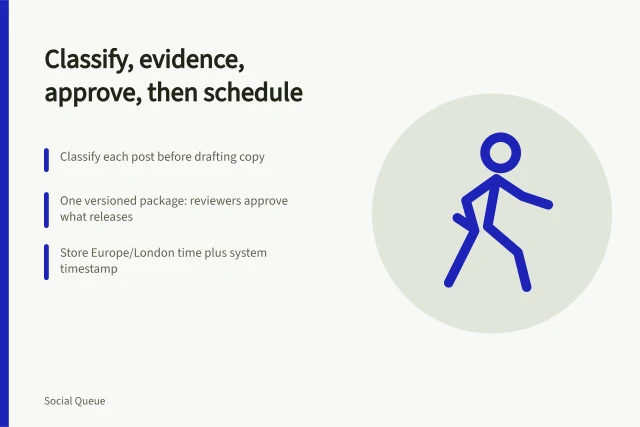
Put these responsibilities in a simple assignment record: decision, primary owner, deputy, evidence, limit and escalation. If one person holds conflicting roles, record the additional check. The structure can be compact, but none of the independent gates should disappear.
Before you act
- Name a primary owner and deputy for every decision.
- Authorise the exact final revision before publishing.
- Keep copy, media, rights and revisions together.
- Check recognisability, evidence and privacy before release.
- Load only the approved revision and inspect the preview.
- Record retention, deletion and supplier exit routes.
Common questions
What does the accountable publisher do?
The accountable publisher accepts the purpose, account, audience, release window and business risk. They authorise the exact final revision or stop it. The NCSC recommends authorised publishing, review routes and senior involvement when normal workflows may be bypassed, but it does not prescribe a job grade.
How should advertising and consumer claims be reviewed?
An advertising and consumer-claims reviewer assesses whether content is an advert, whether its commercial nature is recognisable and whether objective claims have evidence. They review the likely final impression rather than isolated wording. CAP guidance explains the recognisability requirement across paid and brand-controlled contexts, and regulated products may need another reviewer.
What happens if one person holds conflicting roles?
If one person holds conflicting roles, record the additional check. Rights review can sit with the accessibility reviewer only if competence and independence are documented. The structure can be compact, but none of the independent gates should disappear. Put responsibilities in a simple assignment record with decision, owner, deputy, evidence, limit and escalation.