Operations
Part of Social media content calendar template UK: how to build one
Social media content calendar template UK: how to build one
Build a UK social media content calendar template with bank holidays, seasonal hooks, school term dates and fields that survive a monthly review.
What to take away
- A UK content calendar template starts with the national and seasonal dates that shape demand, not with a blank grid.
- Build fields for owner, channel, timezone, asset, approval and review date so the plan survives contact with a busy week.
- Treat personal data in your planning workflow under the UK GDPR and the Data Protection Act 2018.
- Check advertising rules before you schedule a paid or promotional post.
- Rebuild the calendar monthly and retire hooks that no longer earn attention.
Begin with UK dates, not a blank grid
A template that ignores the UK calendar produces posts that miss the moment. Bank holidays, half-term breaks and seasonal retail peaks change when people scroll. English school term dates are set by local councils, so a national template cannot assume one holiday week. Start with the dates, then fit the channels around them.
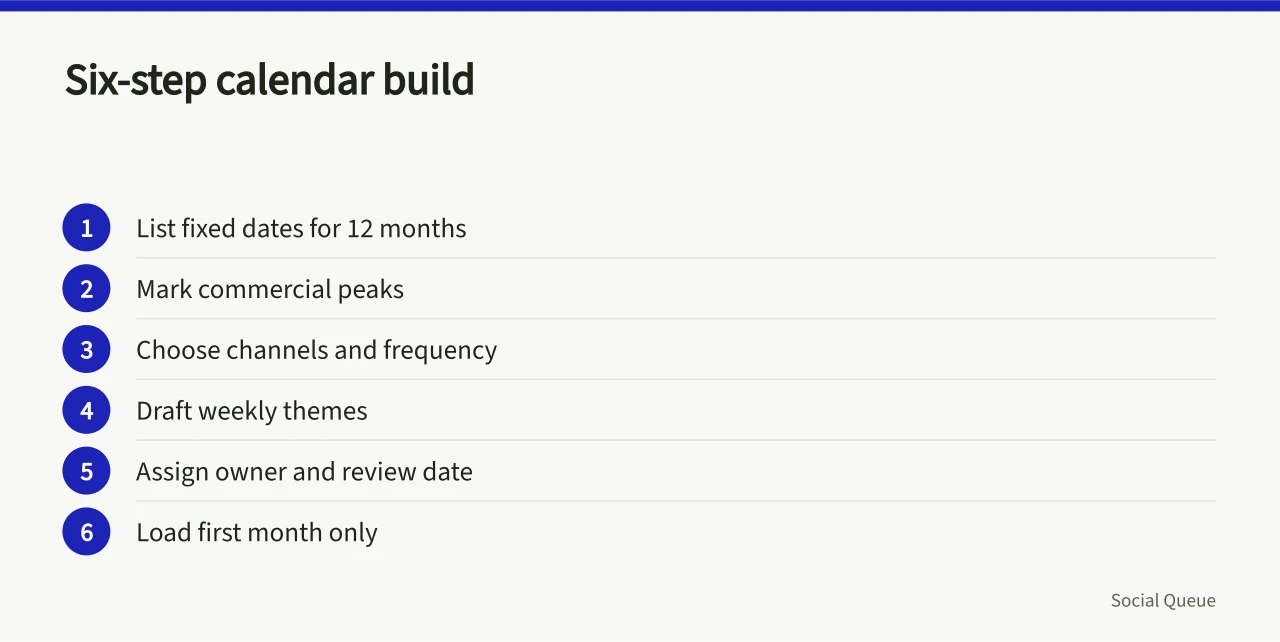
A six-step build sequence
- List the fixed dates for the next 12 monthsbank holidays, religious festivals, school terms and known sector events.
- Mark the commercial peaks, such as back to school, Black Friday and Christmas.
- Choose the channels and posting frequency you can sustain.
- Draft themes for each week, not every post.
- Assign an owner and a review date to each theme.
- Load the first month only, then review before loading the next.
Before you add dates, separate the rules that apply to data, consent and direct marketing, as this UK scheduling rules and compliance guide does.
The fields your template needs
A calendar without owner and review date becomes a wish list. Record the channel, format, draft due date, approval route and the timezone you publish in. British Summer Time changes twice a year, so a post scheduled for 9am can land at 8am if the tool is set to UTC. Add a field for the asset link and the caption status.
Fields your template needs
- Channel
- Format
- Draft due date
- Approval route
- Publish timezone
- Asset link
- Caption status
A rolling 12-week view is easier to keep accurate than a full year. Plan themes for the quarter, then lock the next month. Leave the remaining weeks as placeholders. This keeps the calendar useful without pretending you can predict every news cycle.
The UK hooks worth planning around
| Period | UK hook | Planning note |
|---|---|---|
| January | New year reset | Budgets are tight, so avoid hard selling. |
| February | Valentine's Day | Book florists and restaurants early. |
| March to April | Easter and school holidays | Dates move each year. |
| May | Early May and spring bank holidays | Expect lower B2B engagement. |
| June to August | Summer term and festivals | Local events vary. |
| September | Back to school | English term dates differ by council. |
| October | Half term and Halloween | Half-term week varies. |
| November | Bonfire Night and Black Friday | Plan stock and delivery cut-offs. |
| December | Christmas and New Year | Last posting dates matter for ecommerce. |
The UK social media holidays calendar is not a fixed list. Some hooks, such as Ramadan or Diwali, move each year. Check the date for the year you are planning. For school term dates, use your local council's calendar rather than a national guess.
UK hooks by month
- JanuaryNew year reset
- FebruaryValentine's Day
- March to AprilEaster and school holidays
- MayEarly May and spring bank holidays
- June to AugustSummer term and festivals
- SeptemberBack to school
- OctoberHalf term and Halloween
- NovemberBonfire Night and Black Friday
If your calendar keeps growing without a decision, read these social scheduling strategy mistakes before you add another platform.
Keep the calendar lawful and honest
A content calendar collects names, emails and sometimes special category data if you plan campaigns for health or politics. The Data Protection Act 2018 sits alongside the UK GDPR, and the ICO's advice for small organisations explains the duties that apply to a small marketing team. If a scheduled post is an advert, the CAP Code applies, so check the advertising codes before you publish.
If you collect emails through a scheduled post, record the lawful basis and the date consent was given. Keep the calendar link to the privacy notice. That record makes the next audit quicker.
Review and retire
A template is a working document. Set a monthly review to check what published, what slipped and what should be retired. If a hook produced no replies for two years, remove it. Keep the calendar short enough to read in one sitting. A UK planner that nobody opens is worse than no planner.
At each review, compare planned posts with published posts. A gap of more than 20 per cent usually means the calendar is too ambitious. Trim the next month before you add new ideas.
Common questions
What should a UK social media content calendar include?
It should include fixed UK dates, seasonal hooks, channel, owner, asset status, approval route, timezone and a review date. Add a column for the source of each date so you can check it next year.
Where can I find UK social media holidays?
Use official bank holiday lists, awareness day calendars and your own sector events. Check the exact date each year because many religious and cultural festivals move.
How do I handle English school term dates?
English school term dates are set by local councils, so check your council's calendar. If you sell to families, plan around half terms in your main customer areas.
Should I schedule posts for bank holidays?
Only if your audience is likely to be online. Many B2B audiences switch off on bank holidays, while consumer and leisure accounts may see higher engagement.