Strategy
Part of A social scheduling strategy that begins with a communication decision, not a calendar
Six social scheduling strategy mistakes, starting with the posting quota
Avoid six social scheduling strategy mistakes in England using a dated, non-ranked method grounded in regulator, platform, security and rights evidence.
These social media scheduling strategy mistakes weaken the decision record before content reaches a queue. The list is diagnostic, not a claim about how often each problem occurs in England.
Method: mapped failures in a brief-to-monitoring workflow to current authoritative records. Research date: 6 September 2026. Scope: organisations operating under a stated England rule, with UK legal and regulator sources and labelled global platform or standards records. Inclusions: errors that can change purpose, release, evidence or recovery. Exclusions: unsupported frequency advice, popularity rankings and performance benchmarks. Ranking: non-ranked. Conflicts: no supplier funded the article and no platform was tested.
What to take away
- A posting quota does not define audience, purpose or necessary evidence, so communication must be defined first.
- Platform use data does not prove an organisation's England audience, purchasing intent or response to scheduled content.
- Platforms schedule differently, so a shared calendar does not remove service-specific limits on roles, windows and timezones.
- Advertising approval must consider final context because a content label may render poorly or lose prominence.
- Shared passwords weaken accountability and make leaver control harder, so individual roles and recovery rehearsals are needed.
1. Starting with a posting quota
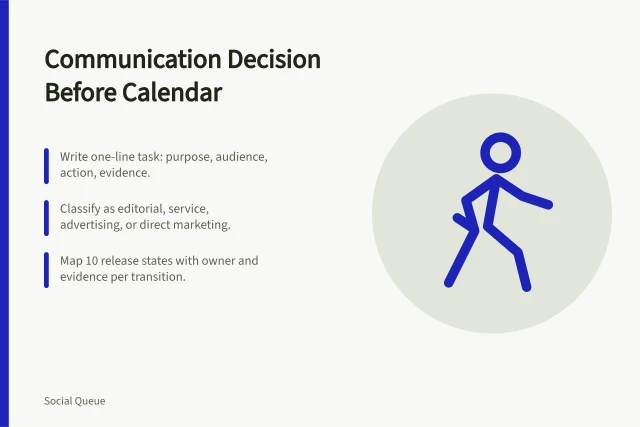
A quota says nothing about the intended audience, purpose or necessary evidence. Define the communication first. The ICO's direct-marketing planning guidance shows that purpose, necessity, fairness, data source and channel affect the analysis. Timing cannot settle those questions.
2. Treating platform use as buyer or audience proof
Ofcom's April 2026 adult media-use findings concern UK adults in a stated survey population. They do not identify an organisation's England audience, purchasing intent or response to scheduled content. Research the actual service population.
3. Assuming platforms schedule the same way
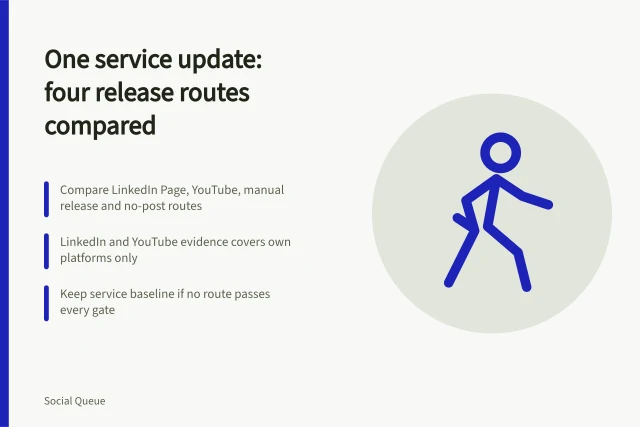
LinkedIn's Page scheduling record specifies role, window and content restrictions for Pages. YouTube's scheduled video page uses a different publication and timezone process. A shared calendar does not remove these service-specific limits.
4. Approving advertising without the final context
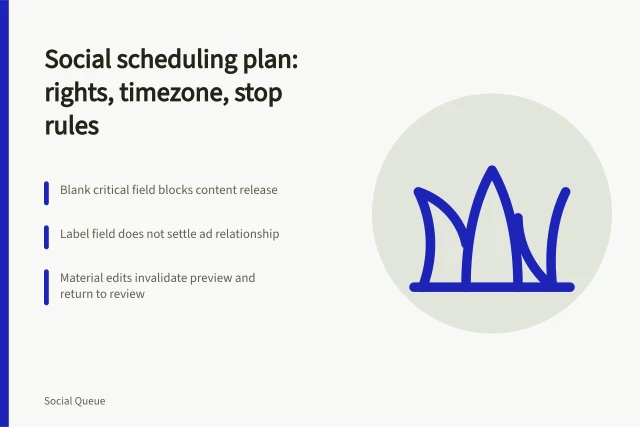
A content label stored in a plan may render poorly or lose prominence. The ASA's August 2026 guidance on recognising social-media ads treats identification and placement as contextual. Preserve substantiation, relationship, label and final preview, with qualified review.
5. Sharing credentials to keep the queue moving
Shared passwords weaken accountability and make leaver control harder. The NCSC's social-media publishing guidance supports organisational oversight and access protection. Assign individual roles, protect administrators and rehearse recovery instead.
6. Reusing assets without renewed checks
An old image or clip may have a limited licence, expired claim or inaccessible output. GOV.UK's copyright-use guidance outlines permission, ownership and exception routes. W3C's WCAG overview supplies technical accessibility criteria, but the final platform rendering still needs testing.
Use the list as a release review
For each item, name the affected communication, evidence owner, source date, corrective action. Close a mistake only when the new control is observed on the exact workflow.
Replacing a shared password with named roles still requires a leaver test and an account-recovery owner, and adding alternative text to a source file still requires inspection of the final platform output.
Track exclusions as well. A cancelled item, unavailable platform or withdrawn approval should not vanish from the record merely because it never reached the scheduled state. Those events may reveal why the strategy needs a fallback or a narrower purpose.
Record each finding as pass, fail or unknown. Stop release for an unresolved critical issue instead of balancing it against a fuller calendar or a claimed engagement benefit.
Before you act
- Define the communication before setting any posting quota.
- Research the actual service population rather than relying on platform use.
- Check each platform's scheduling rules for roles, windows and timezones.
- Preserve substantiation, relationship, label and final preview for ads.
- Assign individual roles and protect administrators instead of sharing passwords.
- Renew checks on old assets for licence, claims and accessibility.
Common questions
Why is starting with a posting quota a mistake?
A quota says nothing about the intended audience, purpose or necessary evidence. The ICO's direct-marketing planning guidance shows that purpose, necessity, fairness, data source and channel affect the analysis. Timing cannot settle those questions, so the communication must be defined first.
Can platform use statistics prove who my audience is?
No. Ofcom's April 2026 adult media-use findings concern UK adults in a stated survey population. They do not identify an organisation's England audience, purchasing intent or response to scheduled content. Research the actual service population instead of assuming platform use equals buyer or audience proof.
What should I do about shared credentials for scheduling?
Shared passwords weaken accountability and make leaver control harder. The NCSC's social-media publishing guidance supports organisational oversight and access protection. Assign individual roles, protect administrators and rehearse recovery instead of sharing credentials to keep the queue moving.