Measurement
Part of Social scheduling measurement with five evidence layers kept separate
Testing a social scheduling benchmark for population, definitions and false precision
Research social scheduling benchmarks without inventing thresholds by testing population, geography, definitions, periods, methods, bias and comparability.
Social media scheduling benchmark research often fails before comparison begins. Two reports may use the same metric name while covering different platforms, users, paid activity, dates or event rules. Do not average incompatible evidence.
This article does not publish an England benchmark. The defined source review found no authoritative figure for a comparable population of organisations in England using scheduling tools under one stable metric specification.
What to take away
- Do not average reports that share a metric name but cover different platforms, users, dates or event rules.
- No authoritative England benchmark exists for organisations using scheduling tools under one stable metric specification.
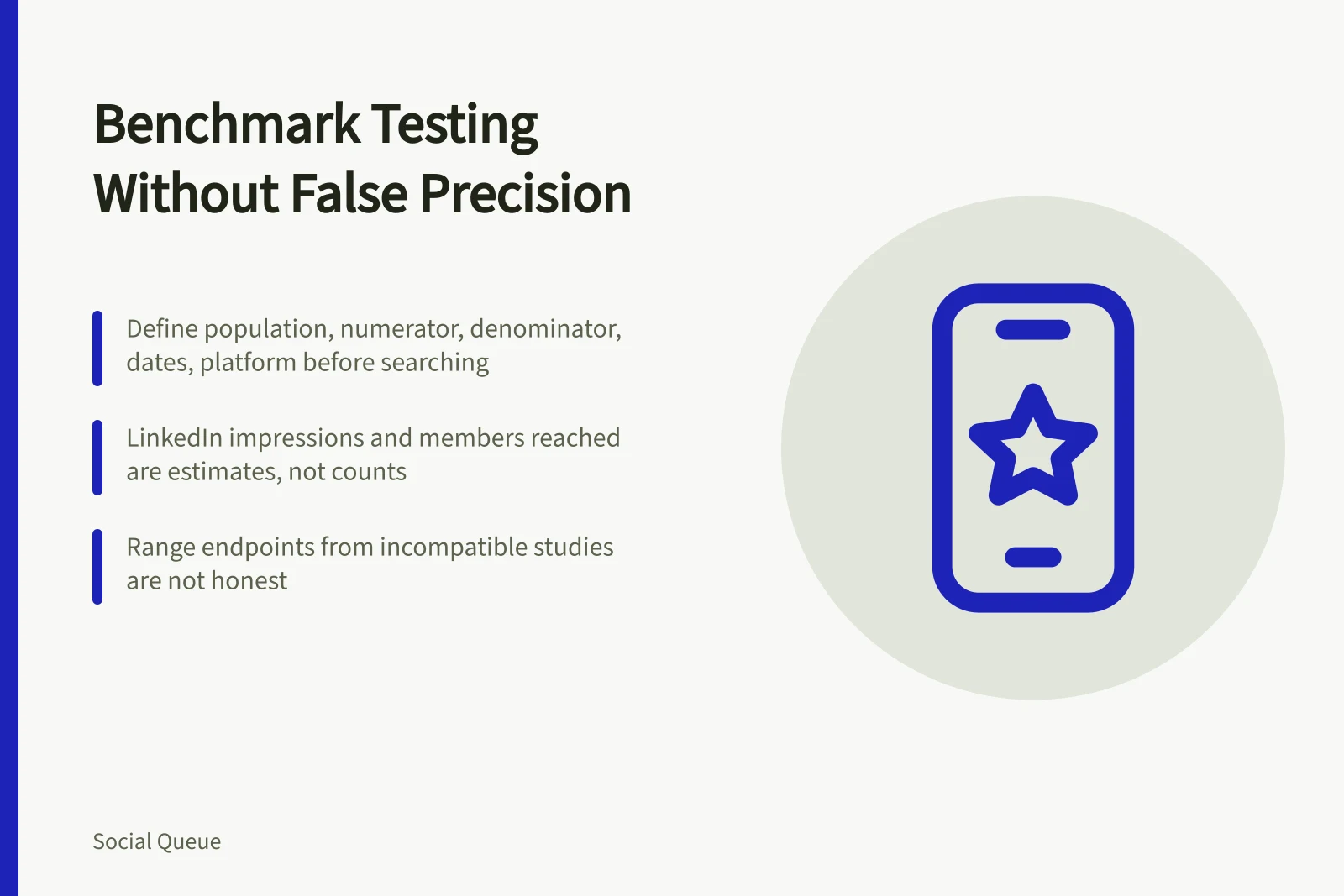
- Define the population, numerator, denominator, dates and platform surface before searching for any benchmark.
- A range is not automatically honest if its endpoints come from incompatible studies.
- Where no candidate meets the evidence grid, the correct benchmark field is not established.
Define the target before searching
Write a benchmark request with these fields:
Define the target
- decision and metric event;
- eligible population and geography;
- numerator, denominator and unit;
- date range and timezone;
- organic, paid or combined scope;
- platform surface and product definition;
- inclusions, exclusions and missing-data rule;
- collection or sampling method;
- uncertainty, owner and expiry trigger.
For a rate, preserve both counts. For a platform count, write denominator: not applicable. If the question is about England, a UK source is contextual evidence unless it provides a valid England breakdown.
ONS describes quality as fitness for purpose. Its dimensions include relevance, accuracy, timeliness, clarity, coherence and comparability. ONS quality and methodology information is designed to explain data strengths, methods and limits. These official-statistics practices are useful tests, not evidence that a private benchmark has official status.
Record the search and source population
The review for this draft was conducted on 6 September 2026. It included current UK official evaluation and statistical-quality guidance plus first-party platform definition pages. It excluded unsourced league tables, figures without numerator and denominator, inaccessible methods, mixed geographies presented as England and vendor summaries that did not define the contributing population.
For every candidate, record publisher, access date, field dates, geography, unit of observation, recruitment or data-contribution route, sample or record count, weighting, paid or organic status and revision policy. A publisher's large dataset can still be unsuitable if participation is selective or the event definition differs.
The Office for Statistics Regulation's Code of Practice sets standards for official statistics. Voluntary use of its source, method and limitation questions can expose comparability gaps, but it does not certify a supplier report.
Test platform definitions directly
LinkedIn's Page content analytics record, checked on the research date, calls impressions and members reached estimates and gives product-specific interaction rules. An impression rate from another platform cannot be placed beside it unless event, population and denominator genuinely match.
Supplier definitions can also change. Save the page capture or evidence record permitted by its terms, note the product surface and add an expiry trigger. If the definition changed during the comparison period, report a series break instead of a trend.
Reject false precision
The Government Analysis Function's guidance on quality and uncertainty recommends explaining bias, methods, adjustments and what can be concluded. A range is not automatically honest if its endpoints come from incompatible studies.
Benchmark evidence should also remain separate from causal evidence. HM Treasury's 2026 Magenta Book distinguishes monitoring from impact evaluation. An external engagement rate does not show what scheduling caused for the reader's organisation.
Use an internal reference when external evidence fails
Freeze one metric card and collect a stated local period. Retain missing records, definition versions and operational changes. Summarise the distribution only when the population is stable enough for the intended decision and privacy review permits the segmentation.
An internal reference is not an England norm or a forecast. Use it to investigate an unusual process change, then retire or reset it when the platform, workflow, audience or event definition changes. Where no candidate meets the evidence grid, the correct benchmark field is not established.
Before you act
- Write the benchmark request fields before searching.
- Record publisher, access date, field dates, geography and unit of observation.
- Preserve both counts when reporting a rate.
- Check platform definitions directly and note the product surface.
- Keep benchmark evidence separate from causal evidence.
- Freeze one metric card and collect a stated local period.
Common questions
Why can two reports use the same metric name but not be comparable?
They may cover different platforms, users, paid activity, dates or event rules. The article says social media scheduling benchmark research often fails before comparison begins for this reason. It advises against averaging incompatible evidence and says an impression rate from another platform cannot sit beside LinkedIn's unless event, population and denominator genuinely match.
What should you do if a platform definition changes during the comparison period?
Report a series break instead of a trend. The article notes that supplier definitions can change, so you should save the page capture or evidence record permitted by its terms, note the product surface and add an expiry trigger. If the definition changed during the comparison period, a trend would be misleading.
When should an internal reference be retired or reset?
When the platform, workflow, audience or event definition changes. The article says an internal reference is not an England norm or a forecast, and should be used to investigate an unusual process change. It should only be summarised when the population is stable enough for the intended decision and privacy review permits segmentation.