Measurement
Part of Social scheduling measurement with five evidence layers kept separate
Five social scheduling metrics defined down to timezone, exclusions and uncertainty
Define social scheduling metrics for England with complete event, population, denominator, period, timezone, source, exclusion and uncertainty fields.
Useful social media scheduling key metrics start with delivery integrity, then move to platform observations and the organisation's own outcomes. Keep those levels apart. A platform count is not an England market statistic, and a tagged outcome is not proof that a post caused it.
Before calculating anything, complete these fields: event, eligible population, numerator, denominator, unit, date range, timezone, exclusions, source system, query or export version, owner and uncertainty. Write not applicable for a count's denominator.
What to take away
- Keep process metrics separate from platform counts and organisation outcomes.
- Define every metric with event, population, numerator, denominator, unit, timezone, exclusions, source and uncertainty.
- LinkedIn impressions are estimates and not comparable to other platforms or England population figures.
- Attribution ratios show model-assigned contribution, not causal return, as QPIE guidance explains.
- Set decision thresholds from your own objective, risk and evidence, not industry averages.
Metric 1: due-item release match
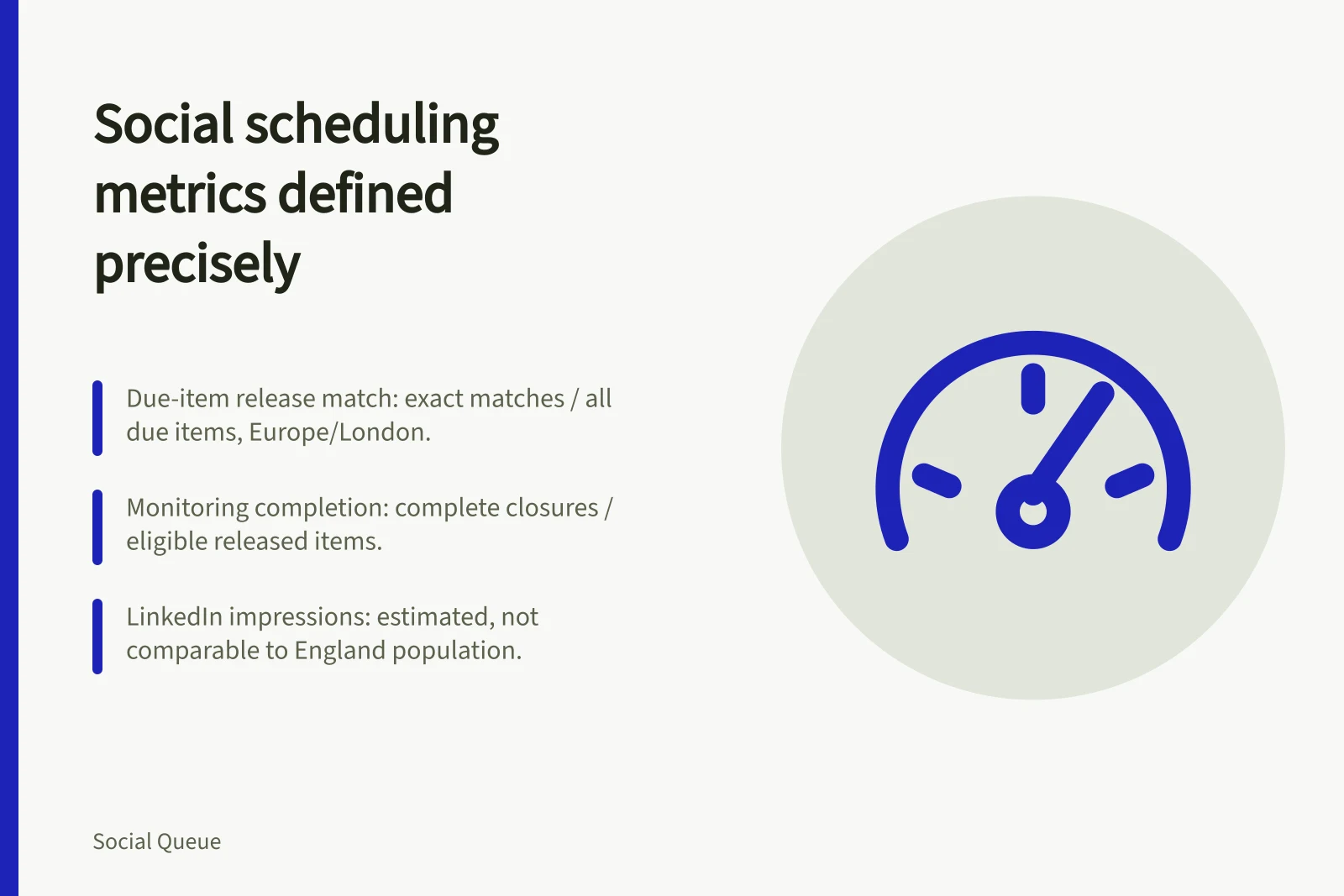
Event: a live item matches the approved revision, account, audience and scheduled time. Population: all items due in the reporting period. Numerator: exact matches. Denominator: all due items, including failures. Unit: percentage with both counts. Period and timezone: stated dates in Europe/London. Exclusions: items formally withdrawn before the due time, reported separately. Source: approval record, scheduler log and live capture. Owner and uncertainty: operations analyst; missing captures and timestamp differences are disclosed.
Release Match Formula
release match = exact live matches / eligible due items x 100
Numerator: exact matches
Denominator: all due items, including failures
Exclusions: withdrawn items, reported separately
Blank formula: release match = exact live matches / eligible due items x 100.
Metric 2: monitoring completion
Event: the required monitoring record closes with evidence and unresolved issues. Population: released items assigned a monitoring window. Numerator: complete closures. Denominator: eligible released items. Unit: percentage and counts. Period and timezone: window start and end in Europe/London. Exclusions: cancelled items that never went live. Source: publication and monitoring registers. Owner and uncertainty: duty editor; lost access or unavailable logs remain missing, not assumed complete.
Monitoring Completion Checklist
- Eventmonitoring record closes with evidence
- Populationreleased items with monitoring window
- Numeratorcomplete closures
- Denominatoreligible released items
- Exclusionscancelled items never went live
- Uncertaintylost access or logs remain missing
These two measures describe the operating process. They say nothing about audience response.
Metric 3: LinkedIn Page impressions
Event: an impression under the LinkedIn content-analytics definition current at export. Population: the exact Page posts, audience settings and organic or sponsored scope selected. Numerator and denominator: not applicable. Unit: estimated impressions. Period and timezone: export dates and recorded supplier or account timezone. Exclusions: any surfaces or delayed data omitted by the product record. Source: saved export and definition capture. Owner and uncertainty: reporting analyst; supplier estimation, processing delay and definition change are flagged.
Impressions vs Members Reached
Impressions
- Definition
- Estimated views
- Supplier
- LinkedIn estimate
- Coverage
- Page analytics
- Use
- Not population
Members reached
- Definition
- Unique members
- Supplier
- LinkedIn estimate
- Coverage
- Campaign Manager
- Use
- Not population
LinkedIn's current Page content record, checked on 6 September 2026, describes impressions as estimates and distinguishes them from members reached. It also notes coverage differences between Page analytics and Campaign Manager. Do not apply these definitions to another platform or infer an England population from them.
Metric 4: eligible destination action rate
Event: a tagged visitor completes the pre-defined eligible action in the destination service. Population: sessions arriving through included scheduled-post identifiers. Numerator: valid completed actions within the outcome window. Denominator: eligible tagged sessions. Unit: percentage with counts. Period and timezone: cohort entry dates and Europe/London cut-off. Exclusions: staff tests, stated bot rules, duplicates, untagged traffic and unavailable observations. Source: versioned destination query and campaign-key table. Owner and uncertainty: service analyst; cross-device loss and tracking choices limit coverage.
The ICO's final storage and access technologies guidance covers analytics, link decoration and advertising measurement. A qualified practitioner should assess the real technology and purpose. Do not broaden collection simply to improve a dashboard.
Metric 5: attributed contribution ratio
Event: a finance-approved outcome contributes value under a named attribution rule. Population: eligible recognised outcomes credited in the period. Numerator: observed contribution after stated reversals, in GBP. Denominator: full economic cost for the same scope, in GBP. Unit: ratio. Period and timezone: finance period and cut-off. Exclusions: documented taxes, transfers or costs outside scope. Source: governed finance ledger plus attribution output. Owner and uncertainty: finance owner; attribution and causal impact remain distinct.
Blank formula: attributed contribution ratio = credited observed contribution / full economic cost.
HM Treasury's QPIE guidance explains why monitoring a changed outcome does not show that an intervention caused it. Report this ratio as model-assigned contribution, never causal return. Set decision thresholds from the organisation's objective, risk and observed evidence, not an unsupported industry average.
Before you act
- Complete all metric definition fields before calculating.
- Separate process, platform and outcome metrics.
- Check platform definitions at export date.
- Exclude staff tests, bots and untagged traffic.
- Report uncertainty and missing data.
- Do not treat attribution as causation.
Common questions
What fields must be completed before calculating any metric?
The article lists event, eligible population, numerator, denominator, unit, date range, timezone, exclusions, source system, query or export version, owner and uncertainty. Write not applicable for a count's denominator. These fields ensure the metric is fully defined and comparable.
Why should LinkedIn Page impressions not be used as an England market statistic?
LinkedIn's current Page content record describes impressions as estimates and distinguishes them from members reached. It also notes coverage differences between Page analytics and Campaign Manager. The article says do not apply these definitions to another platform or infer an England population from them.
How should the attributed contribution ratio be interpreted?
Report it as model-assigned contribution, never causal return. HM Treasury's QPIE guidance explains why monitoring a changed outcome does not show that an intervention caused it. Set decision thresholds from the organisation's objective, risk and observed evidence, not an unsupported industry average.