Operations
Part of Social media scheduling for local businesses UK needs a local approach
Social media scheduling for local businesses UK needs a local approach
Local scheduling for UK high street shops, cafes and trades: location fields, Google Business Profile posts, claims, data protection and what to measure.
What to take away
- Local scheduling starts with a location list, not a content calendar.
- Google Business Profile posts, grid posts and service-area updates have different lifetimes and need different rules.
- The scheduler should hold the town, branch and service radius for every post it publishes.
- One named person should own local pages and the evidence behind every claim.
- Report on calls, direction requests and enquiries rather than impressions alone.
Local demand does not arrive on a national calendar
National scheduling assumes one audience and one voice. A high street shop serves a patch: a few streets, a town centre, sometimes a delivery radius. Someone searching on a phone at 8am wants opening times, parking and whether a table is free today. A calendar that publishes generic brand content at 10am misses that window.
Local scheduling runs query first, location second, post third. Publish time is the last decision, not the first.
Build the location layer before the calendar
Three records do most of the work, and they belong in the scheduler rather than in someone's memory.
Three location records to build
- Location listbranch, address, hours, radius
- Page mappost to Google Business Profile
- Enquiry logcalls, messages, forms, walk-ins
- Tag every enquiry to a branch
- Carry branch field into content calendar
Build the location layer
- A location listbranch name, address, opening hours and service radius.
- A page mapwhich Google Business Profile each post targets.
- An enquiry logcalls, messages, form fills and walk-ins, tagged to a branch.
A post that says "open late tonight" should not go to every profile you own. With a location field, that same post becomes a decision about one branch. Once the location list exists, a content calendar template can carry the branch field next to the caption, so nobody rebuilds it each week.
A five-step local scheduling routine
Five-step local scheduling routine
- Review last week's local queries and enquiries before drafting anything.
- Write one post for each location that has real news, and skip the quiet ones.
- Set the branch, the target profile and the end date before the caption.
- Check the price, the claim and the image rights against your evidence file.
- Publish, then log the outcome against the branch rather than the account.
Step three is where national tools fall down, because location sits in a tag rather than a required field. Keep the routine in the tool itself, so the steps become fields rather than a document nobody opens.
Five-step local scheduling routine
- Review last week's local queries and enquiries
- Write one post per location with real news
- Set branch, profile and end date first
- Check price, claim and image rights
- Publish and log outcome against branch
The local post types and their lifetimes
Local post types and lifetimes
| Post type | What it is for | Shelf life in practice | Scheduler rule |
|---|---|---|---|
| Google Business Profile update | Answering today's question | Short, refresh weekly | Date-stamp it |
| Google Business Profile offer | A dated promotion | Until the stated end date | Set start and end dates |
| Instagram or Facebook grid post | The shop's character | Weeks | Reuse images only if rights allow |
| TikTok or Reels clip | Showing the work or product | Short | Keep the location in the caption and on screen |
| Service-area update for a trade | Confirming coverage | Months | Pin it and re-check the radius |
Local planning benefits from real local numbers. ONS publishes business population and industry data under its business, industry and trade theme, so you can check how many firms trade in your sector before you assume a market exists.
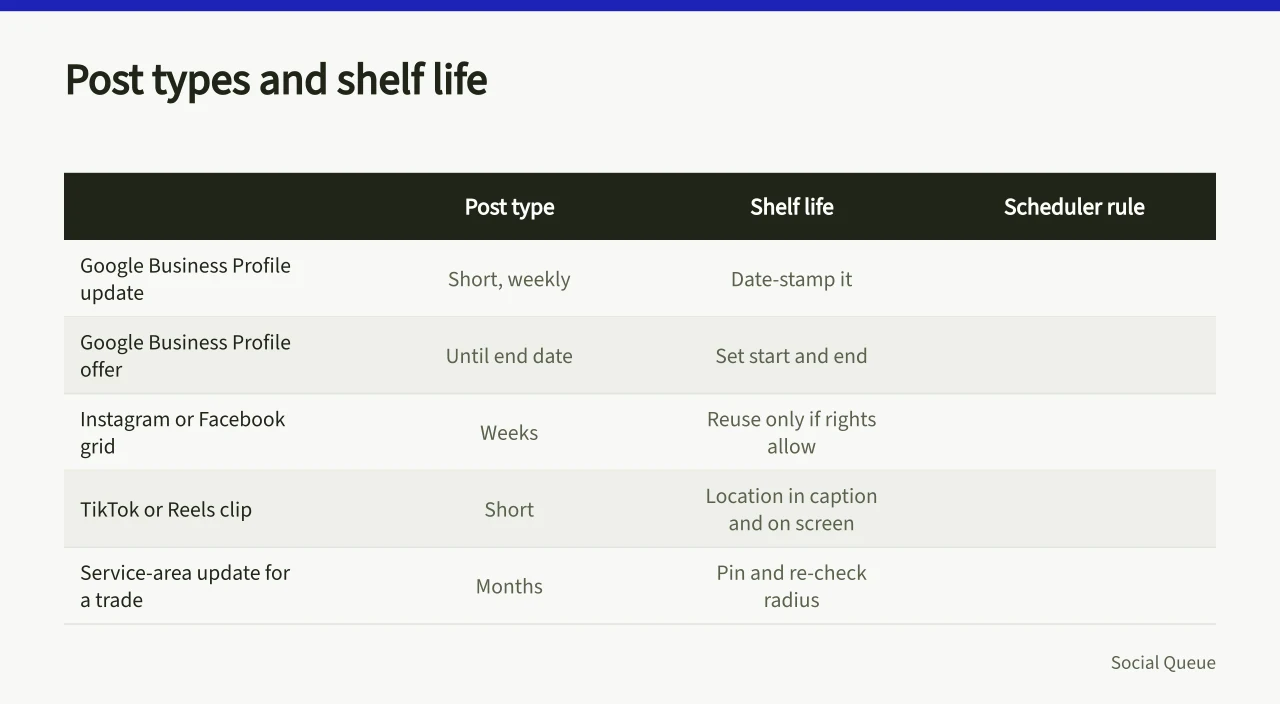
Match the tool to the lifetime. A profile post and a pinned service-area update should not sit in the same content bucket.
Data protection and advertising claims
Local posts often carry customer photos, staff names and reviews. Small businesses handling that material can start with the ICO's advice for small organisations, which covers lawful basis, retention and subject requests in plain terms.
Anything you publish as an offer is advertising. The ASA's advertising codes page is the reference for misleading pricing, availability and comparison claims, and it applies to a two-line post as much as to a poster.
Measure the patch, not the account
A single account-level report hides which branch is working. Split the dashboard by location and give each branch three numbers: profile calls, direction requests and enquiries that staff can trace back to a post. Anything else is context.
Review monthly, not weekly, for anything slower than opening hours. A cafe's lunch trade responds to same-day posts; a plumber's quote pipeline takes weeks. Matching the review cycle to the sales cycle stops you closing a channel that has not had time to work.
Common questions
Does Google Business Profile schedule posts itself?
It does, in the profile itself and one location at a time. A business with four branches repeats the same job four times, which is why many local teams draft once and publish across profiles from a single calendar.
Is a free scheduler enough for a local shop?
Often it is, at least until you need location fields, approval or a second profile. A free scheduler for a small business can cover one branch well; the limit arrives when you add a second site or a franchise rule.
Should local posts follow a national calendar?
Partly. Brand campaigns, seasonal sales and recruitment can run centrally. Opening hours, weather, stock and service-area news should be decided locally, because a head office rarely knows that a road is closed.
How far ahead should a local calendar run?
One to two weeks for time-sensitive posts, a month for seasonal campaigns. Anything planned further out is usually rewritten before it publishes.