Tools and providers
Part of Social scheduling tools chosen on the whole service rather than the headline plan
Selecting social scheduling software with a reversible trial and separate gates
Select social scheduling software through a defined England workflow, dated evidence, synthetic tests and independent privacy, security and exit gates.
Social media scheduling software selection starts with a release process the buyer can describe and test. A useful specification names the social accounts, content types, approvers, emergency pause owner, records and exit route. It does not begin with a supplier score.
What to take away
- Define who may draft, approve, schedule, amend, publish and delete for every platform and account type.
- Turn each requirement into a testable event with timestamped evidence, not a sales demonstration.
- Collect the exact plan's product schedule, order form, terms, data-processing agreement, sub-processor list, security material, accessibility report, support policy and export or deletion procedure.
- Keep decision gates separatefunctional fit, privacy and PECR, security, accessibility, advertising and consumer claims, intellectual property, employment, contract, procurement, tax and continuity.
- Make the trial reversible with invented posts and synthetic accounts, then finish with a signed decision record.
Write a testable requirement
For every platform and account type, define who may draft, approve, schedule, amend, publish and delete. Add the Europe/London timezone, required media formats, accessibility checks, claim evidence, rights records and correction path. State what the software must not do, such as placing regulated claims without specialist approval or retaining sensitive inbox material unnecessarily.
Synthetic Test Event Flow
- Editor creates synthetic content
- Independent approver rejects it
- Editor changes it
- System records both decisions
- Incident owner pauses queue
- Timestamped record and recovery
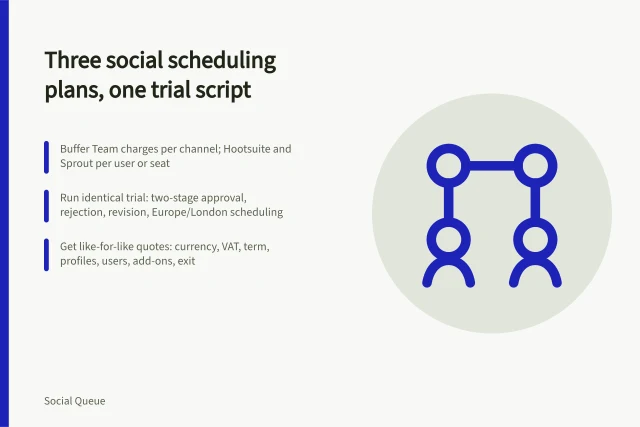
Turn each requirement into an event. For example, an editor creates synthetic content, an independent approver rejects it, the editor changes it, the system records both decisions, and an incident owner pauses the queue. The pass evidence is a timestamped record and successful recovery, not a sales demonstration.
The NCSC treats a scheduling service as an important route into organisational social accounts in its guidance on protecting what organisations publish. Buyers should therefore test individual access, multi-factor authentication where offered, least privilege, offboarding and recovery. Supplier documentation is evidence to inspect, not proof that the chosen configuration is safe.
Build the evidence pack
For the exact plan offered, collect its product schedule, order form, terms, data-processing agreement, sub-processor list, security material, accessibility report, support policy and export or deletion procedure. Record the legal entity, version, publication or access date, geography and any mismatch between marketing copy and contract.
Evidence Pack Checklist
- Product schedule
- Order form
- Terms
- Data-processing agreement
- Sub-processor list
- Security material
- Accessibility report
- Support policy
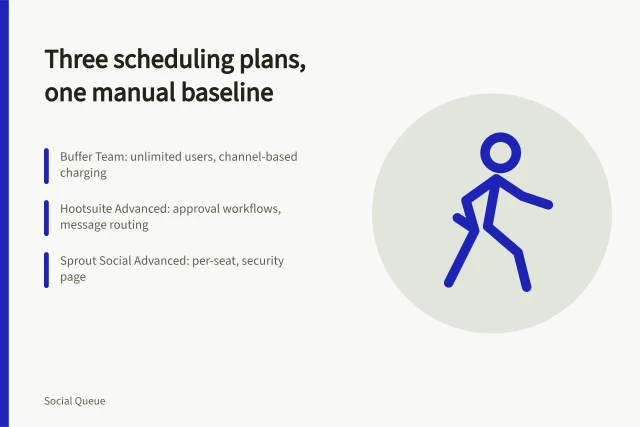
Plan names alone are inadequate. Buffer's first-party plan record, for instance, distinguishes Free, Essentials and Team through users, channels and other limits. The existence of a Team feature does not establish the same feature in Essentials or its suitability for a buyer in England. Capture the actual edition and quote rather than citing "Buffer" generally.
Map every personal-data operation: ICO says controller and processor roles depend on who decides purposes and means. Its contract guidance covers instructions, confidentiality, security, sub-processors and assistance. It covers deletion.
The guidance is under review after the Data (Use and Access) Act, so a named UK data-protection lawyer must check the current position. Direct messages, targeting and audience imports need separate PECR and UK GDPR analysis.
Keep decision gates separate
Use pass, fail or unresolved for each gate: functional fit, privacy and PECR, security, accessibility, advertising and consumer claims, intellectual property, employment, contract, procurement, tax and continuity. A lower cost cannot erase an inaccessible authoring task, missing export or unacceptable transfer.
Where content may be advertising, test the final preview and evidence chain. CAP guidance on recognising social-media ads stresses that identification depends on how the audience encounters the material. A platform label is not automatic clearance.
Make the trial reversible
Use invented posts and synthetic accounts where platform rules permit. Test role changes, a lost credential, rejected content, timezone handling, failed publication, corrected copy, rights expiry, queue suspension, export and deletion. Do not import customer or worker data merely to make the trial realistic.
Finish with a signed decision record: exact edition, evidence date, unresolved questions, failed gates and total-cost units. Add contract owner, launch authority and stop conditions; if no candidate passes, preserve the documented manual process and revisit the market later.
This article is general procurement information, not legal, security, accessibility, tax or financial advice. Named metadata specialists must review the real purchase before publication and commitment.
Before you act
- Name the social accounts, content types, approvers, emergency pause owner, records and exit route.
- Define who may draft, approve, schedule, amend, publish and delete for each platform and account type.
- Turn each requirement into an event with timestamped pass evidence and successful recovery.
- Collect the exact plan's product schedule, order form, terms, data-processing agreement and sub-processor list.
- Use pass, fail or unresolved for each separate decision gate.
- Test role changes, lost credentials, rejected content, timezone handling, failed publication, corrected copy, rights expiry, queue suspension, export and deletion.
Common questions
What should a testable requirement cover for social scheduling software?
For every platform and account type, define who may draft, approve, schedule, amend, publish and delete. Add the Europe/London timezone, required media formats, accessibility checks, claim evidence, rights records and correction path. State what the software must not do, such as placing regulated claims without specialist approval or retaining sensitive inbox material unnecessarily.
How should buyers treat supplier documentation and plan names?
Supplier documentation is evidence to inspect, not proof that the chosen configuration is safe. Plan names alone are inadequate. Capture the actual edition and quote rather than citing a brand generally. The existence of a feature in one plan does not establish the same feature in another plan or its suitability for a buyer in England.
What should a reversible trial include and how should it end?
Use invented posts and synthetic accounts where platform rules permit, and test role changes, a lost credential, rejected content, timezone handling and failed publication. Test corrected copy, rights expiry, queue suspension, export and deletion; never import customer or worker data for realism.
Finish with a signed decision record covering exact edition, evidence date, unresolved questions, failed gates. Record total-cost units, contract owner, launch authority and stop conditions.