Tools and providers
Part of Social scheduling tools chosen on the whole service rather than the headline plan
Implementing a social scheduling tool in controlled stages, with failure rehearsed first
Implement a social scheduling tool through synthetic tests, controlled access, evidence-led approvals, incident rehearsal, staged release and a proven exit route.
Social media scheduling tool implementation should be reversible until the buyer can prove access, approval, pause and recovery. Begin in an isolated workspace with synthetic content. Do not connect every live account on the first day.
What to take away
- Start scheduling tool work in an isolated workspace with synthetic content, not live accounts.
- Reversible access, approval, pause and recovery must be proven before any wider rollout.
- Named owners must approve privacy, security, accessibility, IP, tax and continuity gates separately.
- Rehearse failed publication, compromised users and platform outages before releasing live content.
- Expand to live accounts only after the operational record shows correct approvals, logs and recovery.
1. Freeze the agreed scope
Record the supplier's legal entity, exact plan, order and terms version. List users, roles, social platforms, account types, content classes, add-ons, integrations, data fields, timezone and excluded activities. Keep the accepted test evidence with the configuration baseline.
Set independent owners for privacy and PECR, security, accessibility, advertising and consumer claims, IP, employment, contract, tax and continuity. Software availability does not approve any of those gates. The ICO's direct marketing guidance must be applied to the actual communication and data route, not treated as a generic social-media permission.
2. Configure identities before content
Create named user accounts, apply least privilege and enable the agreed authentication controls. Keep recovery credentials outside the everyday publishing path. Connect one test social account, confirm the token owner and record how access is revoked.
The NCSC's guidance on protecting organisational social-media publishing highlights the need to secure social-media management tools because of their publishing authority. Use that as a control prompt, then verify the selected edition. Sprout Social, for example, publishes an application security record with hosting and control statements; that supplier record does not prove a buyer's configuration has been secured.
3. Build an evidence-led workflow
Require every draft to carry its owner, purpose, audience, platform, content type, rights record, claim source, advertising classification, accessibility evidence, approval and expiry. A direct message, paid creator post and service notice should not share one automatic route.
Test a rejection, amendment and urgent correction. Preview the final platform rendering, including disclosure placement and alternative text. CAP's advice on recognising social-media advertising focuses on what people can recognise in context. A field completed in the scheduler does not show that the final post meets that expectation.
4. Rehearse failure and exit
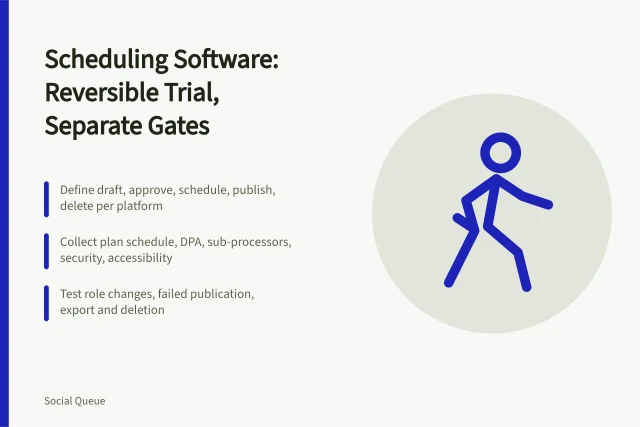
Schedule invented material across a Europe/London clock change. Simulate a failed publication, removed approver, compromised user and platform outage. Prove that the incident owner can pause all queues, preserve evidence, revoke access and switch to the manual release route.
Export users, roles, future content, assets and available audit history, then test whether the files are intelligible without the supplier and check the agreed deletion route. Distinguish cancelling a subscription from removing data or already published posts.
Buffer's support page on cancellation and account deletion says published posts remain on the social networks. Platform-side cleanup belongs in the exit procedure.
5. Release in controlled stages
Approve one low-risk account and a narrow content class first. Set monitoring owner, evidence period, stop events and rollback steps. Expand only after the operational record shows correct approvals, accessible output, expected logs and successful recovery. Do not replace observation with supplier case studies or imagined time savings.
At handover, store configuration version, role matrix, content templates, processor records and sub-processor records.
Store assurance expiry, support contacts, renewal date, export pack and deletion instructions.
Schedule reviews after staff departures, plan changes, new networks, API changes and incidents. Legal or regulatory updates trigger review.
Qualified UK specialists must approve their gates before live use: implementation information, not a compliance, security, accessibility or performance claim.
Before you act
- Freeze the supplier entity, plan, terms and excluded activities.
- Create named accounts with least privilege and recovery credentials outside publishing.
- Require every draft to carry owner, purpose, rights and approval.
- Schedule invented material across a clock change and simulate failures.
- Export users, content, assets and audit history for intelligibility.
- Release one low-risk account and narrow content class first.
Common questions
What should be tested before connecting live social accounts?
Begin in an isolated workspace with synthetic content and connect one test social account. Confirm the token owner and record how access is revoked. Rehearse failed publication, removed approver, compromised user and platform outage. Prove the incident owner can pause queues, preserve evidence, revoke access and switch to manual release.
How should approval and content evidence be handled?
Require every draft to carry owner, purpose, audience, platform, content type, rights record, claim source, advertising classification, accessibility evidence, approval and expiry. A direct message, paid creator post and service notice should not share one automatic route. Test rejection, amendment and urgent correction, and preview final platform rendering including disclosure placement and alternative text.
What belongs in the exit procedure?
Export users, roles, future content, assets and available audit history, then test whether files are intelligible without the supplier. Check the agreed deletion route and distinguish cancelling a subscription from removing data or already published posts. Buffer's support page says published posts remain on the social networks, so platform-side cleanup belongs in the exit procedure.