Foundations
England's social scheduling market, with the unit fixed before anyone talks about size
Assess England's social scheduling market through clear category boundaries, official evidence limits, buyer tests and controlled entry decisions.
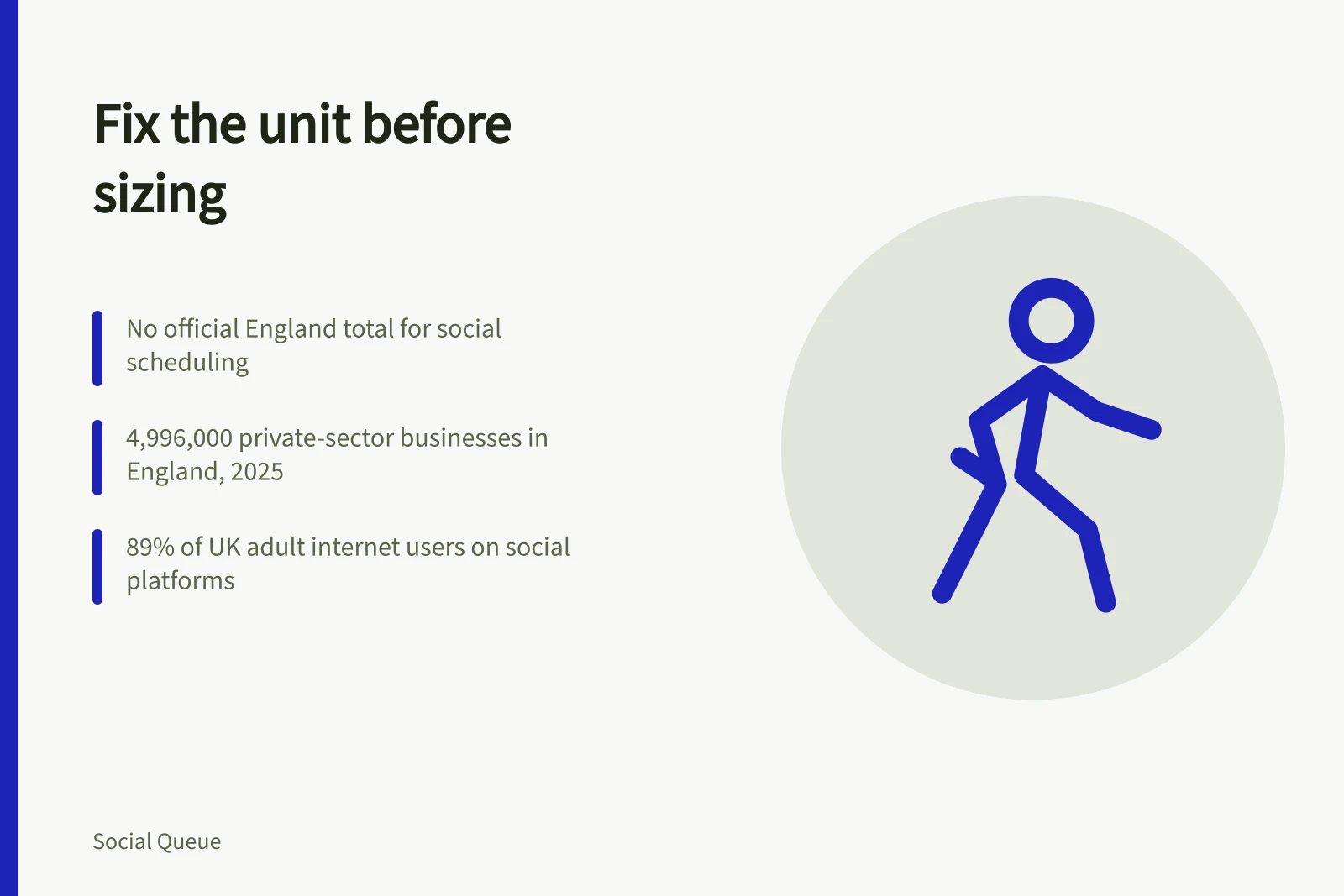
England has no official market total for social-media scheduling software or services. Business statistics describe firms; audience research describes media use. Neither records scheduler contracts, supplier revenue or buying intent.
A defensible 2027 assessment starts with a narrow category and tests one buyer problem. It does not turn a large national denominator into an invented sales forecast.
This guide defines social media scheduling as preparing approved content for automatic publication later via a platform's native control, separate software, a managed service or a custom connection.
It can include queues, approval states and publication records when part of the offer. It excludes media buying, general analytics, content creation and influencer fees unless a named proposition bundles them expressly.
The research cut-off is 6 September 2026. England is the operating context; UK evidence and global technical standards are labelled. These social media scheduling foundations remain on publication hold until named statistical, legal, data-protection, electronic-marketing, advertising, security, accessibility, intellectual-property, employment, commercial and tax reviewers approve their own areas.
What to take away
- England has no official market total for social-media scheduling software or services.
- Fix the unit firstuser, account and contract mean different things.
- Official business counts are context only, not an addressable market.
- Audience evidence shows platform use, not purchasing authority or buying intent.
- Map the whole publishing process, since approval is often the bottleneck.
Fix the unit before discussing a market
The word "user" can refer to an audience member, a staff publisher or a paid software seat. The word "account" can mean a platform identity, a connected profile or a customer contract. Combining those units produces impressive but unusable figures.
| Unit | What it represents | Evidence needed | Frequent mistake |
|---|---|---|---|
| Operating organisation | an entity carrying out the relevant work under the chosen England rule | legal identity, location basis and current workflow | counting every business as a buyer |
| Publishing account | a controlled social profile or page | platform, owner, role and account status | treating several profiles as several customers |
| Authorised publisher | a person permitted to prepare, approve or release content | current role and access record | assuming every employee needs a paid seat |
| Supplier contract | an exact product or service order | edition, users, connected accounts, usage, term and services | equating a free profile with paid demand |
| Audience member | a person who may encounter a post | source population, date, geography and measurement method | calling reach a software purchase |
An England branch may use a contract bought abroad, while a business headquartered in England may manage accounts for several countries. A market study must choose whether geography follows the buyer, contracting entity, publisher, audience or service delivery. Each choice answers a different question.
Use official business counts as context only
The Department for Business and Trade estimated 4,996,000 private-sector businesses in England at the start of 2025. Its business population statistical release assigns each organisation to its head-office location.
It includes estimated unregistered businesses and excludes government and non-profit activity from the main measure, and DBT publishes a 95% confidence interval for England extending 117,000 in either direction.
This is not an addressable market. Many firms have no recurring social-publishing task. Others rely on native controls, a parent organisation or a current supplier. Some will not target an audience that can be responsibly reached on social media.
DBT's methodology note explains successive totals cannot infer business births or closures. They cannot serve as a shortcut to new-scheduler demand either.
For a registered-business frame, the Office for National Statistics publishes UK business activity, size and location for 2025. It draws on the Inter-Departmental Business Register and separates enterprises from local operating units. Its quality and methodology information notes that the register is built mainly from VAT and PAYE sources, so some very small non-employing activity is outside the frame.
Official industrial classification is also too broad to enumerate suppliers. Companies House's SIC guidance and condensed code list groups economic activities, not product editions or active contracts. Software developers, advertising services and consultants may appear under different codes, and each code includes work unrelated to scheduling. A supplier count needs a published inclusion method and entity-level verification.
Read audience evidence without converting it into demand
Ofcom's April 2026 Adults' Media Use and Attitudes release reported that 89% of UK adult internet users used at least one social platform. The quantitative tracker covered 7,533 UK adults aged 16 and over, with mixed-mode fieldwork from 29 September to 28 November 2025. The result concerns people, not England businesses or software accounts.
The same release reported a fall in posting and commenting against the previous year. This is a useful warning against a simple "more users means more scheduling" story.
Audience presence can justify research into a specified communications task, but platform, age and behaviour differences affect whether a scheduled post fits. Ofcom's measure does not observe purchasing authority, workflow difficulty or willingness to pay.
Treat audience data as one input to discovery. A buyer should still name the people it intends to reach, the purpose of the communication and the evidence that a particular platform is suitable. An audience percentage is not permission to process personal information or send direct marketing.
Define the work, including the awkward parts
Scheduling is only one state in a publishing process. A useful map starts when someone proposes content and ends after publication evidence, responses and incidents are handled. It should show:
- who supplied the brief and underlying claim evidence;
- who owns the text, images, audio and other rights;
- who classifies the communication and its intended audience;
- who checks accessibility, security and platform constraints;
- who approves the exact preview, timezone and release account;
- what confirms publication or records failure;
- who can pause the queue, correct a post and preserve the incident record.
This map often reveals that the bottleneck is approval, asset ownership or account recovery rather than calendar entry. A new tool may centralise work, but it may also introduce another supplier, data flow, administrator role and dependency. Compare it with the existing native or manual route on the same task.
Platform rules need direct evidence. LinkedIn's current Page scheduling guidance sets out which Page roles can schedule, a scheduling window and unsupported post types. YouTube documents a different scheduled video publication process, covering timezone behaviour and a restriction for accounts with a Community Guidelines strike.
These first-party records for those services do not prove an external tool can publish every format or keep the evidence a buyer needs.
Compare four delivery routes on the same case
The baseline is the current process, even if it is an editorial calendar plus native scheduling. A fair comparison holds the platforms, account types, content formats, volume, roles, period and acceptance tests constant.
Native controls may avoid a new supplier contract. The buyer still pays staff time and must coordinate approvals, access, failure checks and archives across platforms.
Subscription software may combine queues, roles and reporting. Evidence must identify the exact edition, connected-account and user limits, API dependencies, data locations, sub-processors, renewal terms, export and deletion. A public feature page is a supplier claim, not a successful test.
Managed service moves defined publishing tasks to a provider. The buyer retains responsibility for accurate briefs, timely approval and its own legal decisions. A statement of work should identify service hours, channels, volumes, named roles, subcontracting, failure handling, intellectual property and return of credentials.
Custom integration can fit a specialist workflow but creates engineering, hosting and maintenance work. Platform permission changes may remove a function. The buyer needs supported interfaces, versioned tests, monitoring, a rollback route and someone authorised to maintain or retire the connection.
The NCSC's cloud-provider selection collection provides questions about shared responsibility and supply chains. It does not certify a particular service. For commercial scope, the Small Business Commissioner's contract guide recommends recording parties, what is supplied, quantity, limitations, duration and payment. A qualified solicitor must review the actual contract and risk allocation.
Test demand through recent buyer evidence
A demand interview should begin with a specific recent publication, not a request for a feature wish list. Ask the participant to reconstruct the brief, asset source, edits, approvals, scheduled time, platform response and follow-up. Collect the artefacts only with an approved research and privacy process.
Classify findings carefully:
- a documented missed approval is an observed workflow failure;
- a manager's stated concern is a participant statement;
- the idea that software would fix it is an editorial hypothesis;
- an authorised budget and decision date are commercial evidence;
- a signed order is a purchase.
One case can expose a problem but cannot establish prevalence across England. Record the sampling frame, eligible population, recruitment route, dates, respondent roles, non-response and competing explanations. A useful demand signal survives review against the current process and has a person willing to own the change.
Keep publishing permission separate from timing
A queue does not determine a communication's lawfulness; the ICO's direct-marketing planning guidance covers social-media targeting and audience matching. It covers the need to define purpose, necessity, fairness, transparency and lawful basis.
Direct messages and similar electronic mail may engage PECR rules, and classification, subscriber type, collection route and objection evidence belong in a qualified review outside scheduler's status field.
Advertising is another decision. The ASA's August 2026 advice on recognising ads on social media explains that advertorial content must be identifiable and that labels need sufficient prominence in context. Approval should preserve the commercial relationship, claim substantiation, label, placement and final rendering. A platform's branded-content control cannot cure an inaccurate claim or settle legal obligations by itself.
Content rights must be checked before an item enters a reusable library. GOV.UK's guidance on using copyright material describes permission, ownership and applicable exceptions as possible routes. Store the source, owner, licence terms, territories, permitted media, expiry and evidence with the asset. Seek specialist advice where ownership or an exception is uncertain.
Treat access, accessibility and contracts as release gates
Several workers or suppliers may need limited access without sharing a platform password. NCSC guidance on protecting organisational social-media publishing covers oversight and security controls, while its small-organisation account advice includes social accounts among services that need protected sign-in and removal of unnecessary users. A buyer should rehearse leaver access, compromise, mistaken publication and account recovery.
Accessibility must be assessed in the authoring process and in final platform output. The W3C WCAG 2 overview sets a technical standard for perceivable, operable, understandable and strong web content. It does not certify a scheduler or prove a post works for disabled people.
Test representative text, alternatives, captions, contrast, focus order and error recovery with appropriate expertise and assistive technology.
Supplier relationships need role-specific review. If a service provider processes personal data, the real decisions and processing determine controller and processor positions. The ICO's contracts and liabilities guidance covers instructions, confidentiality, security, sub-processors, assistance, deletion and audits. The ICO marks parts of this material for review following the Data (Use and Access) Act 2025, so publication-day legal verification is mandatory.
Freelancer and agency labels do not conclusively determine employment status. Acas's April 2026 self-employment guidance says that the working relationship and what happens in practice matter. Employment and tax specialists should assess the proposed delivery arrangement instead of copying a label into the contract.
Price the whole route without inventing a benchmark
No public source reviewed for this guide provides a comparable England market price. A buyer's quotation sheet should leave amounts blank until evidence arrives, then capture:
Cost field / Required unit
- Supplier access
- exact edition, users, connected accounts, usage, currency and billing period
- Setup
- migration, configuration, permissions, integration and training hours
- Content operation
- internal and external roles, approved rate and evidenced time
- Assurance
- legal, privacy, security, accessibility, claims and rights review
- Failure and continuity
- monitoring, incident response, recovery and fallback work
- Exit
- export, deletion, credential return, transition and replacement service
Request GBP excluding VAT and GBP cash including VAT, and note HMRC's VAT rates guidance: most goods and services use the standard rate. The actual supply and recovery position depends on the invoice and buyer.
Qualified tax and finance review should settle treatment; do not compare one supplier's monthly licence with another route's full annual service or internal economic cost.
Run a small, reversible market-entry test
Choose one buyer group, one publishing workflow and no more than the platforms needed for that workflow. Before outreach, write the eligibility rule, research purpose, evidence to collect and retention decision. Do not upload contact lists or send promotional direct messages merely because a scheduling service can do so.
The first useful deliverable is a buyer evidence pack:
- recent workflow artefacts and the participant's role;
- current platform and supplier records;
- defined failure, cost and risk measures;
- a manual baseline and at least one alternative route;
- independent decisions for privacy, PECR, advertising, security, accessibility, rights, employment, contract and tax;
- a dated go, revise or stop decision with an owner.
Use synthetic content and non-production access for initial acceptance work. Test exact formats, timezones, approvals, permission changes, alerts, audit evidence, corrections, export and recovery. A result applies only to that configuration and test date.
Expansion should wait for repeated evidence from eligible buyers and a delivery process that can survive a platform change or supplier exit. Stop the proposition when buyers cannot reproduce the claimed problem, the native baseline meets the need, a critical gate fails, or the economics depend on an unsupported market assumption.
A practical next research decision
Write a one-page study protocol before commissioning a market model. It should name the category boundary, England geography rule, buyer and contract units, sampling frame, field dates, evidence hierarchy, exclusions and uncertainty. Give a second analyst enough information to reproduce the eligible-case count.
Only verified contracts or buyer-approved quotations should populate commercial fields. Audience statistics may explain why a communications task deserves investigation, but they remain outside revenue calculations. If the research cannot separate interest, use, account access and paid demand, retain the evidence gap and do not publish a market-size number.
Before you act
- Choose the unit before estimating any market size.
- Label England evidence separately from UK and global sources.
- Verify supplier inclusion methods at entity level.
- Map approval, rights and account recovery steps.
- Compare native, software, managed and custom routes on one case.
- Test the exact edition, limits and data terms.
Common questions
Why can't England's business population figures be used as a market size?
The Department for Business and Trade estimated 4,996,000 private-sector businesses in England at the start of 2025, but this is not an addressable market. Many firms have no recurring social-publishing task, rely on native controls or a parent organisation, or do not target a responsibly reachable social audience.
What does Ofcom's audience data actually measure?
Ofcom's April 2026 release reported that 89% of UK adult internet users used at least one social platform, based on 7,533 UK adults aged 16 and over. The result concerns people, not England businesses or software accounts, and does not observe purchasing authority or willingness to pay.
Why is the unit choice so important before sizing the market?
The word user can mean an audience member, a staff publisher or a paid software seat. Account can mean a platform identity, a connected profile or a customer contract. Combining those units produces impressive but unusable figures, so the unit must be fixed first.
In this guide
- Sizing England's social scheduling opportunity without inventing a revenue figureMeasure England's social scheduling opportunity without inventing revenue by defining the category, population, evidence gaps and research units.
- Five social scheduling demand signals that do not turn reach into salesInvestigate five bounded social scheduling demand signals in England using dated public evidence and buyer records, without treating reach as sales.
- Four ways to run social scheduling, compared on the full economic unitCompare four social scheduling business models for England on common workflow, contract, data, service, VAT and exit fields without invented prices.
- Before offering social scheduling as a service, prove the buyer problem existsUse a staged social scheduling market-entry checklist for England covering demand proof, platform access, claims, privacy, security and exit.
- Social scheduling opportunities framed as buyer problems that can be tested and retiredFrame social scheduling opportunities in England as testable buyer problems with evidence triggers, accountable owners, limits and retirement rules.