Outlook
A cautious social scheduling outlook with four watch areas and review dates
A cautious 2027 social scheduling outlook for England, separating current evidence, announcements and scenarios with observable triggers and review dates.
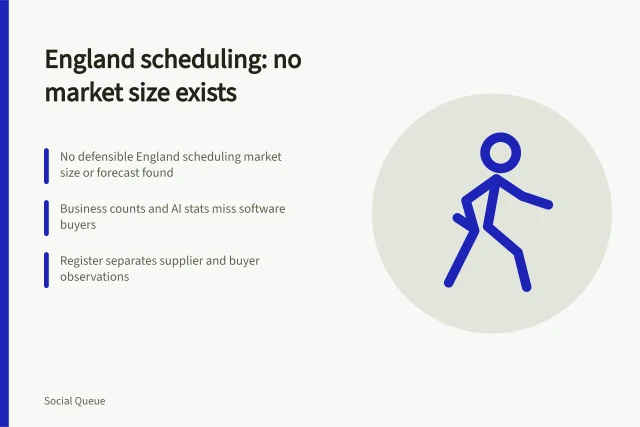
The social media scheduling outlook for England in 2027 is uncertain. No official series measures this niche market, and no reviewed source gives an England adoption forecast. A current supplier feature does not prove future demand. A responsible outlook tracks decisions that may change rather than a curve somebody has guessed.
Separate the evidence types, attach each item to a geography and a date, and agree what would trigger action. UK regulation may affect an operator in England. A global supplier announcement may affect a named product. Neither automatically describes an England-wide trend.
This publication-hold guide was researched on 6 September 2026 by an editorial technology and policy role. No supplier, agency or research subject contributed funding or approved the text. It is desk research only.
Named statistical, legal and data-protection reviewers must examine the final version. PECR, AI and security reviewers join them. Accessibility and advertising specialists sign off too. IP, procurement, workforce and finance reviewers complete the list. The four watch areas below each carry a review date.
What to take away
- No official series measures England social scheduling, so the outlook tracks decisions rather than a guessed curve.
- Label every forward-looking statement by evidence type, from observed current evidence to scenario.
- Buffer's AI Assistant documentation is a global first-party claim, not proof of England use or quality.
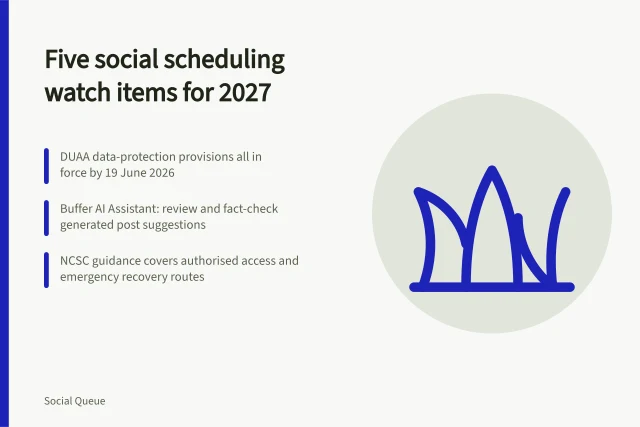
- The Data (Use and Access) Act provisions were in force by 19 June 2026, so it is not a 2027 commencement.
- Scheduling adds another route into valuable accounts, so watch permissions, audit information and recovery.
- Set the review dates now15 January, 16 April, 16 July and 15 October 2027.
Give every future claim a type
An outlook misleads when a planned change reads as a fact or a scenario loses its assumptions. Put a visible label beside every forward-looking statement.
Evidence types and permitted wording
Evidence type
- Observed current evidence
- Publisher, date, geography, method
- Formally announced change
- Announcer, date, subject, effective date
- Third-party forecast
- Publisher, date, horizon, method
- Editorial inference
- Source facts, reasoning, overturn condition
- Scenario
- Trigger, assumptions, indicators, owner
- Recurring check
- Source, capture date, version, next check
Minimum record
- Observed current evidence
- Source records or supplier states
- Formally announced change
- Scheduled only with authoritative date
- Third-party forecast
- Publisher forecasts, never will happen
- Editorial inference
- This may matter if
- Scenario
- If trigger occurs, organisation would
- Recurring check
- Page records as at
Permitted wording
- Observed current evidence
- Formally announced change
- Third-party forecast
- Editorial inference
- Scenario
- Recurring check
| Evidence type | Minimum record | Permitted wording |
|---|---|---|
| Observed current evidence | Publisher, publication date, geography, population or product, method and limitation | The source records or the supplier states |
| Formally announced change | Announcer, announcement date, exact subject, scheduled effective date and dependencies | Is scheduled only when an authoritative record gives a date |
| Third-party forecast | Publisher, release date, geography, base period, horizon, model or survey method and uncertainty | The publisher forecasts, never will happen |
| Editorial inference | Source facts plus the reasoning and a condition that would overturn it | This may matter if |
| Scenario | Trigger, assumptions, indicators, consequence, owner, response and recovery proof | If the trigger occurs, the organisation would |
| Recurring check | Source, capture date, page version, change noted and next check date | The page records as at |
No third-party market forecast is used in this cluster because none reviewed had a direct England social-scheduling-software population and adequate method. No 2027 law or product release with a firm effective date is presented as scheduled. Where a government or supplier describes future work without a date, this guide calls it an announcement to monitor.
Establish the current baseline carefully
Three broad sources frame the research, but none measures purchasing of scheduling software.
The Department for Business and Trade's 2025 business population statistics cover private-sector businesses and explain head-office geography, registered and unregistered coverage, and uncertainty. They do not identify which organisations publish on social media, use a scheduler or buy agency services. Applying an assumed share would invent an England market.
The ONS analysis of artificial intelligence in UK businesses draws on the Business Insights and Conditions Survey. It is evidence about the survey's UK business population and questions, not about social publishing or England-specific adoption.
Ofcom's Adults' Media Use and Attitudes 2026 concerns media use among UK adults. It may help an organisation question an audience assumption, but audience use does not demonstrate supplier revenue or buyer intent. Keep the population and method with any observation drawn from it.
| Source | What it supports | What it cannot show |
|---|---|---|
| DBT business population statistics 2025 | Counts and geography of private-sector businesses, with coverage caveats | Which organisations publish on social media or buy scheduling tools |
| ONS AI in UK businesses | Answers on AI use from the Business Insights and Conditions Survey | Social publishing behaviour or England-specific adoption |
| Ofcom Adults' Media Use and Attitudes 2026 | UK adult media habits and platform reach | Supplier revenue or buyer intent |
The baseline is an evidence gap at niche-market level. Treat that gap as a finding. Do not fill it with global estimates.
Watch area 1: assisted drafting and connected automation
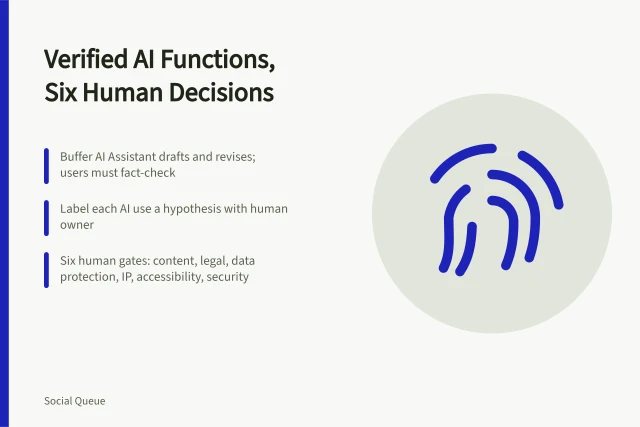
Observed supplier evidence: Buffer's current AI Assistant documentation, checked on 6 September 2026, describes generating and revising post suggestions. The page tells users to review and fact-check suggestions, and it records limitations. Buffer separately describes its current GraphQL interface and AI-client connections in the Buffer API guide.
AI trial gates and stop rules
- Inputsapproved use case, cleared or synthetic inputs
- Outputhuman fact-check, source trace, screenshot
- Stop if personal data or rights-sensitive input appears
- Stop if unsupported claim or untraceable source appears
These are exact global first-party claims about named Buffer functions. They do not show use in England, comparative quality, accuracy, security or productivity. No account or output was tested for this guide.
The 2027 editorial scenario: an organisation trials assistance for a narrow task. The trigger is an approved use case with synthetic inputs and a named human owner.
Indicators: unsupported statements, unexpected personal data, inaccessible output, untraceable sources, interface or model changes. Then stop automated publication, restore the manual workflow and investigate the evidence.
| Trial gate | Evidence required | Stop rule |
|---|---|---|
| Inputs | Approved use case, cleared or synthetic inputs, permitted-input list | Personal data or rights-sensitive input appears |
| Output | Human fact-check, source trace, screenshot of the suggestion | Unsupported claim or untraceable source |
| Access | Named owner, logging, retention limit, rollback route | Untraced access or a failed rollback |
The ICO's AI and data-protection resources give a UK regulator route to assess rights risks. The government's AI Cyber Security Code of Practice sets baseline security principles for developers and deployers.
It says the government will update the code to mirror a future ETSI standard, but the page gives no effective date. Treat that as future work to monitor, not a completed standard.
The NCSC's large-language-model risk note warns against putting sensitive information into queries to public systems. A content team should define permitted inputs, logging, retention, access and rollback before any live trial. Legal permission, advertising substantiation and rights clearance still need separate owners.
Review date: 15 January 2027. Recheck the Buffer pages, the ICO resources, the code of practice and the NCSC note. Confirm whether an ETSI-linked update has a stated date.
Watch area 2: settled law, continuing guidance
Observed current position: the ICO's Data (Use and Access) Act overview says all data-protection provisions were in force by 19 June 2026. According to the regulator, the Act changed parts of the UK GDPR, Data Protection Act 2018 and PECR without replacing those regimes. Calling the Act a future 2027 commencement would be wrong.
Data protection review dates
- 19 June 2026All data-protection provisions in force
- 16 April 2027First review date
- 19 June 2027Anniversary review date
The same ICO page says guidance will continue to be updated. That announcement has no universal effective date.
An operator's watch trigger is a revised regulator page, a new audience source, changed tracking or a different communication purpose. A qualified reviewer should then reopen the affected decision rather than rewrite an old conclusion as current.
Direct marketing remains a classification exercise. The ICO's direct marketing guidance is UK-wide. It does not make every public post, service notice, advert or direct message equivalent. The actual purpose, recipient route and technology determine which questions require review.
Review date: 16 April 2027, then 19 June 2027, the anniversary of the provisions being in force.
Watch area 3: publishing authority and recovery
Scheduling adds another route into valuable social accounts. Current NCSC social publishing guidance addresses authorised access, content review, audit information and emergency recovery. Those controls remain relevant whether a person, agency, integration or AI-assisted process prepares the post.
Publishing authority and recovery checks
- Watch for changed permission model or dormant administrator
- Watch for disconnected account or unexplained post
- Watch for untested recovery route
- Pause releases, retain evidence, revoke access
- Prove recovery with a safe rehearsal
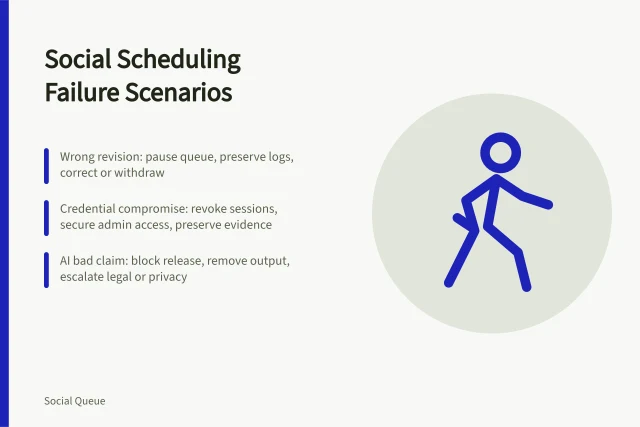
The outlook is operational rather than numerical. Watch for a changed permission model, dormant administrator, disconnected account, unexplained post or untested recovery route. The owner should pause affected releases, retain evidence, revoke access where needed and prove recovery with a safe rehearsal. Do not forecast incident frequency without comparable records.
Supplier dependency belongs in the same review. The NCSC's cloud-provider selection guidance explains why a buyer should assess security needs, contractual commitments, assurance scope and updates. A trust badge or status page cannot prove that a particular publishing configuration is recoverable.
Review date: 16 July 2027. Book a recovery rehearsal before that date, and repeat it after any permission or supplier change.
Watch area 4: claims, rights and accessible output
The ASA's current social-media advertising advice explains that remit and recognisability depend on context and the likely impression of the communication. A scheduled label or approval flag does not substantiate a claim. New commercial relationships, formats or regulated products should reopen the evidence and disclosure review.
Asset reuse creates another boundary. GOV.UK's copyright guidance explains that permission or a licence may be required to use protected work. A team needs records for ownership, licence scope and platform. It also needs territory, duration and withdrawal terms. An AI-generated or supplier-provided asset does not remove that check.
Accessibility has two surfaces: the scheduling interface and the published item. WCAG 2.2 provides testable web-content criteria at global standards level, but it does not certify a specific tool, account or social post.
Watch for changes to alt-text fields, captions, focus behaviour, reading order and preview accuracy. Retest with relevant assistive technology and qualified users when a critical path changes.
Review date: 15 October 2027, and again after any new format, regulated product or asset source.
Capability review: tasks rather than invented job demand
The Department for Education's Essential Digital Skills Standards 2026 apply to England and provide a foundation for education and training. They are not labour-market forecasts for scheduling roles.
Build the workforce view from tasks. Current work includes content evidence, publishing approval and account security. Accessibility, privacy and PECR analysis sit alongside it. So do incident handling, supplier management, measurement and exit.
An AI trial may add prompt controls and output verification. An agency arrangement may shift delivery while leaving accountability inside the buyer. Neither observation proves that headcount, vacancies or salaries will rise.
For each capability, record the owner, required evidence and supervised exercise. Add the acceptance test, backup and refresher trigger. Leave staffing-ratio and shortage fields empty unless a study defines the role, population, geography and period.
Review date: 15 January 2027, alongside watch area 1.
Use three bounded 2027 scenarios
Controlled evolution
Assumption: current platforms and suppliers remain available, while the organisation tests small workflow changes. Indicators are completed acceptance tests, stable exports and documented reviewer capacity. The operations owner allows only the tested scope. Recovery proof is a successful return to manual publishing with retained approval records.
Governance pressure
Assumption: a regulator update, content class, audience source or internal incident changes a non-compensating gate. The trigger is the actual new record, not commentary about it. The responsible specialist pauses the affected activity, revises the decision and documents restart evidence. This scenario does not predict more regulation or enforcement.
Supplier disruption
Assumption: an external product, API, account connection or contract changes. Observable indicators are first-party notices, failed test calls, altered permissions or an export difference. The service manager invokes the manual route, assesses alternatives and preserves evidence. Recovery means the organisation can publish or stop safely without silently losing rights, approvals or audit history.
No probability is assigned to any scenario. Set one only if the organisation has a relevant denominator, observation period, event definition and adequate record quality.
Maintain a dated watch register
Field / What to record
- Evidence type
- Observed, announced, forecast, inference or scenario
- Source
- Publisher, page title and captured copy
- Geography and subject
- England relevance, named product or organisation
- Dates
- Publication or announcement date, effective date if stated
- Status
- Position on the check date
- Assumption and trigger
- What must hold, what would force action
- Indicator
- The observable signal to watch
- Owner and action
- Who pauses, revises or escalates
- Recovery proof
- Evidence that safe publishing or stopping is possible
- Next check
- The review date for that line
One line per issue is enough. Attach the captured source and note any method limitation.
| Review date | Watch area | What to recheck |
|---|---|---|
| 15 January 2027 | 1, plus capability | Buffer functions, ICO AI resources, the code of practice, the NCSC note |
| 16 April 2027 | 2 | ICO data-protection and direct marketing pages, tracking, audience sources |
| 16 July 2027 | 3 | Permission model, administrator list, audit information, recovery rehearsal |
| 15 October 2027 | 4 | ASA advice, asset licences, alt-text, captions, preview accuracy |
Recheck high-risk sources on the intended publication day. Verify that a supplier page still describes the same named function, that regulator guidance has not moved, and that an announcement has not acquired or missed an effective date. Retire scenarios whose assumptions no longer fit.
The resulting outlook will not offer a dramatic prediction. It gives an England operator a disciplined way to notice change, withhold certainty and act only when the relevant evidence moves.
Before you act
- Label every forward-looking claim with its evidence type.
- Attach each item to a geography and a date.
- Agree in advance what would trigger action.
- Keep population and method with any observation.
- Define permitted inputs, logging, retention, access and rollback.
- Prove recovery with a safe rehearsal before relying on it.
Common questions
What are the four watch areas and their review dates?
Watch area 1 covers assisted drafting and connected automation, reviewed on 15 January 2027. Watch area 2 covers settled law and continuing guidance, reviewed on 16 April 2027 and 19 June 2027.
Watch area 3 covers publishing authority and recovery, reviewed on 16 July 2027. Watch area 4 covers claims, rights and accessible output, reviewed on 15 October 2027.
Why does this guide avoid giving an England adoption forecast?
No official series measures this niche market and no reviewed source provides an England adoption forecast. A current supplier feature is not proof of future demand. The outlook tracks decisions that may change rather than a curve somebody has guessed, so the baseline is an evidence gap.
What does the ICO say about the Data (Use and Access) Act timetable?
The ICO overview says all data-protection provisions were in force by 19 June 2026. According to the regulator, the Act changed parts of the UK GDPR, Data Protection Act 2018 and PECR without replacing those regimes. Calling it a future 2027 commencement would be wrong.
What should an operator watch for in publishing authority and recovery?
Watch for a changed permission model, dormant administrator, disconnected account, unexplained post or untested recovery route. The owner should pause affected releases, retain evidence, revoke access where needed and prove recovery with a safe rehearsal. Do not forecast incident frequency without comparable records.
In this guide
- Five social scheduling watch items for 2027, with dated sources and no invented rankingFive evidence-led social scheduling watch items for 2027, with dated sources, England and UK limits, triggers and no invented forecast or ranking.
- Verified AI functions in social scheduling tools, and the six decisions a human keepsSeparate verified social scheduling AI functions from proposed uses, with human review, rollback and distinct privacy, security, rights and accessibility gates.
- A social scheduling outlook that admits the market-size gap and watches signals insteadA bounded England social scheduling outlook that exposes the market-size evidence gap and uses observable demand, supply and procurement signals instead.
- Social scheduling capability for 2027, mapped from tasks rather than vacancy forecastsPlan social scheduling capabilities for 2027 from documented tasks and current England guidance, without inventing job demand, shortages or headcount forecasts.
- Five social scheduling failure scenarios, from the wrong revision to a bad AI claimFive social scheduling scenarios with triggers, assumptions, indicators, owners, responses and recovery proof, while leaving unsupported probabilities blank.