Outlook
Part of A cautious social scheduling outlook with four watch areas and review dates
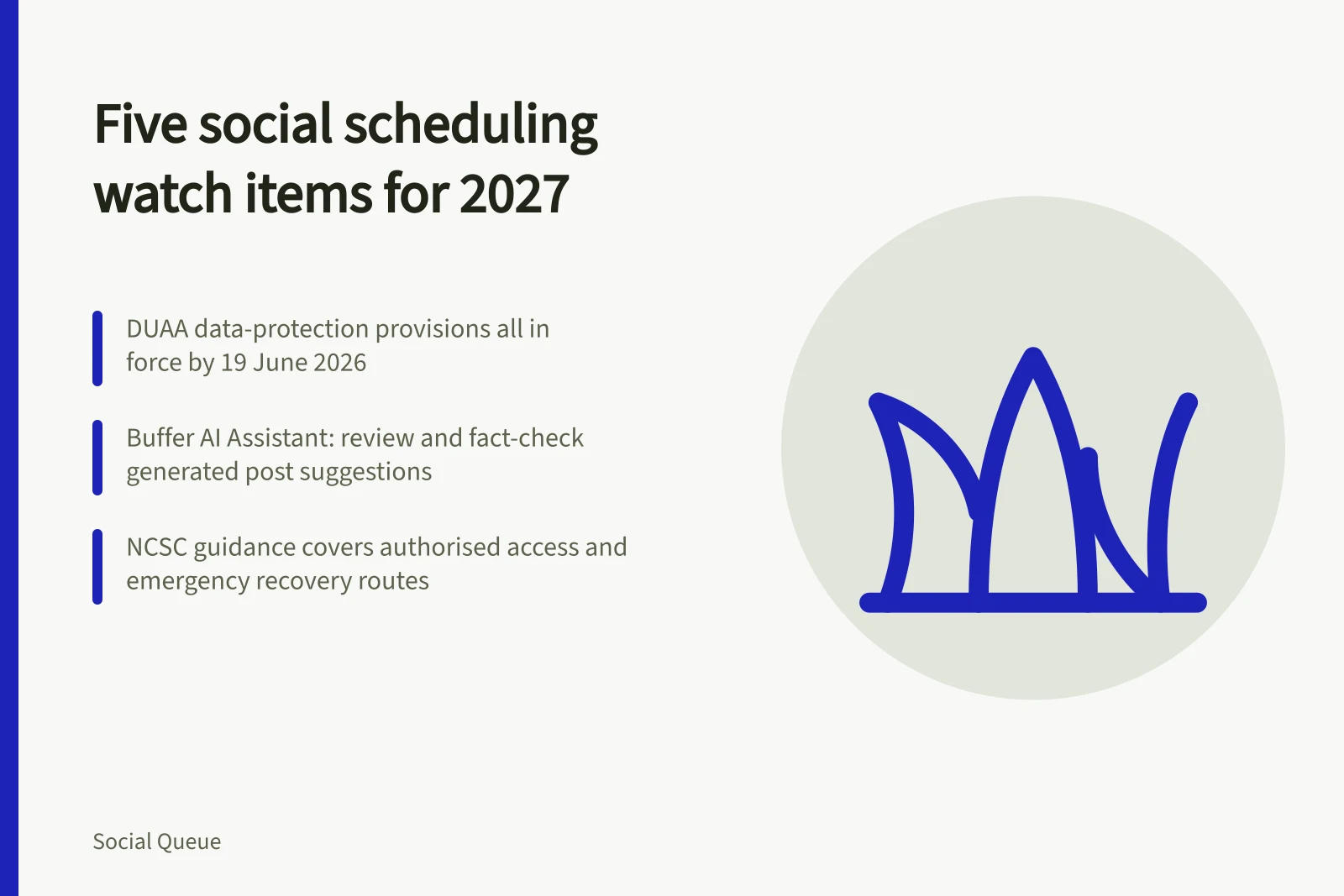
Five social scheduling watch items for 2027, with dated sources and no invented ranking
Five evidence-led social scheduling watch items for 2027, with dated sources, England and UK limits, triggers and no invented forecast or ranking.
These social media scheduling 2027 trends are watch items, not predictions. No authoritative source reviewed provides an England market forecast for scheduling software. The useful question is which current signals should make an operator reopen a workflow, supplier or control during 2027.
What to take away
- These are watch items, not predictions, and no England market forecast for scheduling software was found.
- Recheck data practice after the Data (Use and Access) Act 2025 provisions were all in force by 19 June 2026.
- Put AI-assisted drafting behind an approval gate and record source material, reviewer, corrections and rejected output.
- Treat account recovery as part of scheduling and test operational recovery routes when a trigger occurs.
- Keep a small watch register with source capture, evidence type, geography, affected workflow, owner and next check.
Published method
- Research date
- 6 September 2026.
- Reviewer
- editorial technology and policy researcher; a named person is required before publication.
- Scope
- organisations operating in England, with UK-wide law and global supplier records labelled at source.
- Inclusions
- current regulator, government, standards-body or exact first-party product records that create a practical monitoring trigger.
- Exclusions
- adoption estimates, supplier performance claims, prices, market-size forecasts and changes without a primary announcement.
- Conflicts and funding
- none declared; no supplier provided access or editorial approval.
- Ranking
- non-ranked. Entry order does not indicate likelihood, value or urgency.
1. Recheck data practice after completed legal change
Observed evidence: the ICO's DUAA overview says all data-protection provisions in the Data (Use and Access) Act 2025 were in force by 19 June 2026. This is not a future 2027 commencement. The watch item is later ICO guidance or a changed use of personal data in audience selection, monitoring or automation. Trigger a qualified review when either changes.
2. Put AI-assisted drafting behind an approval gate
Current supplier claim: Buffer's page for AI Assistant describes generating and revising post suggestions and warns users to review and fact-check output. It does not show England adoption, accuracy or business benefit. The 2027 scenario is that an organisation chooses to trial assistance for low-risk drafts. Record source material, reviewer, corrections, rejected output and rollback before expanding use.
3. Treat account recovery as part of scheduling
Current UK authority record: the NCSC's social publishing guidance covers authorised access, review before release and emergency recovery. A relevant signal is a supplier permission change, an unavailable administrator or an unrehearsed recovery route. The response is operational testing, not a forecast that compromise will rise.
4. Preserve claim and rights evidence
Observed regulatory context: the ASA's social-media advertising advice explains that remit and recognisability depend on the communication and context. GOV.UK's copyright guidance sets out when permission or a licence may be needed. Watch for new content types, commercial relationships or asset sources that the approval record does not cover.
5. Test accessible output, not just the editor
Current global standard: WCAG 2.2 contains testable web-content criteria, but it does not certify a social platform or scheduled post. A practical 2027 watch item is any platform or tool change that affects text alternatives, captions, focus, sequence or error handling. Retest the authoring task and the live output with qualified accessibility input.
No formally announced 2027 rule or product release with an effective date is relied on here. Recheck every source on publication day and retire any entry whose trigger no longer matches the operating brief.
Keep a small watch register, not an indefinite list, and for each item record source capture, evidence type, geography, affected workflow and owner. Add the next check and removal condition.
A supplier notice without a date stays an announcement; a prediction without a disclosed method stays excluded. When a trigger occurs, open the relevant control review before changing live scheduling.
Before you act
- Recheck every source on publication day and retire any entry whose trigger no longer matches.
- Record source material, reviewer, corrections, rejected output and rollback before expanding AI use.
- Test the authoring task and live output with qualified accessibility input.
- Open the relevant control review before changing live scheduling when a trigger occurs.
- Exclude supplier notices without a date and predictions without a disclosed method.
Common questions
What is the scope of this article's watch items?
The scope is organisations operating in England, with UK-wide law and global supplier records labelled at source. Inclusions are current regulator, government, standards-body or exact first-party product records that create a practical monitoring trigger. Exclusions are adoption estimates, supplier performance claims, prices, market-size forecasts and changes without a primary announcement.
Why is the Data (Use and Access) Act 2025 a watch item if it is already in force?
The ICO says all data-protection provisions in the Act were in force by 19 June 2026, so this is not a future 2027 commencement. The watch item is later ICO guidance or a changed use of personal data in audience selection, monitoring or automation. Trigger a qualified review when either changes.
How should an organisation handle AI-assisted drafting for social scheduling?
Buffer's AI Assistant page describes generating and revising post suggestions and warns users to review and fact-check output. It does not show England adoption, accuracy or business benefit. The 2027 scenario is a trial for low-risk drafts. Record source material, reviewer, corrections, rejected output and rollback before expanding use.