Outlook
Part of A cautious social scheduling outlook with four watch areas and review dates
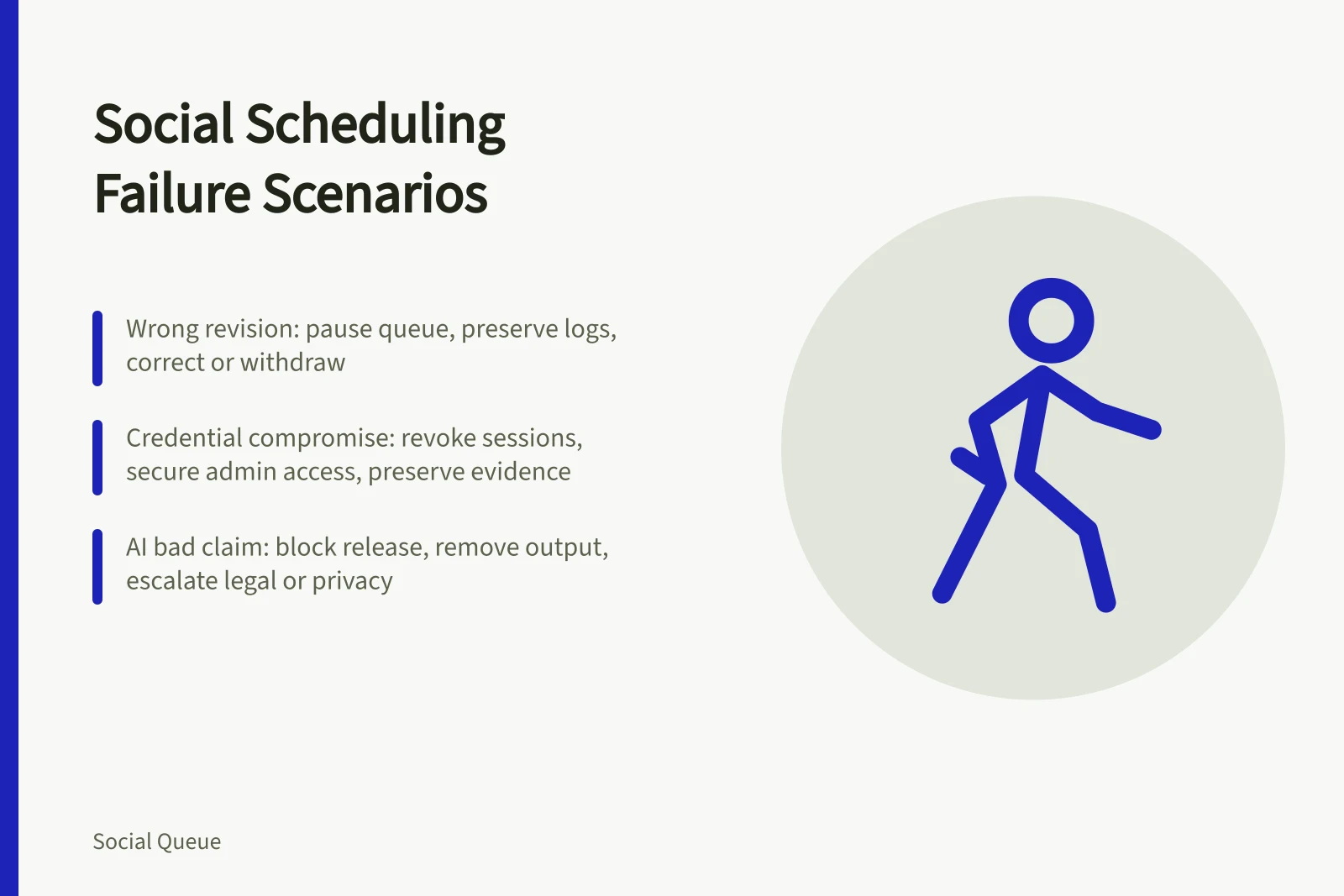
Five social scheduling failure scenarios, from the wrong revision to a bad AI claim
Five social scheduling scenarios with triggers, assumptions, indicators, owners, responses and recovery proof, while leaving unsupported probabilities blank.
These social media scheduling risk scenarios are planning exercises for an organisation operating in England. They are not forecasts. Probability remains blank until the owner has relevant incident or control evidence.
What to take away
- Each scenario names a trigger, owner, response and recovery evidence so rehearsals stay grounded in real workflow.
- Probability stays blank until an owner has incident or control evidence, not a risk label.
- A synthetic replay or controlled rehearsal proves the approved object, destination and time before release resumes.
- Regulator guidance supports checks but does not replace a case-specific assessment for each scenario.
- Retire a scenario when its assumptions no longer match the workflow, and date every rehearsal.
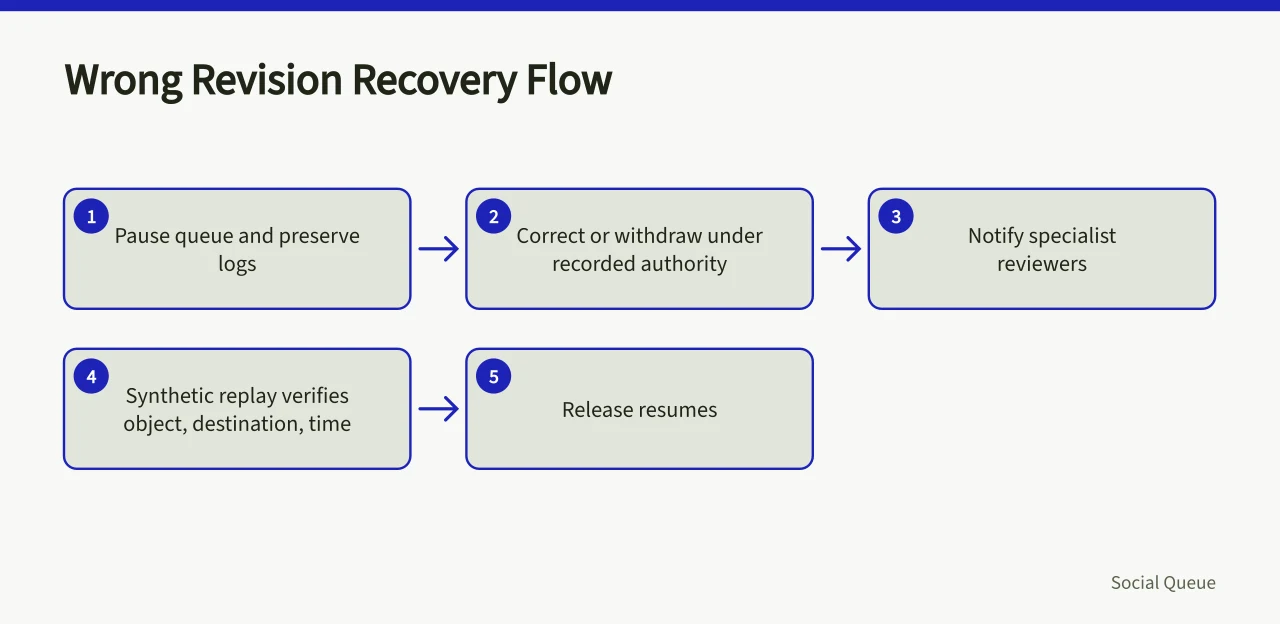
Scenario 1: the wrong revision goes live
- Trigger
- a queued item differs from the approved capture.
- Assumptions
- several drafts exist and the tool permits a later edit.
- Indicators
- revision mismatch, missing approval event or unexpected release time.
- Consequence
- inaccurate, inaccessible or unsubstantiated content remains public.
- Owner
- publishing duty manager.
- Response
- pause the queue, preserve logs, correct or withdraw under recorded authority and notify specialist reviewers.
- Recovery evidence
- a synthetic replay proves that the approved object, destination and Europe/London time match before release resumes.
The NCSC recommends review and authorisation before publishing in its social media guidance.
Scenario 2: an account credential is compromised
- Trigger
- unrecognised access or a post outside the approved process.
- Assumptions
- the scheduling service can reach live accounts.
- Indicators
- unfamiliar login, changed connection, disabled control or anomalous post.
- Consequence
- unauthorised publication and possible exposure of account or personal data.
- Owner
- security incident lead.
- Response
- revoke sessions and integrations, secure administrator access, preserve evidence and follow the incident plan.
- Recovery evidence
- controlled reconnection, least-privilege check and successful emergency-publishing rehearsal.
Scenario 3: the supplier or platform changes an interface
- Trigger
- first-party notice, failed API call, missing destination or changed terms.
- Assumptions
- the workflow depends on an external service.
- Indicators
- repeated queue errors, altered permission request or export difference.
- Consequence
- delayed posts, incomplete records or an unusable exit file.
- Owner
- service manager.
- Response
- stop affected automation, switch to the documented manual route and assess the changed evidence.
- Recovery evidence
- representative items publish through the approved fallback and a restored export retains required metadata.
The NCSC's cloud-provider selection guidance supports checking contractual change, assurance scope and service dependency.
Scenario 4: AI output introduces a bad claim
- Trigger
- a generated draft adds an unsupported fact, imitation or sensitive detail.
- Assumptions
- a human inserted or accepted AI-assisted text.
- Indicators
- no source, rights conflict, unexplained personal data or altered meaning.
- Consequence
- misleading communication, rights dispute or privacy harm.
- Owner
- content assurance lead.
- Response
- block release, remove the output, examine inputs and escalate the relevant legal, privacy or advertising question.
- Recovery evidence
- a new fixture passes source, rights, accessibility and approval checks with automation disabled as the baseline.
The ICO provides AI and data-protection resources, while GOV.UK explains the copyright permission boundary.
Scenario 5: promotional contact is misclassified
- Trigger
- a scheduled direct message or targeted communication is added to an editorial queue.
- Assumptions
- purpose, recipient source or objection status was not checked.
- Indicators
- absent classification, missing suppression evidence or disputed contact.
- Consequence
- a message may be sent under the wrong governance route.
- Owner
- data-protection and PECR reviewer.
- Response
- stop the send, isolate the list and make a current, case-specific assessment.
- Recovery evidence
- a qualified review confirms purpose, audience, permission route, suppression and complaint handling before restart.
Use the ICO's direct marketing guidance as the regulator record, not as an automatic answer. Date every rehearsal and retire a scenario when its assumptions no longer match the workflow.
If an owner later adds probability, preserve the event definition, observation period, exposed population, numerator, denominator, missing records and uncertainty. A risk label such as likely is not a substitute for that evidence. Review consequences and controls separately, since a severe outcome can justify rehearsal even when its probability cannot be estimated.
Before you act
- Pause the queue and preserve logs before correcting or withdrawing content.
- Revoke sessions and integrations, then secure administrator access.
- Switch to the documented manual route when automation fails.
- Block release and examine inputs when AI output adds unsupported claims.
- Stop the send and isolate the list for a case-specific assessment.
- Date every rehearsal and retire scenarios whose assumptions no longer match.
Common questions
What evidence proves a scheduling workflow is ready to resume?
A synthetic replay proves the approved object, destination and Europe/London time match before release resumes. For credential incidents, recovery evidence is controlled reconnection, a least-privilege check and a successful emergency-publishing rehearsal. For supplier changes, representative items must publish through the approved fallback and a restored export must retain required metadata.
How should an owner treat probability in these scenarios?
Probability remains blank until the owner has relevant incident or control evidence. If an owner later adds probability, they must preserve the event definition, observation period, exposed population, numerator, denominator, missing records and uncertainty. A risk label such as likely is not a substitute for that evidence, and consequences and controls should be reviewed separately.
When does promotional contact need a different governance route?
When a scheduled direct message or targeted communication is added to an editorial queue, purpose, recipient source or objection status may not have been checked. The response is to stop the send, isolate the list and make a current, case-specific assessment. A qualified review confirms purpose, audience, permission route, suppression and complaint handling before restart.