Reviews
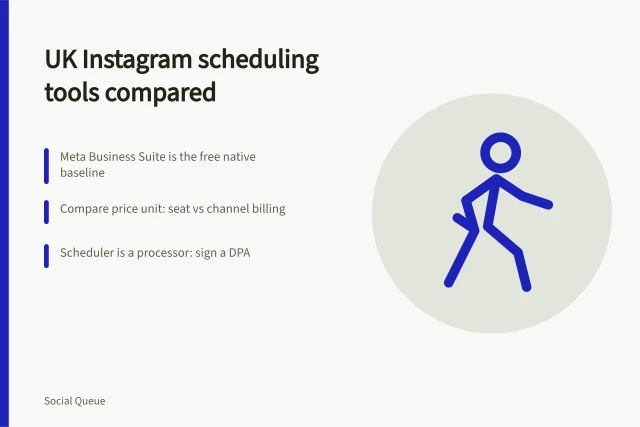
7 Instagram scheduling tools UK marketers should test
Seven Instagram scheduling tools compared for UK marketers, covering sterling pricing, VAT, UK GDPR duties and which Instagram formats actually publish.

Archive
Reviews
Seven Instagram scheduling tools compared for UK marketers, covering sterling pricing, VAT, UK GDPR duties and which Instagram formats actually publish.
Tools and providers
A UK comparison of Buffer, Hootsuite and Later on pound pricing, VAT, data residency and Instagram or LinkedIn scheduling, with a verdict for small teams.
Tools and providers
Buffer, Hootsuite, Later, Metricool, Zoho Social and SocialPilot compared on free caps, seats, VAT and real UK upgrade prices, plus data duties.
Tools and providers
UK B2B buyer's guide to LinkedIn scheduling tools, naming Hootsuite, Buffer, Sprout Social, Oktopost and SocialPilot, plus approval, pricing and data rules.
Tools and providers
A UK guide to scheduling Instagram Reels in advance, covering time zones, native limits, third-party tools, approvals and the checks before release.
Rules and ethics
UK agencies need a social media approval workflow to record client sign-off, meet ASA and UK GDPR duties, and stop rework before scheduled posts go live.
Operations
Build a UK social media content calendar template with bank holidays, seasonal hooks, school term dates and fields that survive a monthly review.
Tools and providers
UK ecommerce social media scheduling needs product-feed sync, GBP prices and plans for Black Friday. Compare Buffer, Hootsuite, Later, SocialBee and Metricool.
Operations
Local scheduling for UK high street shops, cafes and trades: location fields, Google Business Profile posts, claims, data protection and what to measure.
Tools and providers
TikTok scheduling for UK small businesses: what a scheduler must do, UK peak times, mobile data limits, disclosure duties and illustrative monthly costs.
Outlook
Five evidence-led social scheduling watch items for 2027, with dated sources, England and UK limits, triggers and no invented forecast or ranking.
Rules and ethics
Use a pre-release social advertising checklist for claim evidence, commercial relationships, labels, final impressions, targeting and correction.
Reviews
A disclosed desk-review hold on social scheduling agencies, explaining the missing evidence and a safer route for verifying service, access and exit.
Outlook
Separate verified social scheduling AI functions from proposed uses, with human review, rollback and distinct privacy, security, rights and accessibility gates.
Measurement
Compare social scheduling attribution methods on one evidence grid, separating assigned credit, observed association and causal estimates without a winner.
Audience research
Plan ethical audience research for social scheduling in England, from sampling and interviews to privacy, analysis limits and buying decisions.
Measurement
Research social scheduling benchmarks without inventing thresholds by testing population, geography, definitions, periods, methods, bias and comparability.
Reviews
A transparent, non-ranked shortlist of three social scheduling editions, using dated first-party records, disclosed desk research and buyer-side gates.
Tools and providers
A dated, non-ranked desk shortlist of three exact social scheduling plans, with first-party evidence, exclusions, unknowns and buyer-side tests for England.
Costs and pricing
Use a blank social scheduling budget template for England that records exact units, VAT, labour, assurance, risk, renewal, exit, owners and reforecast triggers.
Foundations
Compare four social scheduling business models for England on common workflow, contract, data, service, VAT and exit fields without invented prices.
Audience research
Build evidence-led social scheduling persona hypotheses for England with role, workflow, authority, contradictions, uncertainty and expiry fields.
Strategy
Compare LinkedIn, YouTube, manual release and no-post routes for one England service update using common timing, evidence and control fields.
Rules and ethics
Review six social scheduling contract areas through a dated, non-ranked UK method covering scope, data, security, rights, service controls and exit.
Foundations
Frame social scheduling opportunities in England as testable buyer problems with evidence triggers, accountable owners, limits and retirement rules.
Audience research
Research social scheduling competitors with a dated evidence grid covering identity, claims, rights, personal data, comparability and careful conclusions.
Costs and pricing
Estimate social scheduling costs in England with blank formulas for supplier charges, internal labour, assurance, VAT, operations, incidents and exit.
Costs and pricing
Build an England social scheduling budget from dated plan units, internal labour, assurance, VAT, risk and exit without invented prices, savings or ROI.
Audience research
Run social scheduling interviews around recent work using a dated, non-ranked method covering consent, neutral prompts, evidence and withdrawal.
Rules and ethics
Map data protection for social scheduling in England across purpose, roles, targeting, suppliers, retention, objections, security and transfers.
Foundations
Investigate five bounded social scheduling demand signals in England using dated public evidence and buyer records, without treating reach as sales.
Rules and ethics
Create a blank social scheduling disclosure procedure covering relationships, evidence, labels, previews, approvals, monitoring and withdrawal.
Foundations
Assess England's social scheduling market through clear category boundaries, official evidence limits, buyer tests and controlled entry decisions.
Costs and pricing
A dated, non-ranked list of six social scheduling cost categories often missed in England budgets, with official evidence, exclusions and blank estimates.
Measurement
Define social scheduling metrics for England with complete event, population, denominator, period, timezone, source, exclusion and uncertainty fields.
Operations
A transparent desk review of social scheduling launch evidence for England, with a hold verdict, disclosed limits and the exact proof needed to reconsider.
Foundations
Use a staged social scheduling market-entry checklist for England covering demand proof, platform access, claims, privacy, security and exit.
Outlook
A bounded England social scheduling outlook that exposes the market-size evidence gap and uses observable demand, supply and procurement signals instead.
Foundations
Measure England's social scheduling opportunity without inventing revenue by defining the category, population, evidence gaps and research units.
Measurement
Measure social scheduling with explicit metric cards, separate operational and outcome evidence, bounded attribution, uncertainty and decision-led reporting.
Measurement
A dated, non-ranked list of social scheduling measurement mistakes, with official evidence on definitions, comparability, uncertainty, privacy and causality.
Strategy
Use a staged ninety-day social scheduling plan in England to define the task, clear independent gates, test safely and make an evidenced decision.
Operations
A stepwise social scheduling workflow for England teams, covering classification, evidence, review, timed release, exceptions, monitoring and closure.
Operations
Build social scheduling operations around content classification, evidence, approval, timed release, monitoring, correction, recovery and owned records.
Strategy
Fill a practical social scheduling plan covering audience, evidence, rights, accessibility, approval, timezone, monitoring, correction and stop rules.
Costs and pricing
Compare channel, user, seat, usage and service pricing models for social scheduling with common definitions, blank calculations and England buying controls.
Reviews
Compare three exact social scheduling editions for one England approval workflow, with common criteria, first-party evidence, unknowns and no winner.
Operations
Use this evidence-led social scheduling checklist before release, covering claims, rights, accessibility, approval, timing, security and recovery.
Measurement
Build a social scheduling dashboard that preserves metric definitions, platform scope, missing data, uncertainty, attribution strength and decision ownership.
Costs and pricing
Calculate social scheduling ROI only from observed project evidence, a credible counterfactual, attributable contribution, full economic cost and sensitivity tests.
Reviews
A defensible method for reviewing social scheduling software, with evidence grades, buyer tests, conflicts, unknowns and independent decision gates.
Reviews
Review social scheduling software and services with a defined England use case, evidence hierarchy, fair comparison, buyer tests and independent risk gates.
Outlook
Five social scheduling scenarios with triggers, assumptions, indicators, owners, responses and recovery proof, while leaving unsupported probabilities blank.
Reviews
Use a gated social scheduling selection checklist covering workflow fit, privacy, security, accessibility, claims, contracts, support and exit evidence.
Operations
Define social scheduling service standards with exact events, populations, clocks, evidence, exclusions, owners and remedies instead of invented benchmarks.
Outlook
Plan social scheduling capabilities for 2027 from documented tasks and current England guidance, without inventing job demand, shortages or headcount forecasts.
Tools and providers
Select social scheduling software through a defined England workflow, dated evidence, synthetic tests and independent privacy, security and exit gates.
Strategy
Build a social scheduling strategy from a defined England audience task, independent approval gates, platform evidence and reversible delivery plans.
Strategy
Use a six-part social scheduling framework to connect an England audience task with evidence, owners, release gates, measurement and stop rules.
Strategy
Avoid six social scheduling strategy mistakes in England using a dated, non-ranked method grounded in regulator, platform, security and rights evidence.
Tools and providers
Compare three exact social scheduling plans for one England use case using common units, dated first-party evidence, unresolved fields and independent gates.
Audience research
Compare Microsoft Forms, Google Forms and a manual baseline for England research using common evidence, privacy, access, export and exit fields.
Audience research
Define a social scheduling target audience in England through observable work, clear eligibility, careful recruitment and decision-ready evidence.
Operations
A dated, non-ranked map of social scheduling roles for England teams, with evidence for ownership, review, security, accessibility and recovery.
Tools and providers
Implement a social scheduling tool through synthetic tests, controlled access, evidence-led approvals, incident rehearsal, staged release and a proven exit route.
Tools and providers
Choose social scheduling software through an England-focused workflow covering exact plans, evidence, legal gates, security, accessibility, cost and exit.
Outlook
A cautious 2027 social scheduling outlook for England, separating current evidence, announcements and scenarios with observable triggers and review dates.
Rules and ethics
Understand the separate UK legal questions behind scheduled social content in England, from data and PECR to ads, rights, access and contracts.
Rules and ethics
Map current UK rules for social scheduling in England across privacy, PECR, advertising, consumer claims, rights, security, access and contracts.
Tools and providers
A practical England due-diligence checklist for social scheduling suppliers, covering plan identity, data, security, accessibility, contracts, cost and exit.